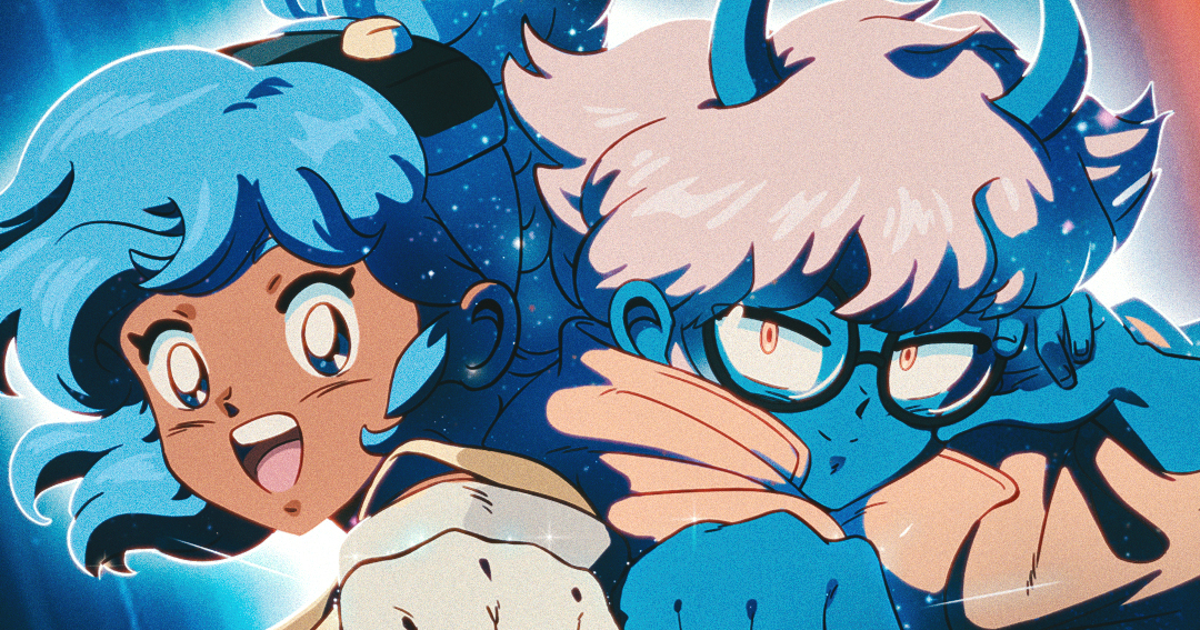
From Akira Toriyama lending his spiky-haired character art to Chrono Trigger, to Hayao Miyazaki’s long-lasting influence on Final Fantasy airships, anime and video games have always felt tightly connected. That said, to be completely honest, very few titles have ever truly managed to recreate an anime look in a convincing way. Over the years, developers have made plenty of daring tries with cel shading — we all know the ones, like Guilty Gear and Dragon Ball Fighterz — but no true anime equivalent to Cuphead has appeared. A game that genuinely makes you feel like you’re stepping into a playable episode of your go-to shonen. Good news: that long-held wish is arriving soon, thanks to the Switch 2 exclusive Orbitals.
If you caught an early segment of The Game Awards or saw the newest Nintendo Direct, you might already be counting down to Orbitals. The entire experience is designed around cooperative play, dropping players into the well-worn space boots of teens Maki and Omura as they kick off an intergalactic adventure. After barely surviving a terrifying storm that nearly wiped them out, the two dynamic travelers push deeper into space on a mission meant to prevent yet another catastrophic cosmic explosion.
“It’s a tribute [and] a love letter to our childhoods,” says Creative Director Marcos Ramos. Raised in Argentina, he explains that, back in the 90s, he was hooked on the intensely unfamiliar thrill of Japanese animation, sprinting home from school to catch every new episode. “The original Dragon Ball series was a significant influence… I feel Akira Toriyama was at all times simply doing what made him happy, untouched by lore or science….” Ramos adds, “If he thought something was awesome (martial arts, cool machines, anthropomorphic animals, dinosaurs), he just rolled with it.”
That same attitude of joyful recklessness is what gives Orbitals its personality. Whether Maki and Omura are needling each other during a laser-tag standoff, steering a shared hovercraft across molten lava, or discovering a sweet alien resting asleep in a vent within their ship, the game keeps turning whimsy into a constant presence. Naturally, there’s a familiar issue looming in the background: the Hazelight connection. With co-op now strongly associated with Josef Fares’ EA-backed studio, it’s hard not to compare Orbitals to It Takes Two. Still, if the game feels even a little familiar, it’s because it’s been guided by a 10-year Hazelight veteran.

“I think the most defining factor is undoubtedly the art style,” says Jakob Lundgren, Orbitals’ Game Director and Hazelight alumni. “Orbitals’ art style genuinely makes it feel distinct.”
It’s difficult to argue with that. As I sit down for the world’s first hands-on look at this much-anticipated adventure, I find myself staring in awe at the presentation. The game blends hand-painted still backgrounds with animated 3D characters, carefully layering individual anime-style cells across every character model. The result is a subtle blur between classic animation principles and the real-time game engine. As the characters shift with a pleasantly uneven, cartoon-like motion, a gentle VHS grain brings an extra hint of nostalgia over the expressive duo of Maki and Omura. Meanwhile, polished anime-style cutscenes slide naturally into my exploration of the world.
It’s no coincidence that Orbitals looks like it was lifted straight from a beloved anime VHS collection. As Shapefarm’s first original project — an international team of developers from New Zealand, Argentina, and Sweden, all operating out of Tokyo — the studio didn’t take this on by itself. What’s their secret weapon? A joint effort with the renowned Japanese animation studio Studio Massket.
With experience across more than 150 anime productions, Massket shines in digital anime work, contributing to projects ranging from Attack On Titan to One Piece. As I move through three of their softly lit office spaces, I pass rows of young animators quietly sketching on iPads. For each different anime assignment Massket handles, they collaborate with a separate director — and for Orbitals’ nostalgic visual style, they needed to bring in someone truly special.
“We actually brought on board a very old-school, legendary anime creator for Orbitals – Tôru Yoshida,” explains Riku Seitei, CEO of Studio Massket. Since Yoshida is widely known for his hand-drawn contributions to the original Gundam, this anime legend was a perfect match for crafting the cutscenes for Orbitals’ 80s-inspired retro-futurism.
As the two studios traded storyboards back and forth between their Tokyo offices, what began as a simple outsourcing arrangement grew into a real creative collaboration. “It ended up being pretty much co-development,” says Shapefarm’s Johannes Varmedal, Orbitals’ Assistant Art Director. “We learned a great deal from them, including how to create character sheets for anime, how we structure production, and all the logistics,” he continues. “We even created hand-painted backgrounds that we then scanned and integrated into the game for certain UI elements… which was entirely inspired by our collaboration.”
Along with delivering that gentle, classic anime mood, my one-hour demo also came packed with gameplay likely to put a smile on your face. As players steer their ship toward new star systems, they unlock additional mini-games that pop you back into your ship to explore between missions. It’s a friendly, lively base to return to. Over time, these newly available mini-games reshape your between-level space into something full of pleasant interruptions and distractions. If you like to poke around, your home base is full of delightful touches — anime-themed references tucked beside your reading, little Easter eggs hiding in bookshelves, and the Orbitals theme playing from a radio. NPCs even mutter jokes while you disrupt their daily routines.
The puzzles within each level are just as engaging. While Hazelight’s Split Fiction split its world into two separate styles of play, Orbitals keeps its concepts and mechanics flowing smoothly, with a gravity-defying ease. Whether you’re controlling the energetic Maki or the more grounded Omura, you’ll rely on one of two tools for solving problems: a massive beam cannon that lets you combine sparking electronics, or a grappling hook cannon designed for pulling objects toward you — including removing vents from walls.
“It doesn’t look like it’s just a straight copy of Hazelight’s games,” Lundgren explains. “The way we’re building Orbitals isn’t that platform-heavy… It’s much more about the instruments themselves and working alongside them.” Even if you can sense a trace of Fares in Orbitals’ cooperative adventures, the emphasis on figuring things out rather than reflex-driven platforming makes the whole experience feel far more laid-back.
When you leap across worlds filled with lava or through rock-covered research facilities, the gadgets available to both players stand out in a refreshing way. They let you tinker with the surroundings—and with each other—while working through puzzles. Unlike Split Fiction, where each level locks you into a single set of abilities, Orbitals gives you the option to toss a tool to your teammate, letting you switch responsibilities on the fly.
Many of these ideas, according to Lundgren, took shape after the team got together to try the game late in development. He calls it a “Wouldn’t it be fantastic if we could include this?” phase. “In the end, you’re at your least capable at the start of making a game, and you’re at your strongest when you finish it.”
Orbitals is mostly played in split-screen, but there are major stretches where that separation fades away—so both players can share the moment through a single camera view. One example centers on a DDR-style dance showdown: Maki and Omura sweat their way through a stream of fast button cues while trying to bring an old-looking computer terminal back to life.
That said, just like the best multiplayer experiences, these charming stages mostly serve as jumping-off points for creating truly memorable shared scenes. “What makes an co-op game great is the couch moments,” Ramos says. “The little talks that begin because of something you just went through together. It’s not only about the level… It’s about the connection you build with the other person. A one-of-a-kind memory you share with someone you care about.”
Because it’s a lively local multiplayer experience, it’s easy to see why Nintendo chose Orbitals as an exclusive. Still, for art director Varmeda, Orbitals is actually the second Nintendo exclusive he’s worked on—after first contributing to 2015’s Devil’s Third. “What stayed with me over time is the importance of trusting the creative intent and direction, instead of trying to predict how an audience will react.”
While Devil’s Third ultimately didn’t perform well, the prospects for Orbitals look far brighter. Even before release, Shapefarm’s first original effort succeeds in capturing that airy appeal of watching anime on an old CRT—finding something unfamiliar that sparks your attention. It remains to be seen whether Orbitals can keep its distinct charm and energy across its eight-hour campaign, but if it does, Orbitals will absolutely turn out to be something special.