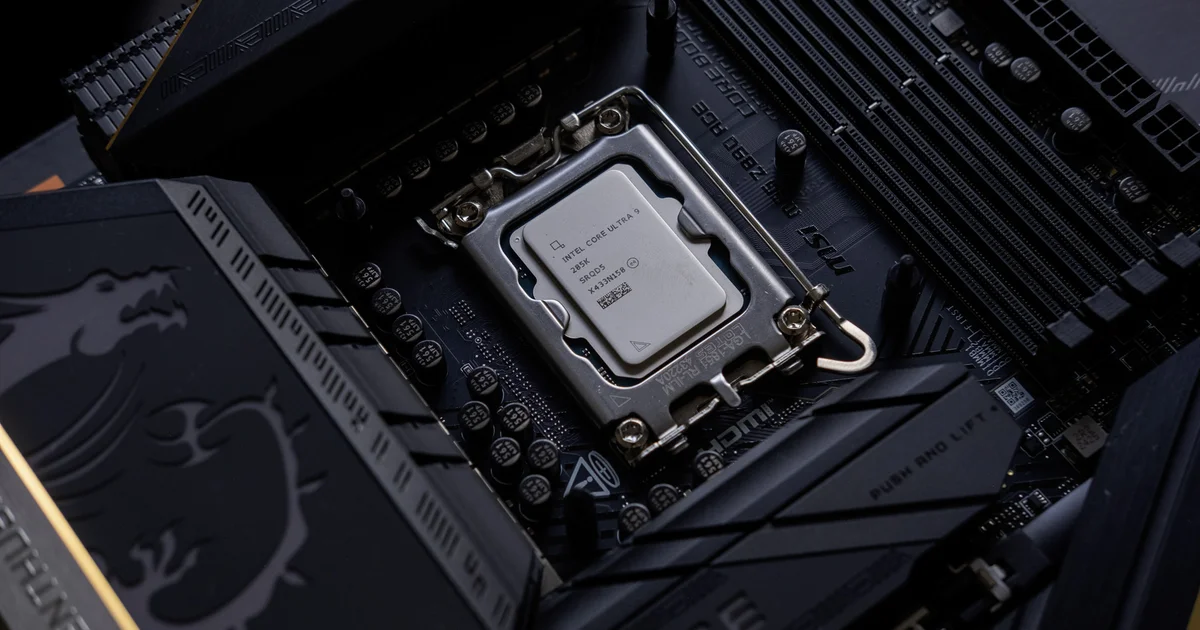
Intel’s most recent Core Ultra 200-series desktop chips, codenamed Arrow Lake, came out in October with reviews that were notably underwhelming. Since then, the American company has laid out five problems it says account for the gap between its performance expectations and what reviewers actually experienced. Intel reports that four of these items can be addressed via BIOS, Windows, or software updates, and it also expects further performance gains to roll out by January 2025.
To add context, our testing of the Core i9 285K alongside the Core i5 245K showed clear advantages for the 285K versus the prior Core i9 14900K in three games: Crysis 3 Remastered, Dragon’s Dogma 2, and Forza Horizon 5. That said, the 14900K continued to lead in the remaining eight titles we benchmarked, frequently with sizable margins.
Below are Intel’s five issues, along with the underlying reasons and the current status of each, as described in the company’s announcement:
| Performance Topic | Root Cause | Status |
|---|---|---|
| Unconventional scheduling, high run-to-run variation, low single-threaded scores, sporadic ~1.5x increase in DRAM latency, lower performance on Windows 11 24H2 compared to 23H2 | Intel miscalibrated the rollout of OS power plan settings (“PPM”), which tune DVFS, core parking, and C-states, resulting in a 6-30% performance drop. | Resolved in Windows 11 26100.2161 or later |
| Intel Application Performance Optimiser (APO) not delivering the expected performance | With PPM missing, the CPU lands in a configuration where APO profiles can’t be applied; additionally, some reviewer BIOS setups leave APO disabled out of the box. Together, these factors lead to a 2-14% performance decline in APO-profiled titles. | Resolved in Windows 11 26100.2161 or later |
| BSOD occurring when launching Easy Anti-Cheat titles on Windows 11 24H2 | A known issue involving Easy Anti-Cheat KMD and Windows 11 24H2, made worse when Virtualisation-Based Security (VBS) is turned off. | Fixed with a new Easy Anti-Cheat driver supplied by Epic. |
| Incorrectly set performance parameters in certain early-release BIOS versions | Intel did not sufficiently verify VIP performance settings—including ReBAR, Intel APO, compute ring frequency, IMC gear, and sustained/transient power limits—leading to a 2-14% performance reduction. | Resolved in customer BIOSes currently available. |
| Planned BIOS performance improvements | Intel and partners are working on additional optimisations for upcoming BIOS updates. These changes are currently being validated, and Intel expects a single-digit uplift on a 35-game geometric mean. | Motherboard BIOS releases expected in January 2025. |
The table lays out intriguing details, and Intel’s community blog goes further by expanding on each issue. In that post, Intel says it will share “a comprehensive performance summary, inclusive of the January BIOSes” at CES early next year, which should help clarify the performance differences you can expect once all five fixes are in place.
We also ran into extremely weak performance in Cyberpunk 2077 specifically, though it appears to have been addressed in game update 2.2, assuming the patch notes are accurate.
If you’re among the relatively small number of users operating a Core i5 245K, Core i7 265K, or Core i9 285K system, you’ve likely already moved to the newest Windows and BIOS releases. Still, it’s a good idea to update now if you haven’t, and then again around mid-January as more BIOS versions are released, so your setup can reach its best possible performance. Intel notes that the January BIOS files can be “identified by Intel microcode version 0x114 and Intel CSME Firmware Kit 19.0.0.1854v2.2 (or newer).”
We’ll also plan to rerun tests on the Core i9 285K and Core i5 245K after the January BIOS updates arrive. During our initial testing, performance landed far below what we expected, and we want to confirm what these processors can truly deliver. We also expect additional updates from Intel at that point, along with developments from AMD and Nvidia, so keep an eye out for our CES coverage as the new year begins.