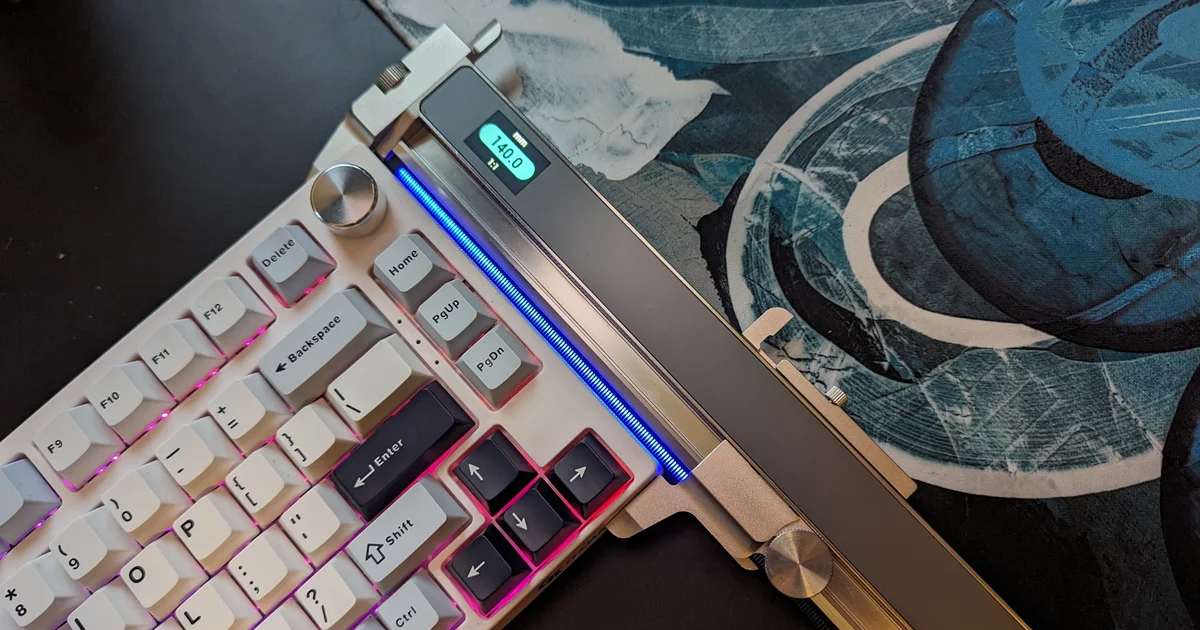
Digital Foundry’s toolkit launches a new, ongoing look at the tools—both physical and digital—that DF staff rely on to carry out their analysis of video games and tech. In this first installment, Will Judd walks through his thoughts on digital calipers, with a close focus on the Hozo NeoCaliper.
Every PC gamer eventually builds up a “must-have” set of instruments, from Phillips-head screwdrivers you can use to assemble or tweak almost any system, to Allen wrenches that make it easier to dial in sim racing layouts, monitor stands, and other bigger fixtures. Even so, one useful item I rarely see discussed is a caliper set—whether you go with a classic analogue model or opt for a modern digital version. I’ve used a digital set for years now, and I still consider it one of the most practical tools for everyday PC building, and especially for PC journalism.
Let’s start with the essentials: calipers are particularly handy for compact Mini ITX setups, where you could simply cram every part straight into the case. Still, taking measurements ahead of time is usually the more sensible move to make sure everything fits with proper clearance. Calipers won’t replace a tape measure for very long items—graphics card length is a good example—but for smaller components like CPU tower coolers or radiators, digital calipers let you measure quickly and precisely. That means you can verify whether your intended build truly works in the often tight space you’re working with. It’s also worth noting that a caliper doesn’t only help with object size (outer diameter); it can also measure available space (inner diameter). By gripping the arms in the opposite direction, you can see how much room you actually have to work with.

I’ve been spending a fair bit of time lately on 3D modelling and 3D printing, and calipers turn out to be just as useful there. If you’re trying to recreate a specific piece—or designing something that needs to sit neatly alongside another component—quick, accurate measurement is key to avoiding the frustration of printing something that looks correct, only to be off by a few millimeters. (Yes, I’ve been there!) The caliper set I’m using at the moment, Hozo’s NeoRuler (plus its NeoCaliper attachment), goes a step further by letting you set a measurement scale. So if you’re making a model meant to be 1:40, you can check each individual section to confirm it’s sized properly.
I don’t think either SFF builds or 3D modelling show up often enough for digital calipers to be a “must-buy” for every enthusiast. That said, they’re fairly affordable, and even occasional use could justify picking up a low-cost set. In practice, it’s been as a PC-focused technology journalist that I’ve most often seen these calipers pay off—whether that’s getting accurate measurements down during reviews or fine-tuning sim racing gear.
For example, there’s frequently a mismatch in how manufacturers report measurements for peripherals like mice. With plenty of potential reference points that you could use to measure width, it’s easy to end up comparing numbers that don’t tell the same story. So while you might encounter tightly specified figures on a product page or in a press release, it can still be hard to confidently judge mice from different brands. That’s why I usually ignore those printed measurements and measure for myself, knowing I’m checking the same area on each mouse. With a solid set of digital calipers, you can make those measurements—on camera if you want—in just seconds. A tape measure could do the job too, but it takes longer, tends to be less convenient, and introduces more uncertainty into the result.
I also find calipers really helpful when it comes to repairs and routine maintenance. If you can accurately measure the diameter of a faulty fan inside a graphics card—or determine the length of a bolt you need a few more of—you can save yourself a lot of time and hassle compared with guessing or relying on a tape measure. In the PC world, common sizes are fairly standard, and you’ll likely start recognizing the most typical measurements fairly quickly, but it’s still smart to confirm your assumptions.
There are plenty of calipers on the market right now, and the cheapest options are often digital models that run on a replaceable coin cell battery rather than using traditional analogue mechanics. The Hozo NeoCaliper is a premium option, but it’s also clearly more capable: it’s rechargeable via USB-C and is part of a smart ruler kit that includes an integrated LCD and buttons. Those controls let you set scales as mentioned earlier, swap between different units without fuss, and handle a lot more besides.
They’re exceptionally tidy tools, too, and are accurate to one-tenth of a millimeter, which is impressive. Of course, they also come with a broader set of measuring features, but if you’re primarily a PC gamer rather than a general hobbyist or machinist, a good budget set of digital calipers may make more sense.
I’d love to hear whether anyone else uses (digital) calipers regularly—and, if they do, what they use them for. If you don’t use them currently, do you think they’d be helpful? Share your thoughts in the comments section or via the poll below.