To begin with, this feels genuine. After three long years filled with speculation, reports, and leaks, Ubisoft announced the Assassin’s Creed Black Flag remake in March, and in April we also got more clarity on what it actually includes. The remake—called Resync—will arrive on PS5, Xbox Series X/S, and PC on 9th July. Having just spent a significant amount of time with Assassin’s Creed Black Flag Resynched, I’m honestly more captivated than I expected by how raw and unfinished it still feels.
That said, one detail kept coming back to me: where do the modern-day parts stand? Our own Matt addressed this after looking into the game through a preview that didn’t involve hands-on play during its reveal, and the early takeaways offered a strong starting point. For a quick refresher, the modern-day sections of Black Flag in 2013 followed the Abstergo corporation as it guided people into its Animus simulation, supposedly so it could collect footage for an interactive film focused on the Golden Age of Piracy (yes, really).
But that setup was just a cover. Abstergo—somewhere between Ubisoft itself and the era’s living Templars—was trying to gather information tied to a particular piece of sci-fi lore: a “First Civilization structure” known as “The Observatory.” A lot of players, myself included, felt the modern-day components in earlier Assassin’s Creed entries were a bit underwhelming. Still, the whole premise had a spark of curiosity. I remember genuinely enjoying how the first game’s Desmond eagle vision helped me track down every glyph and clue inside his small cell at the end. I also found myself invested in the wider meta-storyline involving Shaun Hastings and Rebecca Crane, and I think that thread continues to matter across the series even now.

For years, the modern-day portions of Assassin’s Creed have often been pushed to the side, barely taking up any meaningful real estate in games like Mirage or Shadows. Back in March, Ubisoft said that Black Flag’s modern segments “reflected where the franchise was” at the time, acting as a bridge to carry the series into its next chapter. “Changes were necessary” for the remake, Ubisoft added. So what exactly will those changes look like?
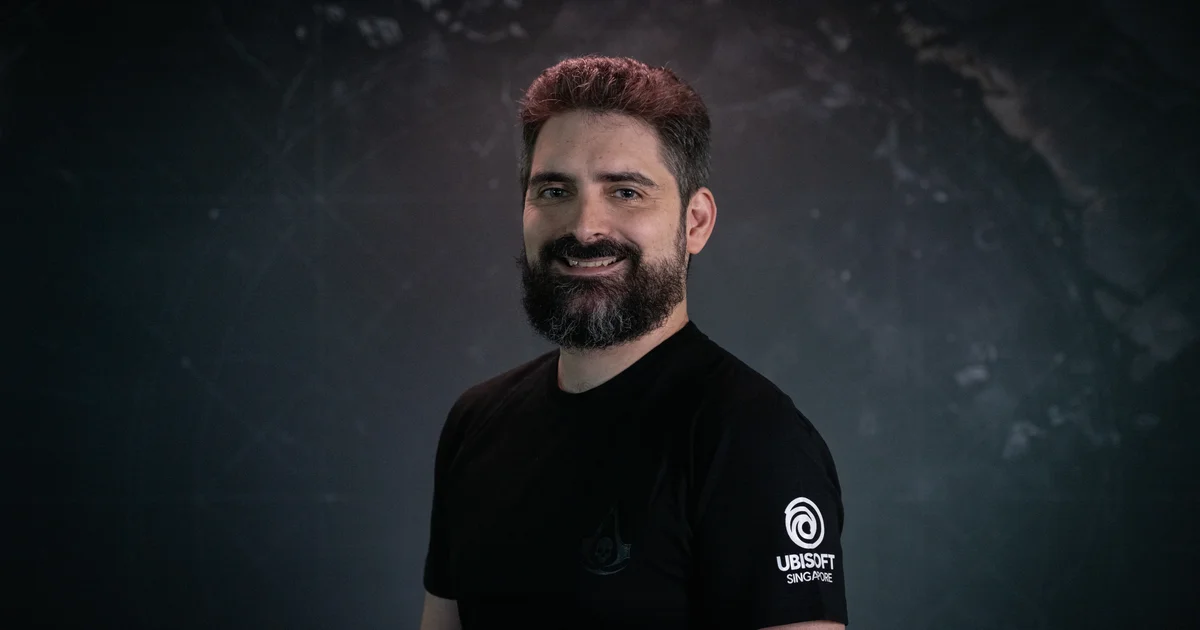
“Our game features a new narrative,” Julien Koch, design director at Assassin’s Creed Singapore, tells me. “Both narratives are valid, but as you spend more time with the game, you’ll notice that ‘Resync’ fits—not only as a brand shift, but also for the storyline.” Interesting. Ubisoft also previously mentioned there would be “modern-day riffs” in Resynched, yet we haven’t seen any actual gameplay moments in that vein, at least not in the segments we played in the 2013 original.
“In the original Black Flag, the modern-day storyline was mainly about how we linked Black Flag with other entries in the series, such as Assassin’s Creed 3 and [the Ezio trilogy], among others,” Koch continues. “From the start, we chose to tackle [the modern-day component] in this direction with Resynced.”
So what might that mean? Here’s my theory. I think the 2013 version of Black Flag has already happened—somewhere within the game’s own timeline. In that case, Abstergo could have obtained our unnamed character from that earlier period, pulled information from their memories, and everything that occurred after that is already over. Following that logic, Resynced—true to its name—would have Abstergo going back to this same historical window using its advanced tools to uncover even more from the protagonist Edward Kenway’s “genetic memories.”
This provides a tidy explanation for the updated sequence of events and the new narrative threads (“we have roughly six hours of new content,” Koch tells me) that writer Darby McDevitt has brought back into the game. It also helps make sense of the “new moments that [will] focus on Edward’s internal conflicts”—maybe an improved Animus lets Abstergo look deeper into what’s going on in its subjects’ minds, rather than limiting itself to analyzing the consequences of their actions and the history around them. Or maybe I’m just reading too much into it?
Either way, Koch’s lighthearted answer to my question gives me a bit of confidence. He wants to leave certain surprises untouched. I even asked about how the added story material fits into the world, and what the workflow looks like when you weave new pieces into an already established narrative. “I’d prefer not to share too much, because I truly want you to experience it,” he smiled. “There’s a new conclusion for Blackbeard, more details on Stede Bonnet’s destiny… it’s all connected.” That’s as far as he was willing to go.
All of this reminds me of Final Fantasy 7 Remake, for reasons that aren’t entirely obvious. When Square Enix revisited the title, it introduced an unexpected twist: it didn’t just retell the 1997 original straight-up. Instead, it took a more self-aware look at the RPG’s legacy and history. Ubisoft seems to be aiming at something similar here—acknowledging the original game as it was, shortcomings included, and building it out with extra layers of detail and context. I value that choice, even if it may end up being controversial. I’m excited to see how everything ultimately plays out in the finished version.
In the meantime, you can take a look at my impressions of my time so far in our Assassin’s Creed Black Flag Resynched preview.