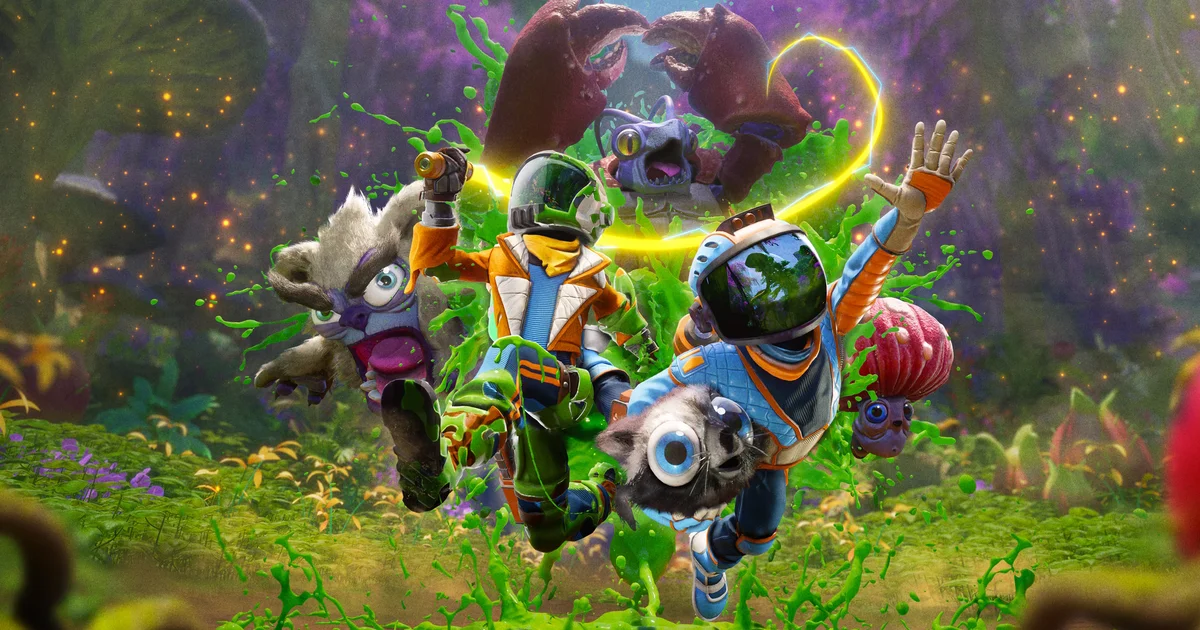
Pulling the rights to the IP for Savage Planet and obtaining the associated source code from Google took far more time than selling Typhoon Studios to the company. “Google is used to purchasing assets, but they are not used to giving them back,” Reid Schneider, co-founder and studio director of Racoon Logic, explains during my visit to their Montréal office for a practical, low-touch preview of Revenge of the Savage Planet, a kind of follow-up to Journey to the Savage Planet.
Schneider and other members of Racoon Logic say Google wasn’t fully versed in several realities of building games. “The core idea is: partner with firms whose primary business is creating games if you want to make games,” Alex Hutchinson, Racoon Logic co-founder and creative director, summarizes. Schneider adds later, “[Google] wasn’t impressed with what game development actually felt like.”
Racoon Logic’s confidence with Google work comes from the fact that the studio was started with, and staffed heavily by, former Typhoon Studios employees—Typhoon being the team behind Journey to the Savage Planet. “The first, last, and only game Google funded internally,” Hutchinson quips while he and Schneider recount Typhoon’s rocky experience with the company.
In short: Typhoon Studios launched in 2017 with a small group of ex-AAA developers who brought experience from major franchises including Assassin’s Creed, Far Cry, Watch Dogs, The Sims, and Batman: Arkham. Google bought Typhoon in 2019 and folded it into their Stadia Games and Entertainment group. You can probably see how things went—Stadia announced its discontinuation on 1 February 2021, the very same day Journey to the Savage Planet released on Stadia. Instead of celebrating a new release, the team found themselves toasting together over Zoom.
“When you get laid off, having support from coworkers is priceless,” Schneider says, “but during a pandemic, everyone is stuck in their own home.”
“It was pretty bleak,” Hutchinson remembers. “Some of the most ruthless layoffs in gaming happen on the day you launch, you know… but trying to go through that during a pandemic was especially grim.” Even so, the moment became a rallying point; as Hutchinson puts it, many of the team members were ready to “try again.”
Racoon Logic positions itself as Typhoon Studios’ “second opportunity,” and in a similar way, Revenge of the Savage Planet feels less like a traditional sequel and more like a chance for the team to revisit—and sharpen—their original intent for Journey to the Savage Planet. The most visible change is the move from first-person to third-person. The developers understood that the shift would bring added costs, and Hutchinson still feels a real pull toward first-person play, but he ultimately agreed that the switch made sense. “It’s better for platforming, simpler for customization, it’s hopefully more entertaining to watch because you’re not only looking at your hands, and our animators didn’t quit because they said there’s only so much you can do with two hands.”
Another big change is the scope. You can now explore four full planets, instead of just one (plus a separate fifth planet that wraps up the story). From the jungles of Stellaris Prime to the frozen emptiness and volcanic zones of Zephy, each area has its own unique habitats and creatures you can scan while also running dubious scientific trials. There are more tools and upgrades for your expeditions, including a brand-new Goo Gun that can generate things like sticky green slime to trap unsuspecting targets—though the goo can also react with other systems. For example, a stray bit of fire from a teammate in co-op could make everything messy. That might clear a path for a puzzle, or it could spell a messy end in a pool of burning goo.
“We were aiming for that feeling of natural chaos,” Hutchinson says. “For me, while I was at Far Cry, a moment that sparked this was when I threw a Molotov cocktail to deal with an enemy—only to accidentally set a bear on fire, and then it attacked my friend. If we can recreate that kind of moment in 50 different ways, that would be a fantastic experience.”

It’s still limited to a two-player co-op mode, but now you can team up through split-screen couch co-op as well as online play, including cross-platform support. You can even share your custom “Crash Pad” base with a friend the moment they step into your world—right down to “co-op toilets” that face one another. That’s definitely the kind of organic chaos you’d hope for.
Additional new elements include underwater swimming, a remote-controlled drone, character customization, the much-requested ability to capture creatures, a map, and a flexible whip/lasso that helps you capture creatures, grapple with surfaces, or transform into a sliding device for new Ratchet and Clank-style rail sections.
Although I’ve only had a quick look at it during this preview, Revenge of the Savage Planet seems to keep the lively, quirky Metroidvania-style adventure that defined the first game—even with all these additions. This time, though, we see it through third-person, paired with delightfully exaggerated character animations, and the multiplayer situations can become even more chaotic. I can’t yet say for sure whether those changes truly improve the overall experience without playing it myself. Still, I can say with confidence that the offbeat comedy that made Journey to the Savage Planet stand out is still here.
That brings us back to Google and Stadia, since Revenge of the Savage Planet is presenting a storyline that feels strikingly familiar. In the first game, you worked for a company named Kindred Aerospace (the fourth-best interstellar organization), and that firm has now been bought by a huge multinational
…the corporation called Alta Interglobal, which has placed you on a mission deep in space.
“But soon after takeoff,” Hutchinson explains, “Alta Interglobal understands that space exploration is intricate and expensive, so they decide to scrap all of it. By the moment you touch down on the planet, you’ve already been dismissed.”
“It’s a perfect setup for satire,” Schneider says, reflecting on the grim, dry comedy that surfaced from what the team went through.
with Google. The television program Silicon Valley was a major source of inspiration, since the goal was to capture that specific comedic tone in the game. “You’re still ranked fourth, but now you’re the acquired fourth best.”
“The pitch turned into the fourth best—acquired by the first worst,” Hutchinson adds.
It wasn’t only Google’s awkward, ill-timed layoffs that sparked these reactions within the team. As mentioned earlier, the tech company seemed to miss a basic grasp of how game development actually works. That disconnect left Typhoon Studios moving on to the sequel for Journey to the Savage Planet—“Much to [Google’s] displeasure,” Hutchinson reveals. “They kept pushing us to pitch the huge games they wanted.”
Marc-Antoine Lussie, co-founder and Technical Design Director at Racoon Logic, says that one of Google’s requests was for games that could only exist in the Cloud.
“It was almost like saying, ‘Here at Netflix, we only make TV shows that can’t work in any other television format’—and you’re left thinking, ‘I don’t really know what that means,’” Hutchinson says, smiling at the memory. “They were pretty strange.”
Google also asked the studio to propose games that included major licenses such as Marvel and Star Wars. The team already understood from past experience in triple-A development that those kinds of projects would take hundreds of people. Google assumed they’d handle the work with Typhoon’s 25 staff, and then add more hires if the game turned out to be successful.
Another expectation was to create a title that every player—100 percent of them—would enjoy.
“Nobody was really using the same language… it was extremely hard,” Hutchinson says.
“We would ask these questions, and we’d get the same confused puppy look,” Schneider adds.
Did the team learn anything from the experience?
“Money,” Hutchinson jokes.
One lesson Racoon Logic says they took from their triple-A stint is the need to set sustainable, realistic goals to prevent burnout. “We want our team to keep producing great games over the lifetime of the project, without turning into zombies,” Schneider says. “We all went through that in the early 2000s, and we don’t want to end up there again.”
The team also wants to avoid the games-as-a-service approach—especially since they’re now working on indie projects. While there will be features like cosmetic customization and some smaller future updates for Revenge of the Savage Planet, the game won’t be built to trap players in an endless loop. “During triple-A, everyone was looking for 1000 hours of gameplay, and I started to think that might be the scariest idea imaginable,” Hutchinson shares. “We’d like to create full, memorable experiences that don’t run on and on. You know? Going back to the games I loved when I was growing up—ones that you could actually finish, put on a shelf, and forget.”
“We’ll absolutely stand behind the game after launch,” Schneider confirms when asked about potential plans for a roadmap or DLC. What that support looks like will depend on the game’s results, but it could include different gameplay modes, a photo mode, and additional cosmetic options. Still, Schneider makes clear that it will not involve microtransactions.
Beyond monetization, after my short time with it, I get the distinct impression that Revenge of the Savage Planet could be the kind of game that invites repeat sessions. It might not reach 1000 hours, but it does seem like something you can dip into and out of with friends—spinning up a different funny moment each time. Was this round another wild adventure through the swamp, or did you both end up meeting an explosive fate? Did your friend shove you off a cliff just for laughs, or did you team up to blast those unfortunate creatures to bits with your Goo Guns? There’s definitely more emphasis on playing together this time, though solo play is still available. I can see myself having a great time with both friends and my younger nieces. It’s colorful and silly enough that almost everyone should be able to enjoy it—as long as it delivers on the promise of spontaneous chaos I saw during the demonstration.
“We wanted it to feel vibrant and cheerful, hopeful and full of energy,” Hutchinson says, describing their hopes for both the first game and this sequel. “Whenever I watch an Xbox showcase or a PlayStation showcase, everything is constantly so gray, so serious, and kind of depressing.”
“If you’re launching an indie studio, you need to produce work that stands out,” Schneider says.
Revenge of the Savage Planet isn’t the sort of game that only works in the cloud. It isn’t a Marvel or Star Wars product, and honestly, I doubt that 100 percent of people will be into it. Still, I think it clearly distinguishes itself—it has real charm. And that’s something that’s getting rarer in many games trying to succeed in the multiplayer space these days. Right now, it’s hard to judge whether that charm actually turns into a truly enjoyable game without playing it myself, but at the very least, I’m looking forward to trying the Goo Gun, the fire, and my unsuspecting co-op teammate.
This preview is based on a press trip to Montréal. Racoon Logic provided flights and accommodation.