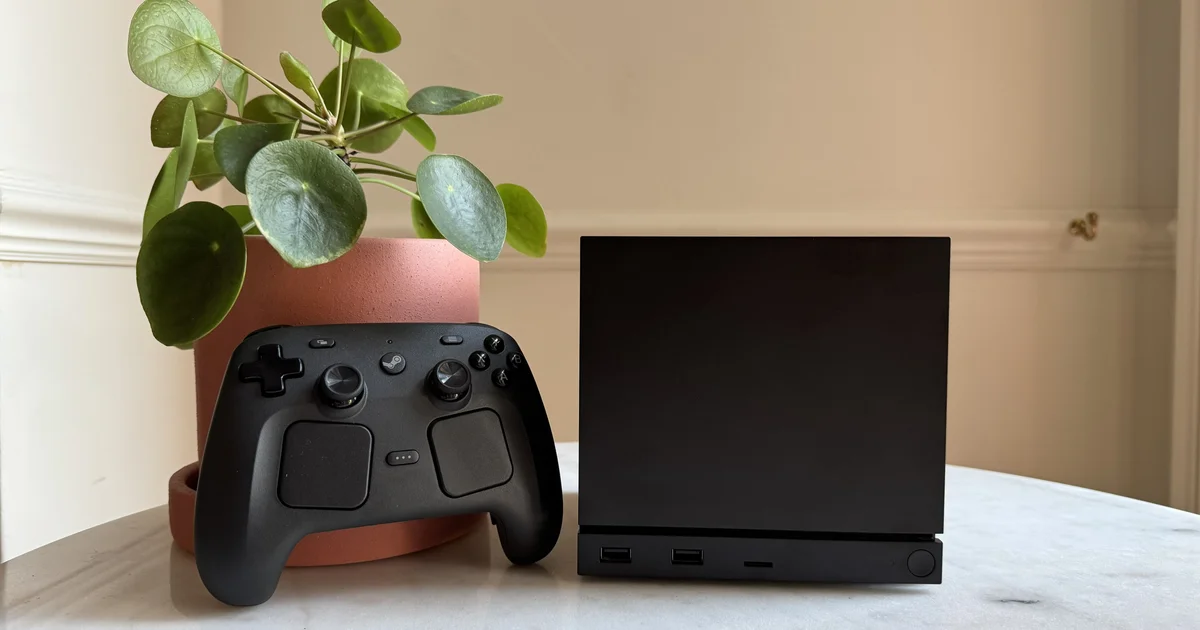
What is the Steam Machine? I’ll be honest: I’ve spent a fair bit of time trying to get to the bottom of that question. Valve will tell you—just as it did to us—that the device has essentially been built for people who want to move their existing PC games library, whether it’s on Steam or elsewhere, into the living room. That’s a worthwhile goal, and it’s one the company has been working on for more than ten years, starting with the arrival of Big Picture Mode in 2012, then moving through the first run of third-party Steam Machines in 2015, and continuing with Steam Link and beyond.
Still, this ambition naturally raises a bunch of questions—so here we are with a review. Quick clarification first: we teamed up with our excellent PC gaming sibling site RPS to bring you coverage. And when I say “teamed up,” I mean I contacted RPS’s deputy editor and hardware specialist James Archer and asked him to do a large amount of extra work (thanks, James!). The goal is to make sure you get a full range of viewpoints. This review is designed around real-world use: what’s it like to live with the Steam Machine day to day—whether it’s the kind of living-room console you’d genuinely want, how enjoyable it is to operate, and whether it actually meets your needs.
If you’d rather dig into the technical side, meanwhile, we’ve also got a Q&A piece built around conversations I had with James. It’s meant to answer your key technical questions about the Steam Machine, plus added context from our interview with Valve’s designers about what they were aiming for. They discuss the initial price expectations before supply issues and how the Steam Machine stacks up against other consoles, including Xbox’s Project Helix. We also published a straightforward guide for placing an order if you’re interested, given the slightly unusual ordering path. On RPS, James has his own more technical review and benchmarking for additional perspective.
For now, though, let’s focus on the questions in front of us. In particular: does the Steam Machine justify a fairly hefty price tag? It’s worth going back over those numbers, since they’ve just been released. Here’s a quick breakdown:
| Bundle | GBP | EUR | USD | PLN | CAD | AUD |
|---|---|---|---|---|---|---|
| Steam Machine 515GB | £879 | €1,039 | $1,049 | zł4,389 | C$1,509 | A$1,609 |
| Steam Machine 515GB + Steam Controller | £938 | €1,108 | $1,128 | zł4,698 | C$1,628 | A$1,728 |
| Steam Machine 2TB | £1,149 | €1,359 | $1,349 | zł5,739 | C$1,919 | A$2,109 |
| Steam Machine 2TB + Steam Controller | £1,208 | €1,428 | $1,428 | zł6,048 | C$2,038 | A$2,228 |
That’s not exactly cheap! And this is where the “What is a Steam Machine?” question becomes unavoidable. One answer is that it’s a “PC gaming device for your living room”—and that, in turn, opens the door to even more questions. For example: is it really smart to put that amount of money into the Steam Machine, instead of spending far less on something more traditional, like a “Big HDMI Cable” (so you can route your usual office PC to your living room with a simple, discreet setup)? Or, to put it another way: would it have made more sense for Valve to invest in a more up-to-date Steam Link?

The Steam Machine’s packaging is refreshingly plain and environmentally minded, made entirely from cardboard—an easy win in terms of not having to scream for attention on store shelves. When you open the main box, you’ll get the Machine itself, plus an HDMI cable, a power cable, and a USB-A to C cable.
Another way to look at it is to treat the Steam Machine as an appealing way into PC gaming—directly competing on price with cheaper gaming PC builds. As RPS’ James explains, and as we discussed, you could put together a capable system around Nvidia’s entry-level RTX 5050 for roughly the same money. The difference is that an entry-level PC would still deliver clearly stronger performance, as James’ benchmarks show.
There’s also the broader idea of what the Steam Machine really is: Valve’s attempt to create a console. Valve insists it’s not exactly that—Valve’s hardware engineers made that point clearly—but it still looks and behaves very much like one. Could it be aiming at people who want to spend some money, plug in a device, and start playing on their living-room TV? If so, it faces what might be its biggest obstacle: the extremely large PS5 Pro, which costs less and offers noticeably better gaming performance (along with, now, a long list of future PlayStation exclusives that won’t be coming to PC).
All of this comes back, once again, to pricing—an area strongly shaped by the AI-driven component shortage that Valve can’t control (unlike, ahem, some other console makers). Valve said the original plan was for the Steam Machine to be substantially cheaper, implying it could have jumped in price in a similar way to the Steam Deck, which saw an increase of about 43–46 percent last month—effectively a caution to anyone wondering about this device. Under that original pricing, the £879 512GB model would have landed around £610, while the £1,149 version would be closer to £790. So, plenty of uncertainties still remain.
Is the Steam Machine a good fit for your living room gaming setup?
Let’s start with consoles, because even though Valve avoids calling it one directly, many people will understandably see it that way—and for good reason. It has a tailored, purpose-built design. It’s meant for the living room and a big TV, and for a lot of buyers it will likely sit alongside traditional consoles in the way you set up and enjoy gaming.
If you own nothing besides a Nintendo
Switch or Switch 2, for example, the Steam Machine is an intriguing alternative.
It’s a strong way to widen what you can do on a large TV screen. In that sense, it’s also a worthy pick: PC gaming’s broad, ever-expanding lineup means this device lets you dig into more games than essentially any other console-style system you can currently buy.
It also covers a lot of the key roles a good console should handle. To begin with, it looks striking—something that really matters, and something Valve’s team clearly took to heart when considering how people want their entertainment hardware to fit into their homes. The compact cube form factor—about the size of a GameCube at 6×6 inches, and visually close to an Xbox Series X sliced in half—comes across as attractively minimal on the outside. It takes the sharp, blocky look of that Series X device, reshapes it into a cube, and ditches the gamer-green color for good, giving it a personality of its own. Plus, there’s room for personal style. You can order different faceplates straight from Valve; I opted for the walnut and red fabric versions, and both stand out. The walnut feels like a timeless, flexible option that suits modern spaces, mixing mid-century and bohemian touches, while the red delivers a vividly burnt, richly textured look. It’s unusual to see a console maker pay attention to the tactile feel of what it ships, beyond pure practicality—or maybe it’s just a bit of cheeky self-awareness, in the way the PS5’s tiny bumpy detailing does. On top of that, Valve’s “open” approach means we should see plenty of third-party accessories too—DBrand has even put together a Companion Cube skin already. And swapping the faceplate is refreshingly simple: you can take it off and put a new one on using just one hand.
It’s also notably quiet, and fingers crossed there’s no overheating problem. For instance, I’ve spent time playing current major AAA games with the unit kept inside a closed built-in cabinet, and it didn’t create any heat concerns. Meanwhile, my PS5 Pro—under the same conditions—sounds like it’s getting ready to launch and ends up acting as the only heater in the room. That outcome makes sense for an enclosed cupboard, but what stands out with the Steam Machine is the lack of drama overall. I’ve used it outside the cabinet, set on top, and even from the sofa a couple of meters away, I couldn’t hear it at all—especially with the TV muted.
Still, when it comes to performance, the Steam Machine starts to lag a bit—and the gap grows even clearer once you look at what you’re paying per pound. Measuring performance across consoles and PCs is particularly difficult because of differences in settings, plus the variety of approaches used for upscaling and similar techniques, so I won’t go too far into it. In broad terms, based on James’ benchmarking once more, the Machine lands slightly below the results of his RTX 5050 setup in most of the games tested. Very generally speaking: a system with an RTX 5050 can produce performance around the level of a typical PS5—sometimes edging ahead and sometimes falling behind—depending on your settings and the specific game optimizations at play (and, often, the PS5’s upscaling is doing some clever work).
So, as a rough “back of the envelope” estimate, you might expect Steam Machine performance to hover around what you’d see from a standard console. That’s where its real-world value starts to slip—at least for this kind of comparison. In the UK right now, a base PS5 with a disc drive is £569.99 when bought directly from Sony, and at this point in the console’s life cycle you can also find refurbished and second-hand versions for much less. A 2TB PS5 Pro, even with its recent price increase to £789.99, still costs less than the Steam Machine and will usually beat it by a meaningful margin—particularly if you want to play at 4K (or a version of it that’s upscaled). From a cost-versus-performance standpoint, the Steam Machine just can’t match the competition.
Likewise, in terms of pure console-style convenience, Valve’s PC-first philosophy brings some downsides you can’t really avoid. For starters, many of the biggest console games simply won’t run: any title that relies on anti-cheat software needing kernel-level access is out of the question. That rules out games like GTA Online, Apex Legends, Fortnite, PUBG, and others. When you try to start these games, you get a message saying you won’t be able to play them—or, if you somehow manage to launch—there’s a good chance you’ll be banned soon after for bypassing the software.
Then there are the familiar “PC as a console” quirks. You’ll have to fine-tune graphics settings to get the best gaming experience, while consoles generally offer well-polished options straight out of the box. You also need to switch over to desktop mode and install a few third-party apps to access games sold through other stores like Epic Games or GOG; however, Valve keeps this process fairly painless. You simply choose Desktop Mode from the Power menu, and its Linux-based operating system behaves much like any other desktop OS you may have used. Similarly, several conveniences you’d expect from the newest console generation aren’t there. You can minimize a game and use the Machine while it runs in the background, for example, but there’s no Quick Resume or anything in the same category. If you try to launch a second game, the Machine clearly warns you that running both at the same time isn’t recommended.
And just as importantly, I’m not convinced the interface itself—largely echoing the Steam Deck—reaches the polish of an interface designed specifically for a console. For instance, there are three separate menus, each reached through three different buttons. They each include some overlapping submenu items, plus options that are exclusive to one menu or another, but the way everything is organized can be a little confusing. Alternatively, you can bring up a menu by clicking a tiny icon in the top-right corner of the screen—much like on a PC—which brings similar problems. Even though
Despite the notable journey of SteamOS and its steady improvements over the years since the original Big Picture mode, some issues still haven’t been fully resolved and continue to deserve attention.
There’s also a recurring impression that the Steam Machine’s interface feels like a PC adapted for controller-style browsing, rather than something purpose-built for living-room use.
Is the Steam Machine a better choice than just buying a long HDMI cable?
This offers another way to look at what the Steam Machine is meant to be—according to Valve’s vision and, reportedly, the preferences of PC players. The goal was a PC you could place in your living room that doesn’t look like the typical machines people buy off the shelf. It should be designed for that environment and the kinds of content you’d expect to have on it.
This is also where you find the upside of those compromises when compared with consoles. You get flexibility when you need it. Sure, using third-party storefronts can feel more awkward than a console store, but they’re still straightforward to use, which means you can run DRM-free games. Setting up different controllers and input options is likewise simple—for instance, I connected a mouse from the console cabinet and was able to navigate the system right away. I had the same smooth experience with a DualSense controller, which worked immediately too, without any fussing over pairing or tinkering with settings.
Upgrading or swapping storage is just as easy thanks to the SD card slot on the front (and if you’re feeling particularly adventurous, you can also replace the internal storage and RAM). And if you like adjusting the look and feel, the living room vibe comes back into play: the console’s front-facing horizontal light bar can act as a loading indicator or simply serve as a decorative feature.
On top of that, it is astonishingly compact, extraordinarily stylish, and completely silent. PC games are generally cheaper, and there are no ongoing subscription costs for basic multiplayer or cloud-saving. The library is wider than on any other platform, spanning everything from current releases to titles that trace the history of gaming—plus the more distinctive corners of indie games and a variety of online options.
Still, trade-offs are unavoidable. Even if the Steam Machine is far more appealing to look at, quieter, and likely delivers stronger efficiency than any PC you could put together yourself (since it’s ready-built), its upgrade path is quite limited. You can only upgrade the RAM and storage, which means that—unlike other desktop gaming PCs, and even some laptops—the Steam Machine is effectively behind the curve.
It’s also not an especially great time to be stuck with it. The level of performance you’re likely to get for roughly 900 UK pounds is among the weakest it has been for a long stretch, and it doesn’t seem likely to meaningfully improve. When you compare the Machine to an RTX 5050 and cross-check it against recent Steam hardware surveys, it looks to sit at the bottom end of the mid-range—so it will probably soon drift into the “low-end” bracket for PC hardware, with little chance to bounce back. While you can still play games at 1080p and 60FPS for a while, there’s only a narrow margin for delivering acceptable results—especially as more households add large 4K TVs.
That brings up a key question: if you already own a gaming PC, or you have a suitable home office setup for one, or you’re planning to buy a PC for the living room anyway, why choose a Steam Machine? If you already have a capable PC, I’d say it’s worth considering purchasing a good, long HDMI cable and getting a professional to route it neatly around your home. If you’re renting and don’t want to drill holes, another option is to build your own PC instead. As RPS’ James has pointed out, you could likely construct something comparable—or even more efficient—for a similar amount of money, while still having the ability to upgrade it endlessly over time. At that point, the only truly compelling reason to go with a Steam Machine would come down to its visual design. I genuinely think aesthetics carry a lot of weight in a living room, and my own feelings about the sight of my otherwise great-looking PS5 Pro are proof of that. That said, looks aren’t everything: you could tuck a small form factor PC inside a case like the Terra or Node from Fractal Design and it would blend in nicely with the space. Or, for an even simpler approach, you could just put a plant in front of it.
Is the Steam Machine still, in some ways, noteworthy?
In short, there’s no single decisive verdict on how it stacks up against a console, an HDMI cable, or a personal PC. Looking at initial price, performance, setup convenience, and the most useful features—while accepting higher game costs and ongoing console-related expenses—then the PS5 Pro is the one to consider, especially when you factor in the console’s resemblance to that unappealing mid-2000s community centre project called “the future of our town centre,” which is also pretty large.
However, when it comes to flexibility, variety, and lower costs over the long run—and even the fun of having curious visitors over—there’s real value here too. It’s something you can genuinely carry with one hand (LAN parties! If only it had a handle…) and it looks at home in your space, or dare I say cool, next to a quality audio system or a stack of coffee table books. From that perspective, the Steam Machine absolutely has its strengths.
There’s something genuinely significant to be said about that. I can’t help but think about how different the story might have been if the initial Steam Machine had launched at around £599. It would be competing with PS5s and Xboxes in the £300 range by now, of course, but it might have carved out a stronger position as a meaningful option within that price band—supported by a company with serious resources and a large, established audience. It would have arrived as a product shaped with clear purpose and real expertise. While Sony and Microsoft’s teams may be better at getting impressive performance from hardware with remarkable efficiency—and while they also tend to build an interface and ecosystem to match—the Steam Machine brings something else to the table: a fresh viewpoint and a different standard for console-style design in the living room. At the very least, few companies can create a gaming product as distinctive as Valve.
For more details on the Steam Machine, take a look at our Steam Machine FAQ with tech specialist James, our in-depth guide on everything we know about the Steam Machine, how to order one, and a rundown of its specifications.
A Steam Machine with 2TB storage was supplied by Valve for review.