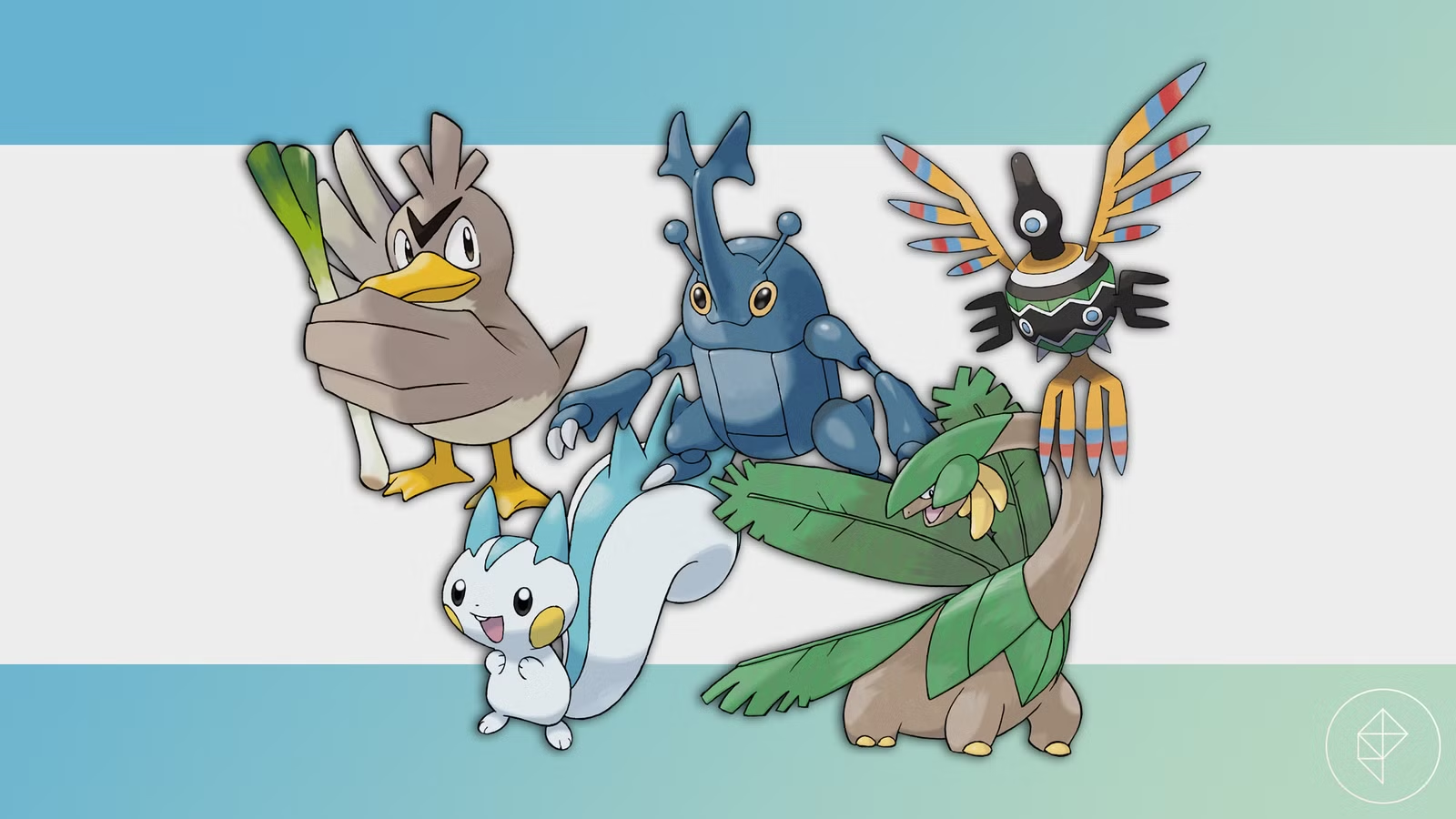
Region-locked Pokémon in Pokémon Go are species that show up only in certain places across the world. To find them, you’ll need to travel in person to those real-world areas (or connect with players internationally, then trade). In this Pokémon Go regional Pokémon handbook, we’ve put together a reference list for where you can track down each of these location-based Pokémon.
If you want to catch them all in Pokémon Go, you’ll have to either travel or link up with other trainers to trade. The game has also run events in the past that let players encounter regional Pokémon outside their usual regions. So even if you think you’ll never make it to Australia to find that Kangaskhan, you still might be able to finish your Pokédex one day.
Update (June 23): This guide has been revised to include information about Squawkabilly and its regional color variations.
List of Regional Exclusives in Pokémon Go
It’s easy to see why a tropical Pokémon like Tropius is tied to tropical areas, while the kangaroo Pokémon Kangaskhan is limited to Australia. That said, the roster of regional Pokémon keeps growing, and it’s not always straightforward to remember which ones appear where.
In the section below, we’ve grouped the Pokémon by their in-game regions (which also sorts them by generation, according to when they were first introduced). We also flag the Pokémon that have shiny counterparts, shown with sparkles.
Kanto

- Farfetch’d: East Asia
- Kangaskhan: Australia
- Mr. Mime: Europe
- Tauros: North America (Southern Canada, extensive areas of the United States, and parts of Mexico)
Keep in mind that Farfetch’d and Mr. Mime have Galarian variants, and both can be found worldwide. Those variants still count toward the same Pokédex entry.
Johto

- Heracross: South America, Central America, Mexico, plus southern Florida and Texas
- Corsola: Near the Equator
Hoenn

- Volbeat: Europe, Asia, Australia
- Illumise: North America, South America, and Africa
- Torkoal: Western/Southeast Asia
- Tropius: Africa, the Middle East, and the Mediterranean region
- Relicanth: New Zealand, Fiji, and New Caledonia
Sinnoh

- Pachirisu: Canada, Russia, and Alaska
- Mime Jr.: Eggs earned from spinning PokéStops and gyms in Europe
- Chatot: Southern Hemisphere
- Carnivine: The southeastern United States (Tennessee, South Carolina, North Carolina, Alabama, Georgia, and Florida)
- Uxie: Asia-Pacific
- Mesprit: Europe, the Middle East, Africa, and India
- Azelf: North America, Central America, South America, and Greenland
Unova

- Pansage, Simisage: Asia-Pacific
- Pansear, Simisear: Europe, the Middle East, Africa, and India
- Panpour, Simipour: The Americas and Greenland
- Throh: North America, South America, and Africa
- Sawk: Europe, Asia, and Australia
- Maractus: Southern United States, Mexico, Central America, the Caribbean, and South America
- Sigilyph: Egypt and Greece
- Bouffalant: New York
Kalos

- Hawlucha: Mexico
- Klefki: France
Alola

- Comfey: Hawaii
- Buzzwole: North America, South America, and Greenland
- Pheromosa: Europe, the Middle East, Africa, and India
- Xurkitree: Asia-Pacific
- Celesteela: Southern Hemisphere
- Kartana: Northern Hemisphere
- Stakataka: Eastern Hemisphere
- Blacephalon: Western Hemisphere
Galar

- Stonjourner: United Kingdom
Pokémon Go migratory Pokémon list

Along with those, there are migratory Pokémon: they start out behaving like regional Pokémon, but they sometimes swap locations with their corresponding counterparts. As of this writing, you can find them here:
- Seviper: North America, South America, and Africa
- Zangoose: Europe, Asia, and Australia
- Solrock: Eastern Hemisphere
- Lunatone: Western Hemisphere
- Heatmor: Europe, Asia, and Australia
- Durant: North America, South America, and Africa
Other regional forms in Pokémon Go
Furfrou isn’t tied to a single region, but you do need to be in particular parts of the world to pick up specific Furfrou variations. If you’re collecting forms, plan on traveling to many different places to collect every trim—or use trading to fill the gaps.
Vivillon’s forms are also tied to where you are, though you can still secure a range of styles by receiving gifts from players who live in those regions.
The next Pokémon can look different depending on where you catch them, though they all count toward one Pokédex entry:

- West Sea Shellos (pink): East of the Prime Meridian
- East Sea Shellos (blue): West of the Prime Meridian
- Red-Striped Form Basculin: Eastern Hemisphere
- Blue-Striped Form Basculin: Western Hemisphere
- Flabébé, Floette, and Florges (blue): Asia-Pacific
- Flabébé, Floette, and Florges (red): Europe, the Middle East, Africa, and India
- Flabébé, Floette, and Florges (yellow): North America, South America, and Greenland
- Oricorio (Pa’u Style): African, Asian, Pacific, and Caribbean Islands
- Oricorio (Pom-Pom Style): The Americas
- Oricorio (Sensu Style): Asia-Pacific
- Oricorio (Baile Style): Europe, the Middle East, and Africa
- Combat Breed Paldean Tauros: Iberian Peninsula (Spain and Portugal)
- Blaze Breed Paldean Tauros: Eastern Hemisphere
- Aqua Breed Paldean Tauros: Western Hemisphere
- Tatsugiri (Curly): Europe, the Middle East, and Africa
- Tatsugiri (Droopy): The Americas
- Tatsugiri (Stretchy): Asia-Pacific
- Squawkabilly (Green Plumage): Eastern Hemisphere
- Squawkabilly (Blue Plumage): Western Hemisphere
Keep in mind that the White-striped Form Basculin isn’t limited to a particular region and can be encountered by traveling along routes. Also, several of the Pokémon listed above have global variants. The Flabébé family can be found worldwide in orange and white, while Squawkabilly is available in yellow and white.