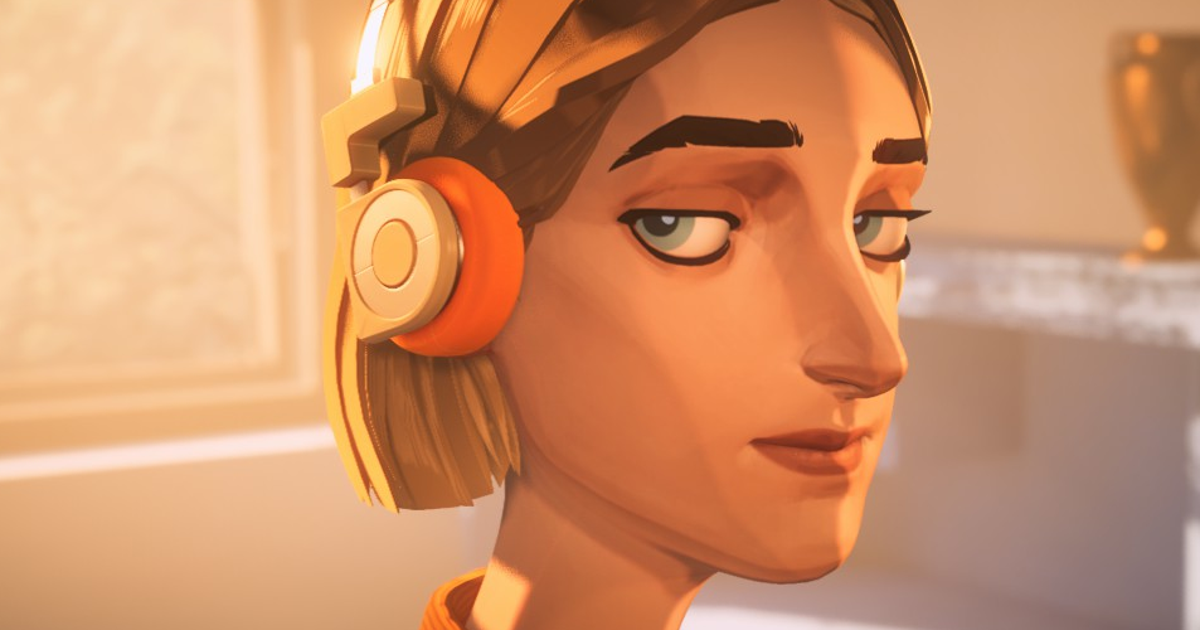
Mixtape, fashioned by The Artful Escape studio Beethoven & Dinosaur, is a delight. It pays tribute to teenage life and delivers its message, quite fittingly, in the way a teenager would.
Maybe it’s because I’ve just spent several hours reveling in teenage defiance, but I feel pushed to break a few rules. Unfortunately, they’re the standard principles of video game reviewing, and I’m expected to follow them (and I do, honestly, even if it’s a little grim) — though I shouldn’t really saddle you with them, since, let’s be candid, they’re extremely dull. My apologies: the situation around Mixtape means I have to start there.
The first guideline concerns quotations: reviews are usually better when they keep quotes to a minimum. The point of a review is to share your own thoughts, opinions, and feelings, rather than those of someone else. Beyond that, leaning too heavily on quoted material can quickly make the writing feel self-important, as if you’re short on original takeaways.
The second guideline goes deeper, and it’s perhaps not as widely practiced: reviews aren’t arguments. A reviewer isn’t here to convince you, dear reader, that they’re right. Their role is to be straightforward — not in the shallow way of “you were paid to give it an X,” but in a more meaningful sense. That means being genuinely candid with yourself about how you feel toward what you’re assessing, and then unpacking why those feelings exist. It’s about separating what belongs to you from what belongs to the game, and weighing intention against execution. If you do it well, you can show that you’ve considered how and why the work triggers certain emotions — and what that might all amount to (all while staying helpful and illustrative, of course). Still, it’s not meant to pressure everyone else into sharing the exact same reactions.
The third guideline is another boring but obvious one: don’t get pulled into other people’s perspectives. I genuinely didn’t — and still don’t! — want to step over that line. But I’m running behind with this review, and the internet argument surrounding Mixtape, like the familiar irritations of adolescence, has been as unpleasant as it has been hard to avoid. Online bickering is both repetitive and unpleasant, so I won’t linger on it. At this point, though, admitting that reality has become unavoidable — which brings me back to rule two, and then straight to rule one.
“One,” says Johnny Galvatron, Mixtape’s writer and director, “you don’t want it to resemble: ‘Remember the Game Boy Advance?!’ You don’t want to approach it in that manner. Nor do you want to assert that this was a better time. You shouldn’t take that route – and I don’t believe the game suggests that.”
Galvatron, who previously played in the Australian band The Galvatrons, is a man in a bright suit with a messy tangle of uneven blonde hair. He’s also the person who founded Beethoven & Dinosaur, the studio behind Mixtape. We talked nearly a year ago at the 2025 Summer Game Fest. By then, I’d already spent the first thirty minutes with Mixtape, and I found it hugely enjoyable — even that part; especially that part! It’s a conversation I’ve always felt slightly guilty about not writing down. So, I’ll include it here in a clumsy way.

“What you aim for is to create something universal,” Galvatron goes on to explain. “In terms of: do you remember when you felt out of place? Think back to the moment when the future felt strange and out of sync with your everyday life. And also: do you recall when everything seemed like a massive problem? Do you remember when you had no real experiences yet, and you defined yourself by what you liked?”
It’s important to note that even when someone says that’s what they intended to do when they made something, it doesn’t automatically mean they pulled it off. It also doesn’t always mean they truly set out to achieve it in the first place. Under the surface, subconscious influences or the broader circumstances around who you are, what you’re creating, and how you carry it out can get in the way of that intention. Intention is complicated. And once you start quoting people and speculating about their motives, it’s easy to fall into deference.
Still, just as crucial: I genuinely believe Beethoven & Dinosaur delivered exactly the kind of outcome Galvatron described this studio intended with Mixtape. And I think that’s impressive.
Mixtape is not, despite its appearance — decorated with autumn leaves
and sunsets, and reminiscent of chunky physical media, and a Blockbuster-style setup, with one needle drop after another—this is a game built on nostalgia. It pulls in nostalgia, sure, but at its core it’s a game about adolescence and what that teenage experience truly means. It even works hard to make the point land: Cassandra, one of the central figures, repeats that Galvatron line nearly word for word in a conversation from her candy-colored, pastel pink bedroom. (One of Mixtape’s few weaknesses is that…
Sometimes it leans a little too hard on stating its themes directly. Its young main cast often delivers observations that feel far more mature than their age. Still, that impulse—like many of Mixtape’s other flourishes—ends up fueling its charm.
Stacey Rockford, her long-time friend Slater, and their new companion Cassandra are spending their last day together in their own self-invented town in northern California. High school is now behind them, and the whole thing is in full swing with those punchy Wayne’s World 90s vibes (picture an umlaut landing on every vowel). Stacey has suddenly decided to hop on a plane to New York to chase a newly discovered goal: becoming a music supervisor. Get ready for a classic 80s-flavored tale that blends Breakfast Club energy with Ferris Bueller momentum, following a one-day run of small-scale rebellion and genuine self-discovery. And, yes, expect plenty of music.
On the music front, Galvatron—who describes his prior project, The Artful Escape, as almost “therapy for my experiences in the rock industry”—isn’t the least bit cautious about going big. That’s a good thing, because Mixtape’s soundtrack is outstanding: a steady stream of cult favorites, deeply personal picks, strong emotions, and sly, subversive humor, bolstered by an excellent original score. Galvatron explained that the game was built around the mixtape first—quite literally, with the track list taking priority from the beginning. From there, the studio produced what he jokingly called a “horizontal slice,” completing the full storyline in rough, skeletal form to match the music before expanding it further. Mixtape opens with a superb deep cut—“That’s Good” by Devo, the sort of song that feels instantly familiar—and it’s also the one Galvatron names as his favorite of all time, before the game rolls smoothly into what comes next.
As a game, Mixtape is basically a set of vignettes. Each narrative moment—there are a couple dozen overall—plays like an anecdote or a flashback, all paired with music Rockford curates with care. She talks to you directly, laying out her tightly confident expectations and also every sudden, dramatic twist away from the plan. Rockford’s personality comes through as someone shaped by her own musical preferences. Still, each song swap comes with a hands-on “mechanical” surprise: Mixtape is less a walking simulator, despite a few outdated jabs calling it that (with a touch of sarcasm), and more like an engine for stories on the fly. One second you might be skateboarding in third-person, and the next you’re sprinting through a sidescrolling, 2.5D setup. Then you’re snapping photos, skipping stones, clapping hands, floating, or messing with slick, shiny—ahem…
You slide into and out of these little episodes mostly by interacting with a specific object in a character’s bedroom or another hangout space, with a pace that keeps whipping you forward and back. (Calling it a “walking sim” is underselling it, too—there’s a bit of the Gone Home feel in the mix, though with nowhere near the same darkness.) Even so, the rhythm dips only slightly during parts of the middle section before it bursts back with a dazzling final stretch. The team at Beethoven & Dinosaur has real filmmaking chops for moving between scenes. Sometimes the transitions go all out, with fireworks and sweeping vistas; other times they’re understated but still beautifully done. In a blink, it’s a shell resting in a closed fist—then an open hand at the beach—then the shell again, flipped over, returning you to the bedroom. The method is relentless. If it isn’t match cuts, it’s smash cuts, crash zooms, and a constant back-and-forth between authentic archival footage and digital material, along with changes in aspect ratios and film styles, shifts between first- and third-person views, extreme close-ups, and long shots. The menu of possibilities feels endless.
Playing Mixtape is a lot like watching someone pour their energy into producing a piece of work after spending a ton of time consuming visual media. The references are everywhere, but they’re offered with celebration rather than borrowing for its own sake. It’s a nonstop stream of craft—composition, blocking, pacing, and the timing of jokes. Mixtape is genuinely upbeat, never shy about leaning into what it is, and it’s packed with care for tiny animation details. I even caught myself getting hooked on watching the stances your companions take as you line up the camera. The way Stacey and Slater’s hands—and, oddly, their heads too—mesh together so smoothly, in such an enchanting yet ridiculous way, while you awkwardly shove them around inside a photobooth. These are the brief, fleeting moments Mixtape creates for small but meaningful acts of self-expression. My Mixtape save is full of my awkward, badly framed pictures; my random attempts at painting; and my silly hand gestures recorded on VHS.
This is where the teenage side really comes into focus. Mixtape’s story is pretty direct: friends, hanging out, parties, strict parents, and plenty of melodrama. But it still hits hard, giving Beethoven & Dinosaur room to toss ideas your way and let you pick them up. It’s still possible to raise objections about whether it feels too staged—take the setting for example. The developer is from Australia, but the game lands in California. It targets millennials while placing the story in the 90s, a period when many of us were too young to live through it ourselves. It’s centered on a narrow, repeatedly shown version of Western nostalgia from that time. Some parts feel like they’re reaching, too—closer to copying its influences than to creating something fully original. The characters can also be frustrating. And it doesn’t quite capture the finer points of rewinding cassette tapes.
I played a large portion of it on the Steam Deck. In practice, Mixtape is almost shockingly vivid. | Image credit: Eurogamer / Annapurna Interactive
What I’m saying does have some basis, though the degree varies—at least when you look only at the surface. But stopping there would mean missing the point. This game isn’t meant to be a documentary. It isn’t a journal entry pinned to an exact day and place. It doesn’t center on the Pacific Northwest, on growing up there, during that period, or on the particular technology it references—or on the specific songs it goes to such lengths to pull you into.
It’s about—brace yourself for the cringe—us. Teens really can be infuriating, and it’s perfectly reasonable to dislike them. I do!
Sure! Here’s a rephrased version of your content while keeping the HTML tags intact:
A kind of self-disapproval is at the core of it: the recollection of who you used to be, the recognition of your own arrogance, misplaced certainty, badly interpreted “wisdom,” a lack of balance and perspective, your pride, and—most of all—how ridiculously eager you could be, all reflected back through a surface that’s uncomfortably polished. I find myself drifting back to that stretch of my life, feeling a chill as it returns to my mind, especially when I watch Stacey, Slater, and Cassandra. And still, I truly value them. Honestly, I care about them a great deal—because stepping into those roles, even for a moment, is so important, so necessary, so deeply meaningful to the human experience.
It’s something everyone knows—so much so that even trying to explain it can sound like a tired cliché. We all recognize it. We’ve all lived through something close to it. If not during the exact moments of Mixtape—though I did, regrettably, do a lot of headbanging in my car—then in your own version of those beats. Maybe you didn’t go quite as hard as these kids, but you’ve probably argued with something painfully obvious, like your life depended on it. Or perhaps at a party, right in the middle of a bold dance move you’d never attempted before and had no real reason to try at that exact second, you caught the eye of some overbearing parent and instantly racked up a whole catalog of internal embarrassment. Maybe you snapped at your mom, or tried to explain an oddly specific theory about divinity to your dad, or melted down again and again over what turned out to be pretty small stuff. And surely, there was at least one night when you lay on your back beside someone you cared about and felt the sheer scale of the universe staring back at you from the sky.
Tucked inside all that teenage nonsense is a streak of genuine, priceless honesty—the kind adults all struggle to nurture and usually can’t keep. That’s what makes Mixtape so undeniably self-indulgent, even a bit cringe-worthy: there’s so much energy, so many blasts, so many exaggerated facial reactions. Yet somehow, it’s also flawlessly aligned. Of course it’s going too far. It certainly piles on about three conclusions too many. It’s plainly trying to be earnest and sweet, written in big, obvious strokes. But that’s intentional. It’s funny; it’s a story that knows it’s telling itself; it recreates youth through its own design; and at its core, it’s genuinely true.
This captures the full feeling of existing in that chapter of life—something everyone has passed through, which is why it lives outside ordinary time and place: a strange 80s-90s pocket of permanent autumn. All those oddities are there because teens naturally carry that kind of mindset. It feels free because it’s built on the idea of having no boundaries. The point isn’t “seize the day” or anything similar. It’s about valuing it, loving it for what it was, not turning away from that time—or from the version of yourself you were then. And it’s about not getting so upset when that moment of awkward, mid-twerk eye contact comes back in your head at 2 AM and refuses to let go.
To misread the heart of it in this way—when you consider how “objective” that heart could ever be, and especially since I shouldn’t really be trying to get you to agree with me—feels like exactly the condition Mixtape is trying to correct. It comes from the heavy cynicism of today, the exhaustion that follows an online life, the weight that comes with adulthood and seriousness. There’s also the increasingly defensible idea that everything is a con, a setup. Or (for goodness’ sake) an “industry plant.” But if you follow that defensive, self-protective logic for too long, instead of “bigness,” you’ll find your world narrows: the peaks sink, and the lows feel flatter. If Mixtape has a message, that may be it. Loosen up a bit. And—just as clearly—recognize your own value. At the very least, I’ll bet your taste in music was better when you were 18. And maybe your teenage self already understood the importance of breaking the rules now and then.
A copy of Mixtape was provided for this review by Annapurna Interactive.