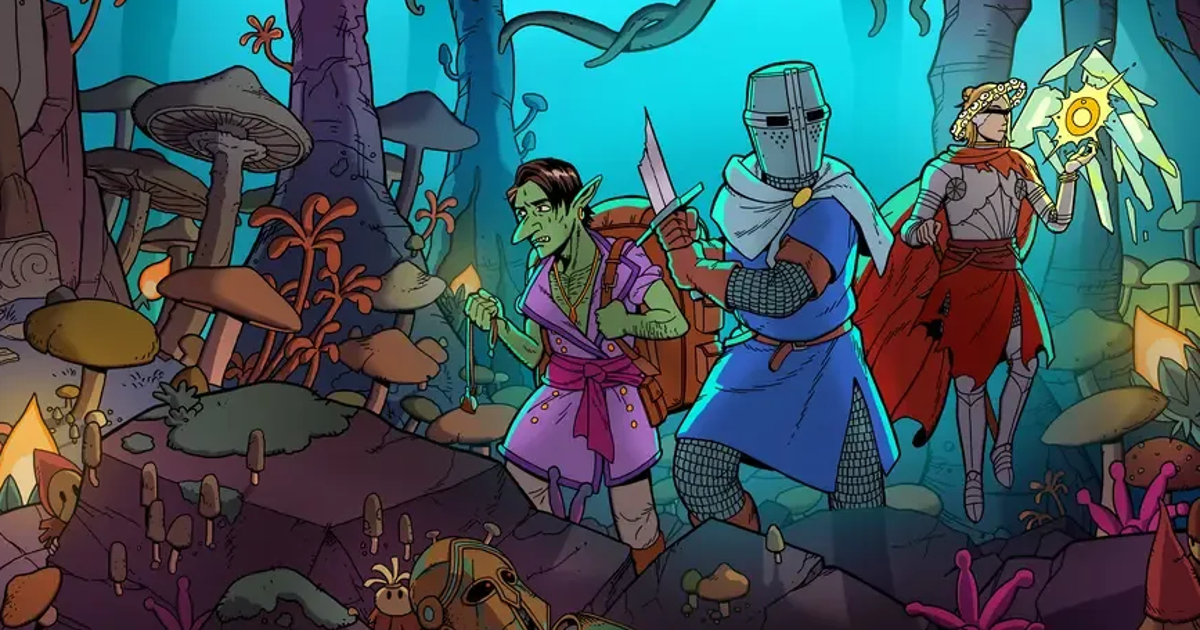
Drawing on overlapping influences from Terry Pratchett, Terry Gilliam, and others, Esoteric Ebb is a playful D&D-style quest in which a cleric who’s lost their way is tasked with solving a mystery just days before the world’s very first election.
Whenever I talk about my time with Esoteric Ebb, I usually add that I play the character as a fool, because there’s something oddly comforting about acting the part of a bumbling government lackey. Of course, I’ve pledged loyalty to authority and bureaucracy, but there’s always the possibility of getting into something wicked, thrilling, or even unexpectedly valiant. As a dutiful representative of the system, I hover right at the edge of plausible deniability and deliberate incompetence. Still, as a government cleric, I can always end up toeing the line out of fear, habit, or whatever keeps civil servants bound to the “public service” grind—because daily life is already difficult, and fretting over work conditions, job stability, and how other people view you is exhausting.
Even so, I’m determined to be a well-meaning fool, even if I’m not fully sure for what audience. I built my cleric to be reasonably level-headed and nimble, backed by the strength and stamina you’d expect from a delicate Victorian street urchin. My assignment is to investigate a crime—an explosion at a nearby tea shop—during the run-up to Tolstad’s first-ever election. Unfortunately, I seem to have died before anyone could find me, then was brought back by the local undertaker. The game starts as I come to on a stone floor, disoriented and disheveled, stuck with a damaged spellbook and sharply reduced magical capability (esoteric here points to a particular school of sorcery). I have five days to figure out what happened—and, just as importantly, maybe to make my first real friend.
Esoteric Ebb wears its influences on its sleeve, and one of them stands out immediately; it offers a nonlinear, story-led, text-heavy dice-rolling experience where competing parts of my cleric’s personality try to seize control whenever the dice are rolled. We move through life and death (sorry) using D&D skill checks, and we gather wearable items that can either improve or sabotage particular stats. Even spotting NPCs requires a skill check, and the higher the roll, the more extra details you uncover. There’s also a tiered magic framework that forces you to prepare spells at altars placed across the map, which grants benefits for skill checks during combat encounters—alongside familiar D&D staples like understanding languages and communicating with animals. Its “feat” system is a genuinely fun form of flexibility: once you complete a specific set of objectives, you can choose particular upgrades or gameplay perks tied to the story threads those goals unlock. These options can be swapped around throughout the game, giving you further room to tailor the cleric’s build.
It blends political tension with personal flaws into a lively, humorous patchwork, built with the kind of sharp, storybook wit you’d associate with fantasy writers like Terry Pratchett and Max Frei, plus a faint nod to Terry Gilliam. There’s also the same jittery assortment of modern-day worries that seem to seep into everyday life—at one point, for instance, you even run into the esoteric version of Ozempic stashed among contraband, as if magical practitioners somehow wouldn’t go for that kind of ridiculous indulgence. In the end, the game is about meeting people and learning how they work: a world packed with familiar quirks and insecurities that stretch beyond any single era, distance, or genre.

My first concern with Esoteric Ebb was the inevitable comparison to the most heavily scrutinized narrative outcast in gaming, Disco Elysium. A common, shallow way some people judge what makes Disco Elysium’s writing so engaging is to focus on verbosity rather than on the tightly interwoven approach to storytelling; it can feel as though some players are simply stunned by the sheer quantity of prose, lyricism, and rhetorical force. Ironically, it’s worth talking about how players relate to text in video games—and ideally, we wouldn’t end up treating “a ton of words” as proof of intelligence and eloquence. We can certainly aim to move past that sort of false choice. Honestly, I worried Esoteric Ebb might fall short of overcoming that hurdle, but it clears it convincingly in its own way.
Where Ebb really shines is in this: it nails the writing from one moment to the next, and it sustains a strong, consistent sense of tone and comedy. From the very first five minutes in the initial area, it makes the idea of roleplaying as a simulated agent feel surprisingly effortless. (Did I swing at the tutorial zombie for no good reason? Yes. Did I somehow get myself tangled up in embarrassment, then come back for more? Naturally.) The breadth of this narrative world—and how all its pieces connect—is genuinely impressive, even when I’m only skimming brief fragments of arcane lore and theological reflections, or uncovering the hidden forces that shape places far beyond my immediate surroundings.
Ebb simmers with a charming blend of situational comedy and enduring melancholy, steering my cleric toward surprising results and worthwhile indignation—because if I can’t finish a task due to weakness or sheer clumsiness, I might as well lean into the flaws with style. I may end up wrestling with doubts about faith and direction, while considering a side hustle to deliver milk for an absurdly low wage, or even spending an equally absurd sum to, in theory, obtain the rights to an underground
lake. I keep landing in one awkward mess after another, and each one feels like a real-world nudge back to my earlier years—when I had the grit and unapologetic will to keep going that I’m trying to channel for my Cleric, like a stubborn little seed. When I stumble in my attempts to size up NPCs because the dice have been unkind…
act, and somehow that uncertainty and irritation end up generating a sharp kind of pressure—both between characters and across the broader puzzles, mysteries, and aims that make up my journal.
Still, there are moments when it feels stretched thin, largely because the prose and scenario planning don’t always stay consistent. At times it even drifts into a level of self-gratification that moves from nervous, self-mocking humor into plain sameness. One example that comes to mind is the cat-people gauntlet corridor in the catcombs: I expected it to be, on paper, an intriguing concept, but in practice it ended up feeling pointless and clunky. More than once, the barrage of clever one-liners doesn’t quite deliver the punch and tension needed to hold up the larger premise of containing multitudes. It doesn’t happen often, but because it’s such a central part of the gameplay, it becomes glaring whenever it does. In some respects, Esoteric Ebb leans toward information maximalism, helped along by its tooltip/Wikipedia-style setup—players can tap different terms and names inside the game text to pull up summaries of major ideas and figures from this universe’s lore. That feature alone isn’t the problem. I genuinely liked it as a way to communicate information, especially because I’m drawn to dense, layered worldbuilding that can feel almost overwhelming.
I try to steer clear of the word “cringe” as a label, but sometimes there’s just no better way to describe the feeling of lingering, uncomfortable disappointment—especially when you’re enjoying a compelling fantasy setting and then run into one of the most stubborn, insidious staples of western genre storytelling: casual, joking, self-deprecating orientalism. In a pile of books in the Cleric’s quarters, there’s a volume that surveys the different peoples of the world—fantastical groups such as Urthfolk, Diminorians, Certs, and People of the Mountain. It’s worth remembering that this is a D&D homebrew world built on sorcery, theocracy, and dragons; it’s incredibly detailed and it also borrows real-world languages into its mythologies (Tolkien, among others, put a lot of effort into this—his Elven tongue, for instance, draws heavily from Finnish, and here it’s essentially just Finnish).
At the very end of the list sits “the Japanese.”
In this setting, the Japanese are portrayed with the same kind of feverish, hyper-oriental charm that made writers like James Hilton famous—taking isolated East Asian regions and turning them into a stock shorthand that shows up again and again across films, comics, and pulp stories. “An almost mythical human populace from the enigmatic realm of Ym – the so-called ‘Japanese’ have been a popular subject of fiction since their discovery in the early mid-Arcane Era,” says the chapter in the book. When I read this passage, my Cleric’s wisdom kicks in—through a successful roll—so I can dig a bit deeper: the Japanese are described as “mysterious human inhabitants of Ym, residing in an isolated kingdom atop vast plateaus, deep inland.” My Cleric’s charisma follows right after, leading to a quiet moment of self-reflection, because the game then tells me, “You, too, experienced a Samurai phase during your younger years.”
The game’s writer/developer Christoffer Bodegård likely meant this as a comedic moment—an affectionate jab at how East Asians, and especially Japanese people, are often turned into objects of western fascination, admiration, and reverence. On the surface, it’s framed as playful, self-aware fun; yet given how much care and effort went into building the rest of this world, it lands as careless and self-serving. The broader truth—that fantasy has often been constructed on a sturdy base of weaponized Otherness, racism, and xenophobia—has never been new. It’s just that fantasy fans can either choose to confront it thoughtfully or keep pretending it isn’t there, like they’re still kids. And since Ebb shows enough concern about racism in fantasy to tackle it directly through other subplots and character conversations—such as second-class citizenship and blatant mistreatment of birdfolk—this depiction of the Japanese feels even more upsetting. It reads almost like a kind of reverse-weeb exceptionalism, implying that only educated, self-aware Westerners are the ones who can “get it” and find it relatable, or even endearing. It makes you wonder why it’s treated as charming in the first place, who it’s supposed to charm, and whether western pop culture writing can ever reach something like a normalized, more grounded viewpoint on Japan.
Leaving this entire sequence out of the game wouldn’t have changed anything about the rest, but keeping it there left such an unpleasant aftertaste that I couldn’t really ignore it. My first run took roughly fifteen hours, so I couldn’t immediately wipe this particular blemish from memory, though it wasn’t hard to keep going since Ebb does a great job of building and maintaining momentum. Right now, in the middle of…
my second attempt still leaves me feeling a bit silly, even though I’m more stubbornly capable than before and I understand the game’s mechanics more deeply now. I’m still not fully sold on the hybrid class setup, though—it lets me pick a different role (such as a Druid or a Warrior), a choice that only becomes available after I talk with the appropriate NPCs.
The game’s slightly unruly temperament matches nicely with the way it pushes the Cleric to define himself through personal expression and clarification. The more I choose to see myself as either a Cleric or simply indifferent to politics, the more noticeable my alignment becomes in those areas. During my first run, I accidentally nudged myself into a Cleric-Druid blend—though I didn’t quite commit to that exact build. It’s also worth remembering that the Cleric is officially framed as a kind of magical prodigy, and while we’re not quite in “chosen one” territory, the game still makes it clear that my sweet, well-meaning but somewhat clueless keeper of holy law has a remarkable talent for the arcane. It’s hard not to admire a game that dishes out both mercy and questionable odds, even for someone as transparently average as me—especially when I genuinely feel undeserving of it.
Working through political alignment is arguably among the game’s most satisfying elements, particularly because it’s election season. The game keeps calling out my Cleric whenever I insist on being neutral. I can practically feel the irritation from my fellow voters as I confidently declare my apolitical position to anyone who’ll hear it—the dwarves championing labor rights, the heavy-handed Freestriders reshaping power and wealth to steer democracy toward their preferred outcome, and my endlessly patient companion, Snell, a goblin who seems to have expertise in just about everything. It’s pretty humiliating when I, as what feels like an ineffective representative of the state, try to debate with fervent campaigners about how I supposedly don’t care about the city’s urgent problems. I come across like dead weight, but once I finally bottom out and dedicate my Cleric to a specific cause, I start to feel a little more pleased with him.
A compact way to describe the heart of Esoteric Ebb is the Cleric’s very first meeting with Snell. That’s the moment I choose a totally off-base greeting for a goblin that feels like it belongs to an “uncivilized” tribe, and my charisma promptly interrupts to announce, quite correctly, “what the HECK are you doing?!” In keeping with the D&D spirit, this game leans into the punchline of that question with broad, generous comedy, a touch of camp, and lots of mischief—an approach that fits a setting powered by dice, imagination, and a steady undercurrent of eldritch dread. The sense of freedom in decision-making is genuinely addictive.
The game’s final stretch plays out on election day: the whole city comes together, everyone you’ve met heads into the city center to handle their civic duties, and the place hums with that shared, anticipatory tension. It’s a historic-feeling moment, too—there’s something deeply personal in how the mood and the coming relief on election day echo the very real frustrations of exhausting political maneuvering, corporate lobbying, and the collective, sinking sense of “I don’t have better options.” If 2026 ends up being the year of the silly election game (and the other standout title is Cosmo D’s Moves of the Diamond Hand—okay, I’m clearly building a theme from two games; indulge me), then let Esoteric Ebb be the relatable buddy comedy that nudges players to think a little harder about their place in the world and about the sort of useful fool they want to become.
A copy of Esoteric Ebb was provided for this review by Raw Fury.