Supermassive ventures into sci-fi horror, delivering a welcome, more cerebral take on its usual blast-of-popcorn thrills. It’s hindered by stiff mechanical stealth and a plot that feels familiar, though a standout ensemble ultimately makes the experience worth the effort.
If this rings a bell (or something close to it), you’re not alone: the planet is nearing its final moments, and humankind’s last shot is tied to a single habitable world, far off across light years. An expert group drawn from Earth’s best is put together for an eight-year journey to investigate the planet, but just after they wake from a four-year cryogenic nap, an unfamiliar presence has already found its way onto their spacecraft—turning what should have been a mission driven by optimism into a tense spiral of suspicion. And as for whether the massive corporation financing the whole operation knows more than it admits? Of course it does. Directive 8020 shapes its story like a sci-fi horror anthology, only marginally less familiar as it moves forward. While it does count as a step forward for Supermassive’s Dark Pictures Anthology in a few meaningful ways, it still never quite manages to define its own identity.
One of the earliest notable shifts in Directive 8020 is how down-to-earth and believable its tone feels. Earlier Dark Pictures entries sometimes leaned a little too hard into heightened, almost playful horror worst-hits, like a cheerful scrapbook of familiar scares—something that, admittedly, has helped them stay entertaining. Directive 8020, by comparison, seems to deliberately move away from the more rowdy, mass-appeal energy of its predecessor toward a calmer and more thoughtful atmosphere.
This patient setup starts by introducing three separate factions from the Cassiopeia crew over a handful of mildly eventful hours. That choice creates plenty of space for conversation and character building as you bounce between each playable crewmember. By the time the threads finally converge and the threat they face begins to feel truly real, they’ve stopped being just faceless alien victims—and I found myself genuinely invested in each individual.
Directive 8020 keeps things relatively measured across its roughly eight-hour run. The constant jump scares that defined earlier games are gone, replaced with a quieter, more creeping form of terror—one that grows increasingly existential. Even the series’ core interactive-movie structure, which usually shepherds you from one staged moment to the next, doesn’t stand out as strongly. You still get a sequence of carefully made cinematic scenes that briefly pause to present decisions, and those calls often push the branching story in a fresh direction; however, the emphasis appears to have shifted toward more traditional third-person play: exploration, light puzzle-solving, and stealth. That change gives the horror a slower ramp-up, as the Cassiopeia’s ordinary corridors and rooms gradually twist into a nightmarish landscape of corrupted flesh, with noticeably more breathing space.
The previous entry, The Devil in Me, also tried to shake up the series’ approach, but here Supermassive reins in the messier parts—like the overly complex inventory systems and aimless wandering—into something tighter and more deliberate. The developer keeps things moving by balancing its different elements. One clever addition is the text-message-style communication system, which lets the studio dig deeper into relationships while also offering extra decision points, all without derailing the immersive third-person moments. Still, once you remove much of the franchise’s playful pastiche and distinct personality—Pip Torrens’ charming Curator and his reflective interludes are missing, along with familiar mechanics like premonitions—Directive 8020’s plot has to carry itself. That makes it easier to examine closely, and you can’t help feeling that it sometimes leans too heavily, too transparently, on ideas that were already handled better elsewhere.

Unlike its predecessors, Directive 8020 isn’t just sampling the sub-genre like a theme park ride; it pulls from the heart of some of the most celebrated movies ever made. Alien is an obvious touchstone, but it also leans hard on The Thing’s body-horror flair and its paranoid sense of dread. I could list a handful of other likely influences, but naming them would give away too much. Eventually, though, Supermassive blends these ingredients into something genuinely intriguing. For example, there’s a fun meta explanation for Directive 8020’s flexible structure, along with a satisfying narrative symmetry as different motivations surface. It uses several storytelling devices to keep momentum, including flashbacks and flash-forwards, plus an episodic structure (complete with cliffhangers that sometimes feel a bit forced). Yet because so much of it feels familiar, it rarely manages to spark major curiosity during most of its runtime. Paired with the slow-burn approach, Directive 8020 never quite reaches full throttle.
The same limitation shows up in its new headline feature—stealth. In many of Directive 8020’s third-person sequences, your tasks are typically just moving from point A to point B (though you can usually stray off the main path to chase collectibles). Occasionally, Supermassive layers in light puzzle challenges, often asking you to inspect a room for hidden wiring so you can reroute electricity and unlock doors. At times, you’ll have to run from an infuriated adversary, but it’s the fairly predictable stealth mechanics that end up taking center stage.
During the opening stretch, stealth mostly boils down to staying hidden while you move through the Cassiopeia’s shadowy spaces as hostile crew members chase you, and later you’re confronted with grotesque monstrosities. In practice, though, those situations don’t feel meaningfully different from each other. The foes rely on the same small set of patrol routes, shuttling predictably back and forth while they…
…repeat the same narrow playbook, with little more than changes in where you are standing when you cross invisible boundaries. The tolerance for mistakes is high enough that you rarely get a real jolt of threat or suspense—at least none that doesn’t come from the art and audio teams, who are doing everything they can to squeeze every encounter for maximum impact.
as hellish crimson light slices through the dense darkness and alarms scream.
To add a bit of perspective, I didn’t lose my life during the stealth sections; instead, most of my deaths came from misreading the overly stylized QTE button prompts. If stealth makes you feel uneasy or on edge, it’s usually because the lively surroundings can hide your opponent, forcing you to constantly ping your radar just to track them down, filling the screen with wireframe overlays. It starts to dilute the atmosphere.
There’s some effort to refresh the core hide-and-seek rhythms and puzzle elements — again, of the powerline variety — and they gradually begin to seep in, too. While that does nudge up the tension as you’re pushed out of hiding, the stakes feel barely real, and the encounters don’t meaningfully change from one to the next. Even though clattering broken glass is introduced as a mechanic, it’s largely dropped almost immediately; likewise, there’s no real attempt to apply the specializations hinted at by each team member’s role. By the end, it starts to feel a little routine.
To be clear, Directive 8020’s no-nonsense stealth isn’t downright awful — it’s just a bit wearisome. For the most part, that’s easy enough to stomach, especially when you know another story beat, another chance to explore, or another decision moment is just a few minutes away. Still, it becomes tougher in the closing stretch, when the plot calls for a sharper rise in intensity, yet the game keeps stacking large numbers of back-to-back stealth sequences that don’t change much. Honestly, it feels like the final-act encounters would land much harder if several of them were cut down.
That said, I genuinely liked my time with Directive 8020. Despite its predictability, the pacing is engaging and carries the narrative forward, with a few truly strong highlights — like a tense, exhilarating first-person crawl through air ducts — where tight direction and impressive artistry elevate the overall presentation beyond what you might expect. It’s also perhaps Supermassive’s best shot at a branching story to date, avoiding the uneven, punchy missteps seen in earlier entries. Plus, being able to revisit prior Turning Points and try alternate routes at any time in Explorer mode is both fascinating and genuinely freeing. If Directive 8020 has a real standout strength — the thing that turns a merely interesting game into something truly engrossing — it’s the cast. Every performer brings their best.
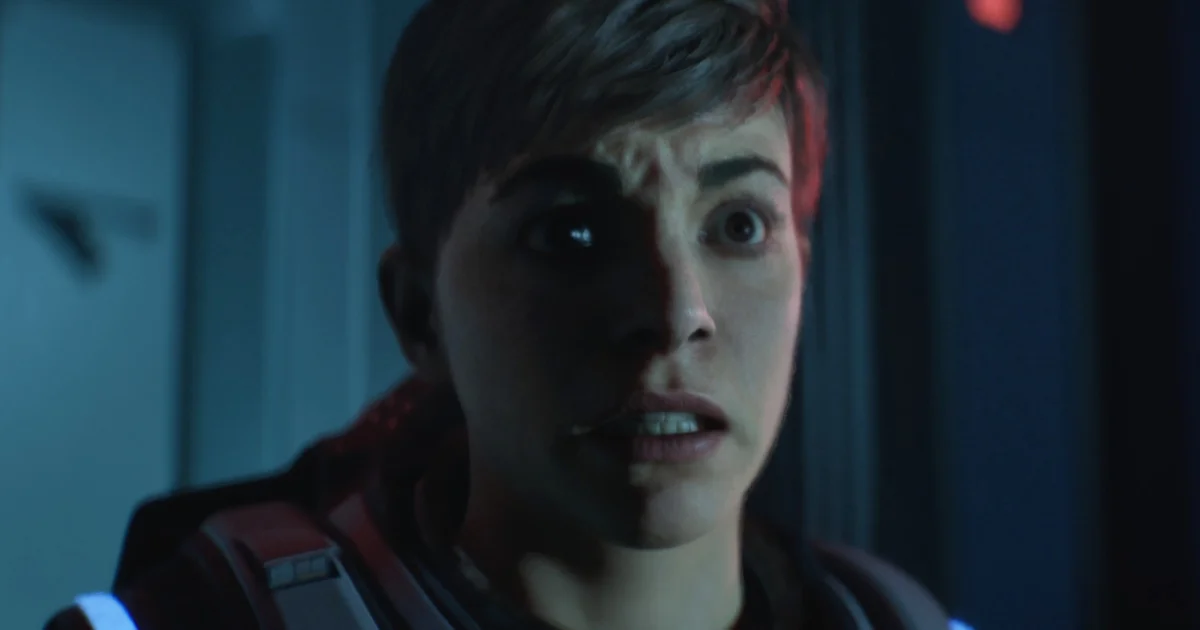
For all its intense body horror, the naturalistic performances add a welcome sense of warmth and teamwork aboard the Cassiopeia crew. Anneika Rose as Pari Simms is likely the most memorable, managing to become the emotional center of the game even with an early exit, while Lashana Lynch as Brianna Young delivers a similarly strong impression. Still, every actor (backed up by solid facial animation work that occasionally slips into the uncanny) is excellent, lifting even the weaker sections during the tougher stretches. These were people I quickly found myself caring about, and I genuinely felt a touch of sadness when they left. Oh, and if you’re wondering why many of the facial models look familiar, there are also some intriguing hints behind that.
Directive 8020 is unquestionably an oddball entry. I genuinely respect Supermassive’s ambition to try something a little different within its anthology lineup, and the move toward new playstyles paired with a more layered, thoughtful tone is refreshing — even if I’m not sure it will become as much of a co-op go-to as its earlier releases, since it lacks those quick, crowd-pleasing thrills. In several ways, Directive 8020 feels like it’s full of missed opportunities and almost-there ideas. Even so, sometimes Supermassive’s risk-taking pays off. It runs a bit long, its tone is a touch too steady throughout, and I only wish it had pushed harder to define its own identity while operating in well-traveled territory. Still, its existential dread works, it has a sincere spirit, and it features an exceptional cast that genuinely made me care. If Supermassive keeps pushing forward with its horror series, I expect great things ahead.
A copy of Directive 8020 was provided for this review by Supermassive Games.