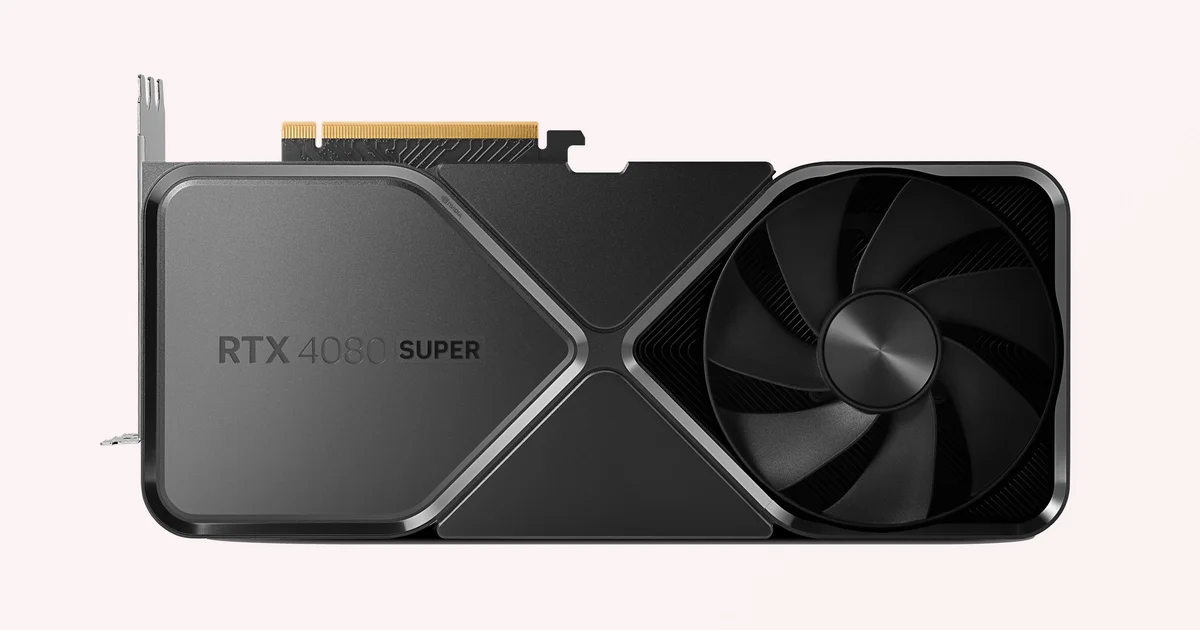
Nvidia revealed its latest line of RTX graphics cards at a press event today as part of the kickoff for CES 2024. The company is extending the RTX 40-series with three fresh “Super” models: the $999/£959 RTX 4080 Super, the $799/£769 RTX 4070 Ti Super, and the $599/£579 RTX 4070 Super. We looked at these cards earlier this week during this week’s DF Direct after extensive leaks, but the official reveal adds some interesting extra detail. In particular, changes to specifications alongside price updates in certain cases could make premium GPUs feel more attainable for a wider range of budgets.
Nvidia plans to roll out the new Super cards across January in weekly steps: the RTX 4070 Super goes on sale first on the 17th, followed by the 4070 Ti Supers on the 24th, and the 4080 Supers on the 31st. It’s a curious schedule that may help with availability. The 4080S and 4070S will be sold in Nvidia Founders Editions as well as standard third-party options, but the 4070 Ti Super won’t include a first-party FE version. It’s worth highlighting that the 4080 Super and 4070 Ti Super models take the place of their non-Super counterparts, while the 4070 remains listed at $549, creating a seven-card lineup stretching from the RTX 4060 up to the RTX 4090.
Looking at the confirmed specs for each card against their immediate predecessors, there are a few pleasant surprises alongside the expected improvements. Take the RTX 4070 Ti Super: it uses the AD103 GPU that was initially destined for the RTX 4080, and it delivers a notable 10 percent bump in CUDA core count. It also pairs that chip with a full 16GB of GDDR6X memory on a 256-bit bus, rather than the original 4070 Ti’s 12GB on a 192-bit interface. That said, boost clocks and rated power draw are unchanged, so we’d only expect a comparatively small performance uplift in practice.
| 4080 S | 4080 | 4070 Ti S | 4070 Ti | 4070 S | 4070 | |
|---|---|---|---|---|---|---|
| Processor | AD103 | AD103 | AD103 | AD104 | AD104 | AD104 |
| CUDA Cores | 10240 | 9728 | 8448 | 7680 | 7168 | 5888 |
| Boost Clock | 2.56GHz | 2.51GHz | 2.61GHz | 2.61GHz | 2.48GHz | 2.48GHz |
| Memory Allocation | 16GB | 16GB | 16GB | 12GB | 12GB | 12GB |
| Memory Interface | 256-bit | 256-bit | 256-bit | 192-bit | 192-bit | 192-bit |
| Memory Bandwidth | 736GB/s | 717GB/s | 672GB/s | 557GB/s | 504GB/s | 504GB/s |
| TGP | 320W | 320W | 285W | 285W | 220W | 200W |
| MSRP | $999 | $1199 | $799 | $799 | $599 | $599 |
| Release Date | 31/1/23 | Out | 24/1/23 | Out | 17/1/23 | Out |
The 4070 Super brings a major 22 percent increase in CUDA core count, along with a higher TDP of 220W instead of 200W. However, that improvement isn’t matched by changes to memory capacity, memory bandwidth, or clock speeds. It will be interesting to see how it compares with the original 4070, especially since Nvidia’s own pricing implies roughly a 10 percent performance gain. At the same time, third-party 4070 cards are currently available for around $535, which is well below the original $599 MSRP.
In the end, introducing three new models suggests that it could be some time before we see RTX 50-series graphics cards—something that was previously rumored to arrive sometime in 2024. Still, maybe we’ll get some clarifications before the year wraps up. For now, Nvidia also announced DLSS 3 for Horizon Forbidden West, DLSS 3 for the social sandbox MMO Pax Dei, and both RT and DLSS 3 for Diablo 4. Other updates included improvements to Nvidia’s AI systems for conversational NPCs running on local GPUs and in the cloud, “AI PC” gaming laptops from a range of manufacturers, and G-Sync Pulsar (variable frequency BFI + VRR) technology aimed at certain upcoming Asus monitors.
CES 2024 also delivered a number of hardware updates that matter to the DF community. This week’s DF Direct Weekly discussion covered LG’s new 144Hz OLED TVs, MSI’s attention-grabbing Intel-powered Claw PC handheld, and the LG 27GR95QE, a 27-inch 1440p 480Hz OLED monitor that looks like a standout choice for competitive esports. (I’m now convinced that a 480Hz display is the only missing ingredient that could push me to a higher rank in Counter-Strike 2, so I’m keeping a close eye on it.)
Alongside these compelling CES takeaways and the conversation around the Unreal Engine VR injector (recently reviewed by Eurogamer’s Ian Higton), Rich, John, and Alex also had the chance to respond to thought-provoking questions from members of the DF Patreon community. This week, supporters asked how Alex has been adjusting his approach to optimized settings as game hardware requirements keep rising, what the team expects from Crysis 4, and whether CD Projekt Red might consider open-sourcing their technically accomplished Red Engine as they move toward Unreal for future efforts.
All of these are great questions, and I’m sure you’ll agree. If there’s anything on your mind that you’d like the team to tackle, we invite you to join our supporter program. It includes early access to DF projects, exclusive behind-the-scenes content, and of course the ability to submit your own questions for the team to answer each week—along with literally thousands of high-quality video downloads over at digitalfoundry.net. Join us!