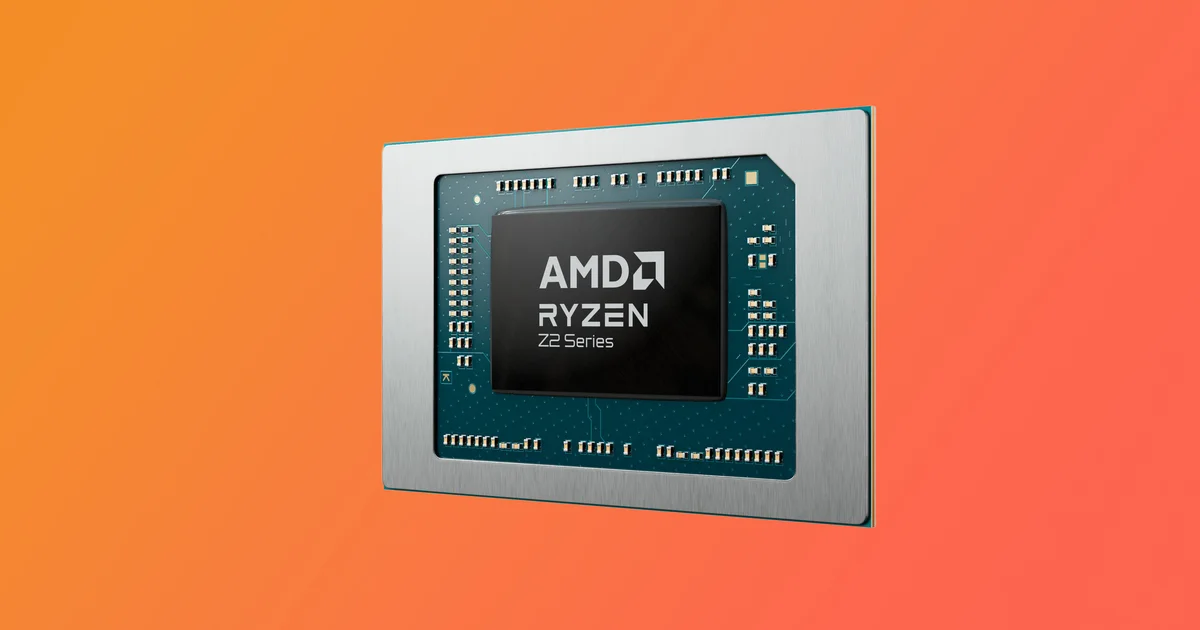
AMD unveiled three next-gen Ryzen Z-series APUs built for gaming handhelds during its CES 2025 keynote. As we outlined back in December, the lineup is made up of three separate architectures that trace back to 2022, yet this reveal still adds some fascinating new context about where these processors may end up.
At the forefront, the Z2 Extreme brings an eight-core, 16-thread setup with a thermal design power (TDP) of as much as 35W, drawing on the Strix Point architecture—recently on our radar via the Beelink SER9 mini PC. This APU also includes 16 RDNA 3.5 compute units (CUs). For the CPU side, three of the eight cores are full Zen 5 units, while the remaining five are smaller Zen 5C cores, which use less on-chip cache but keep the same underlying microarchitecture. The mixed approach is meant to improve the compromise between single-core responsiveness and die size/power efficiency versus a purely uniform layout. It’ll be interesting to see how this chips up in upcoming flagship-style gaming handhelds—think along the lines of the next-gen Asus ROG Ally X or Lenovo Legion Go.

Next up is the Z2, which keeps the eight-core, 16-thread configuration but switches to the Hawk Point architecture—meaning these are Zen 4 cores. This APU includes 12 RDNA 3 CUs and is rated for up to 30W, which likely points to use in more budget-leaning handhelds, including the cheapest version of the ROG Ally.
Finally, and maybe the most interesting entry, the Z2 Go appears to be a Lenovo-only design built for the rumored Legion Go S—Lenovo’s smaller, more affordable handheld. It uses a four-core Zen 3+ (Rembrandt) design with 12 RDNA 2 CUs. Using an architecture from the 2022 era, the goal is to deliver fairly solid performance while trimming features, all at a lower price point. That could make it a strong match for the Go S, which should be priced more competitively than the original Legion Go—and a handheld in the $300–$400 bracket could do very well if it delivers performance on par with the Steam Deck!
Before the embargo lifted, reporting suggested AMD’s announcement implied that Z2-series chips would show up in products from companies such as Valve, Asus, and Lenovo, pointing to a mid-cycle refresh for the Steam Deck. Still, the slides don’t appear to offer meaningful proof for that idea. Instead, these companies are referenced only as part of the category’s standout growth.
In fact, Valve employee Pierre-Loup Griffais, whose Bluesky profile identifies him as a programmer on the Steam Deck, flatly rejects the claim, saying, “There is and will be no Z2 Steam Deck.”
We could still see SteamOS support for the new chips, which would naturally help other firms building third-party SteamOS devices.
I expect we’ll hear more about these new products as CES moves forward, so keep an eye out for all the newest information—including potentially major launches from companies like Intel and Nvidia.