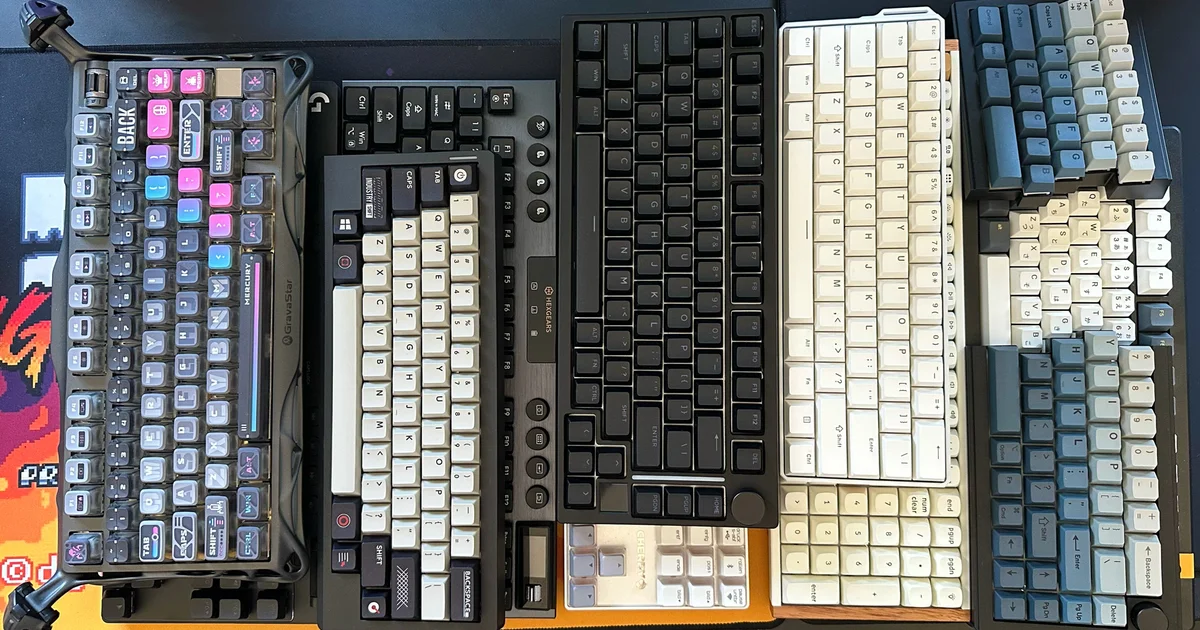
For seven years, I’ve been sharing my excitement for typing and gaming with mechanical keyboards, so it’s probably not surprising that I often contact different companies to ask about their newest, most impressive releases. This time around, I’m bringing you a week’s worth of testing results in the form of 10 keyboards (!), from feature-packed gaming models to stylish mechanical options aimed squarely at typists.
First, a quick note for clarity: just one keyboard here is a full-size model that includes a numeric keypad. Based on what we’ve seen in recent keyboard roundup discussions, Eurogamer readers love number pads. We already have full-sized keyboard recommendations ready, and more dedicated reviews for full-size boards are on the way too—so keep an eye out.
With that said, get ready for a mix of strange and standout mechanical keyboards in all sorts of shapes and sizes. Expect odd HR Giger-inspired and retro Japanese-inspired designs from smaller, less widely known brands, alongside esports-focused picks from established names. You may just find your next keyboard right here—so enjoy.
- Keychron K4 HE: a stylish full-size keyboard with rapid trigger
- GravaStar Mercury K1 Pro: genuinely distinctive and delivering outstanding performance
- Gamakay TK75HE V2: the quietest mechanical keyboard I’ve tested
- Logitech Pro X TKL Rapid: the newest esports standout
- Monsgeek Fun60: could this be a more budget-friendly Wooting 60HE?
- Epomaker Split 65: a comfortable, beginner-friendly ergonomic board
- Cherry Xtrfy MX 8.2 TKL Wireless: a wild name paired with a fantastic keyboard
- Epomaker Hack 59: a modern take on the HHKB layout
- Glorious GMMK 3 HE: extensive customization, with one limitation
- Hexgears Immersion A3: an affordable alternative to the G915 TKL
- Conclusion
Keychron K4 HE: a stylish full-size option with rapid trigger

I’ve noticed you all seem to appreciate number pads—so this keyboard is likely to win you over. The Keychron K4 HE Special Edition is a 96 percent board finished with a wood veneer, built around Gateron double-rail magnetic “nebula” switches. These provide a smooth, straight-line feel that works well for both everyday typing and gaming. This 96 percent layout includes nearly everything you’d find on a typical full-size keyboard, while still being more compact: navigation keys sit along the top, and arrow keys are tucked into the numpad area along with the alphanumeric section. You may need a day or two to adjust, but it delivers a complete keyboard experience in a much smaller footprint.
As with other Keychron Special Edition models we’ve reviewed—such as the smaller K2 HE—the K4 HE stands out with bold rosewood accents that look great alongside cream-colored keycaps and the aluminum frame. A black-and-wood version is also available, and the regular models with metal frames and backlit keycaps cost a bit less. Considering the current push toward wood finishes in PC cases like the SFF Fractal Terra, it’s genuinely nice to see keyboards moving toward more natural materials as well.
Because this model uses magnetic Hall Effect switches, it includes the familiar set of standout features: adjustable actuation points ranging from 0.2mm to 3.8mm to help you find the right balance between responsiveness and precision, a SOCD (simultaneous opposite cardinal directions) option that prioritizes the last key pressed when strafing in FPS games, a dynamic keystrokes mode that can trigger different actions depending on how far you press, and a rapid trigger setting that makes set actuation/release points simpler—helping speed up your inputs. In practice, that covers the full range of capabilities associated with Wooting, with everything controlled through web-based software. I also like that most of these features start turned off; for example, rapid trigger isn’t ideal for typing. Even so, enabling them is simple, and the web tool stays dependable.
Overall, it’s a well-built, good-looking, and responsive keyboard that brings nearly every feature you’d expect from a modern gaming board, aside from possibly higher polling rates. Keychron continues to stand out by offering strong value without cutting corners on quality.
GravaStar Mercury K1 Pro: genuinely distinctive, impressive performance
The Gravastar Mercury K1 Pro calls to mind the kind of design HR Giger could have made if he were still here and suddenly obsessed with keyboards—complete with flip-out claws, a skeletal metal structure, and genuinely strange-looking keycaps from another world. It’s undeniably different from almost anything else you can buy, and that’s exactly why I’m drawn to it. More than that, it feels carefully engineered: there’s no noticeable flex anywhere across the board.
Beyond its unsettling visual style, this is also a sturdy keyboard that handles typing and gaming with ease, thanks to gasket-mounted tactile switches. The 75 percent layout includes the key set I actually want, including arrow keys and function keys, while still staying more compact than a traditional tenkeyless (TKL) design. Naturally, that reduced space is used to showcase the tripod claws—though the keys themselves remain easy to reach.
It also brings a few attractive extras, like a small built-in display at the bottom-right, a volume rocker on the top-right that can be pressed down to mute, and a 2.4GHz wireless USB dongle tucked discreetly into the keyboard’s oddly shaped underside. You can tell a lot of attention went into designing this product, and even with its higher asking price, you won’t feel like you’re paying extra for nothing. In short, this keyboard is truly in a class of its own.
Gamakay TK75HE V2: the quietest mechanical keyboard I’ve ever tested
Gamakay’s TK75 keyboard has quickly become one of my all-time favourites: it’s a 75 percent board with a plastic frame, but the build quality keeps getting better and better—
for a surprisingly reasonable price. The first TK75 came with a sturdy 75 percent layout and a volume dial. The TK75 HE stepped things up with Hall Effect magnetic switches, and the TK75 HE V2 adds a small screen for status notifications, plus the time/date or your chosen set of (animated) images. It also supports polling rates as high as 8K.
The V2 model with Phoenix Silent switches is also the quietest mechanical keyboard I’ve come across. It produces almost no noise during fast typing—instead of the usual clatter, you get unusually deep, satisfying sounds that deliver satisfying, full-bodied feedback. It’s a little uncanny how little sound this keyboard makes, which is exactly why it’s the only mechanical board I’d genuinely point to for a lively but still quiet setting, such as a library or a busy office.
Everything else stays the same: there’s that useful volume dial in the upper-right corner, backlit ABS keycaps that highlight the (optional) RGB illumination, a simple plastic chassis, and Windows-only software that feels a bit basic. Given the cost, both the plastic body and the somewhat outdated software are understandable places to cut back, and I still strongly recommend this model overall.
Logitech Pro X TKL Rapid: the new go-to for esports
So, what sets the Logitech Pro X TKL—one we previously praised—apart from the Pro X TKL Rapid sitting on our desk this week? The answer is pretty simple. The standard Pro X TKL is wireless and uses conventional mechanical switches, while the Pro X TKL Rapid is wired only, but it uses more advanced magnetic switches—and it’s also the first Logitech keyboard to include them. With the keyboard’s existing strengths, such as strong software support and an impressive 8000Hz polling rate, does this end up being the better pick for competitive FPS players?
In short: yes. The Rapid lets Logitech (and its many sponsoring teams and players) tap into the push toward high-performance rapid trigger keyboards, helping gamers react faster—particularly when moving side to side—giving them a small edge over opponents.
Logitech’s approach follows familiar patterns. The Hall Effect switches bring the expected benefits: rapid trigger, multi-point actuation (letting you assign several functions to a single key depending on how far it’s pressed), and key priority (often called SOCD). With SOCD, one of two simultaneous key actions gets automatically suppressed if the system detects the other key—for example, if A and D are configured together, you start counter-strafing as soon as D is pressed rather than waiting for A to be released like you typically would. I also like that you can download configurations from inside the Logitech software, which makes it more approachable even for people who aren’t already comfortable with advanced setups that make use of these features.
Beyond that, the G Pro X TKL Rapid continues to be an excellent typing keyboard, though it’s the noisiest of the models we tested here. The PBT keycaps provide a good amount of grip, which is helpful, the layout remains fairly traditional, and you still get practical media controls plus a volume dial. Overall, it’s a strong option for anyone focused on FPS gaming, offering a polished experience that helps justify its higher price compared with more niche alternatives.
Monsgeek Fun60: a budget-friendly take on the Wooting 60HE?
The Wooting 60HE is still our top recommendation for Hall Effect keyboards, thanks to its excellent software and a distinctive design. The Fun60 Ultra looks to have been made along very similar lines: it’s a 60 percent Hall Effect keyboard with rapid trigger and other magnetic-switch features, but it costs a lot less than the Wooting model (currently £81 versus £163) while also using a more appealing aluminum chassis.
The Fun60 also copies the Wooting board’s key visual language, down to the loop in the upper-left corner used for attaching a 60HE-style fabric strap—though that strap isn’t included in the box, which is a bit disappointing. It feels like a case of copying something purely to match, similar to how Android phones adopted iPhone-style notches even though plenty of arguably better designs were available before.
That said, the Fun60 is still a workable option. You get a strong out-of-the-box typing experience with the included magnetic switches, a stated 8000Hz polling rate that the 60HE lacks, and a wider range of colour choices than the Dutch-manufactured model. The bigger difference comes down to software polish: it’s much less refined than what Wooting offers. In fact, we struggled to even start the software on our Windows test machine. Since that software is so important for getting the most from the board, the 60HE remains our preferred pick, but the Fun60 is worth considering as a more affordable alternative.
Epomaker Split 65: comfortable and easy to live with
The Epomaker Split 65 is a comfortable keyboard that’s also very straightforward to use. You simply split the two halves when you want a more relaxed posture, then bring them back together when it’s time to type quickly—whether you’re writing an article or doing anything else. The layout here feels familiar, but it may not be as ergonomically advanced as more experimental designs with extensive adjustments,
Yet chasing perfection can sometimes limit overall performance — and the Split 65 is proof that “good” can still be excellent.
Beyond its distinctive splitting mechanism — which, for instance, leaves room to set down a cup of tea — the Split 65 is a sturdy choice for both typing and gaming. Its 65 percent design is especially useful because it keeps the arrow keys while staying compact, the wisteria switches together with PBT keycaps feel satisfyingly tactile, and you can tailor the layout to your preferences via online VIA or QMK firmware.
The split layout does create a short, flexible double-ended USB-C cable that stretches across your desk, but there’s also a workaround: you can attach a separate USB-C cable to your computer. The reason is simple—this model supports both Bluetooth and 2.4GHz wireless.
I often find ergonomic keyboards awkward to get used to during my day-to-day workflow, so I was pleasantly surprised to see how quickly the Split 65 clicked for me.
It genuinely astonished me that the Split 65 wasn’t just more enjoyable than a typical keyboard, but also just as straightforward to use. Even though it took me a day or two to hit the smaller split space bar accurately, I adapted faster than I expected.
Cherry Xtrfy MX 8.2 TKL Wireless XAGA: amusing name, stunning board
Cherry’s acquisition of Swedish esports-oriented accessory maker Xtrfy has pushed the company into gaming in a way the well-known switch specialist hasn’t really tried before. Their latest release is this surprisingly long-titled product: the MX 8.2 TKL Wireless XAGA.
That lengthy name hides a relatively straightforward mechanical keyboard. It offers a clean white/silver look, a compact TKL layout, and a choice between the company’s MX2A blue (clicky) or red (linear) switches. These switches first appeared in 2023 and feel noticeably smoother than the MX switches Cherry has produced since the 1980s. What ties it all together is the connectivity: low-latency 2.4GHz, Bluetooth, and the standard USB-C wired option—plus a separate metal carrying case. It’s an arrangement aimed squarely at esports professionals and dedicated mechanical keyboard fans who proudly bring their newest boards to work.
There aren’t many standout special features you’d normally expect—no 8K polling, no ergonomic add-ons, no magnetic switches, and nothing similar—but the typing feel is likely the best I’ve experienced on a Cherry keyboard in quite some time. The attractive design, along with the included metal case, also helps make sense of the fairly steep price. It won’t suit everyone or every budget, but I do respect Cherry’s new direction, delivering solid keyboards that clearly highlight its latest switch lineup.
Epomaker Hack 59: a contemporary HHKB substitute
The Hack 59 doesn’t really try to hide what it draws from: the famous Happy Hacking Keyboard (HHKB), introduced in the 90s as the first widely popular 60 percent compact keyboard. The Hack 59 follows the same overall design thinking and layout—for instance, it omits Control from the lower corners. However, instead of the DIP switches commonly used to tweak functionality, it moves to a more modern, web-based approach with QMK/VIA programming. It also includes RGB lighting (as you’d expect).
This layout may not feel especially natural if you’re coming from a Mac or Windows setup. You’ll probably want to remap Caps so it behaves like Control. Still, it’s a fascinating mix of old and new, and it performs extremely well in Linux—no surprise, considering the HHKB’s Unix background.
Even with its more niche appeal, the Hack 59 feels well made and delivers an enjoyable typing experience, complete with a pleasant key chatter that’s been refined through five stages of sound dampening. That creates a slightly deeper sound than many mechanical boards using comparable switches, though it remains among the louder models in this group of ten. It also includes the expected setup: tri-mode connectivity, PBT keycaps, gasket mounting, and hot-swappable switches, all housed in an ABS plastic frame.
If you like the layout and want to channel the Linux hackers of the past, the Hack 59 is a much more affordable option than a genuine HHKB—and, arguably, it brings even more features to the table.
Glorious GMMK 3 HE: limitless personalization, but first-party GBPT keycaps don’t fit
Reece has already reviewed the highly customizable Glorious GMMK 3, but I wanted to add a few further thoughts about both the keyboard itself and the ongoing run of keycap sets Glorious has been releasing over the last year. In short, this is a dependable keyboard with consistent performance. It doesn’t try to compete with Epomaker or Keychron on price, but it does offer plenty of freedom to build the keyboard you actually want.
I tested a 75 percent version with Hall Effect switches, though you can also choose a smaller 65 percent or a larger 100 percent model. Each size is available with either Hall Effect or more traditional mechanical switches, wired or tri-mode connectivity, and in US/ANSI or UK/ISO layouts with either a north- or south-facing PCB. That means there’s an overwhelming number of choices for new buyers, but it’s an exciting range for enthusiasts—and the customization keeps going with options for different cases, switches, badges, knobs, cables, switch mounts, and keycaps. As a result, two “GMMK 3” boards can feel quite different. The default GMMK 3 HE 75 model I ended up with, for example, uses a compact UK layout, implements rapid trigger in practice, and includes a handy volume knob.
The standout feature is the GBPT Voltage keycaps Glorious supplied as well, decorated with Japanese hiragana and a striking white, grey, and yellow/lime color palette. I really like the fairly smooth feel of these keycaps, but there’s a problem—they do
Hexgears Immersion A3: budget Logitech G915 TKL alternative
If you like the Logitech G915 TKL but hesitate to pay £200 for a keyboard, Hexgears offers a tempting option. Its design mirrors the original closely while also bringing a few improvements, and it comes in at just half the price. This is the Immersion A3, a low-profile mechanical keyboard with a faux-metal top plate and round, non-mechanical-style keys. Even the lettering feels familiar to the G915 TKL, though the legends are much more prominent. That said, rather than giving you a wide volume dial in the top-right corner, Hexgears uses a neat LCD panel that displays the time, date, modifiers, and battery levels. I’m fine with the change, but the smaller dial doesn’t feel nearly as enjoyable to operate as Logitech’s metal wheel.
Switch options come in three varieties: linear white rain, tactile black cloud, and clicky hide mountain. My review sample used the white rain switches, which were perfectly acceptable; however, the gentler landing made them feel more like a membrane board than a sharply responsive mechanical one. I also noticed that the switches are hot-swappable. When I pulled off a keycap, the switch came loose and popped right out as well—hardly the best sign of build quality, to be fair.
In the end, I think it’s still more sensible to wait for a sale on the Logitech G915 TKL, considering its stronger build quality, more proven low-latency wireless performance, and more mature software. Still, I have to credit Hexgears for their work, and the handful of design differences do give the board a bit more personality. For a next release, I’d love to see a bolder redesign that expands on the same low-profile TKL idea—there’s only so much you can accomplish by treading in someone else’s footsteps.
Conclusion
Well, if you’ve made it through the whole piece, I’d like to offer a virtual handshake—that’s a real dedication to digging into new keyboards, and I genuinely applaud it.
It’s interesting to see just how wide-ranging the mechanical keyboard scene still is. Even with magnetic switches becoming more popular, there remains plenty of variation when it comes to layouts, features, and materials… although it’s fair to say there’s often more obvious copying than genuine innovation.
Keep an eye out for more keyboard reviews and updates. The next five (!) keyboards I’ll be testing have already arrived at DF HQ. In the meantime, let us know which keyboard you’re most curious about in the poll below, or jump into the comments to tell us if you’d rather see full-size models that include a number pad?