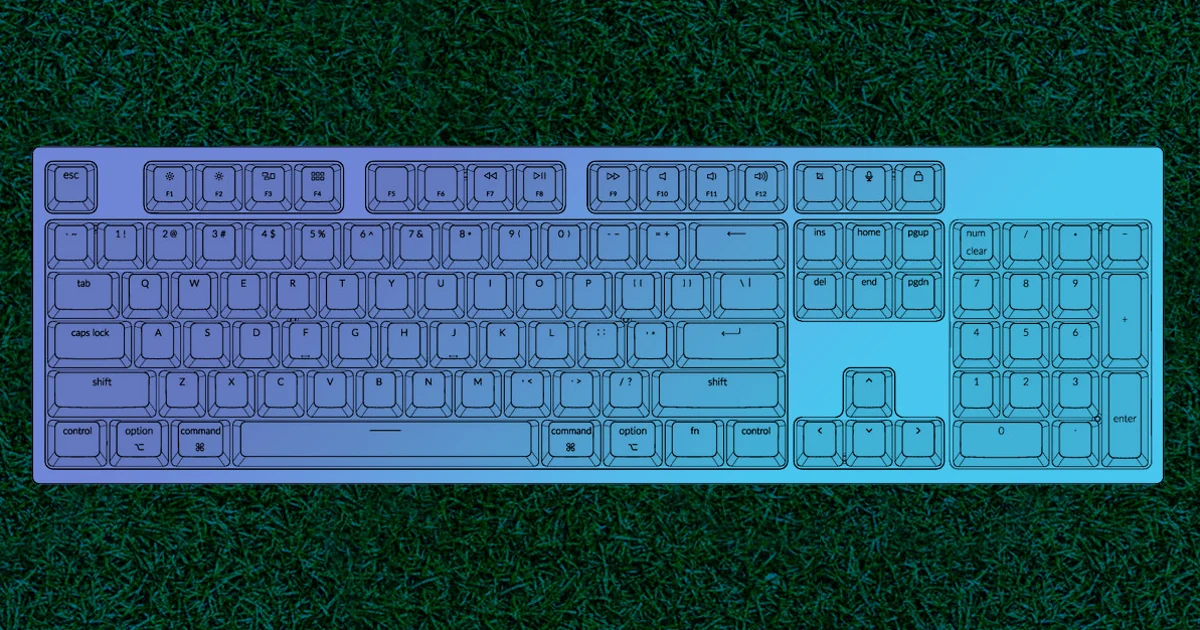
At Digital Foundry, we’ve tested a large number of keyboards, but my most recent head-to-head came up short in one respect: there wasn’t a full-size model in the mix. With that gap in mind, we’re happy to publish this new 100 percent full-size review roundup.
Here, you’ll find four recently released keyboards from Satechi, Ducky, Cherry, and Razer. Each one includes a num pad, making them well suited to data entry, games with heavy control requirements, and other scenarios highlighted by Eurogamer readers that call for a full-size layout.
Take your time with the compilation—you can read it in order, or use the quick links below to jump straight to the review that matters most to you. If you’d like to discover more numpad-equipped options, don’t miss our guide to the best full-size mechanical keyboards.
Satechi Slim SM3 review: Saving money versus Logitech, without a big drop in quality

Purchase:
In our roundup of the top keyboards for Mac and iPad, one thing quickly becomes clear: true full-size, wireless, mechanical choices are in short supply. The reason is simple—there just aren’t many on the market, largely because Apple stopped bundling mechanical keyboards with Macs back in 1990.
Still, a handful of companies have tried their luck since Apple’s move, and Logitech—arguably—stands out as the most established option. Its MX Mechanical is a full-size board with low-profile switches and all the familiar, useful extras, including its responsive backlighting.
The Satechi Slim SM3 is a further alternative for anyone trying to meet the full-size, wireless, mechanical requirement for use with a Mac. It includes an attractive two-tone grey-and-white design, and the brushed metal top plate gives it a welcome sense of sturdiness. There’s no obvious flex in the deck.
The keycaps are made from ABS, which creates a slightly smoother, deeper feel compared with the PBT caps I’m used to, and they’re also more likely to develop the common—unfortunately unavoidable—problem of keycap shine.
The full-size layout is genuinely practical. You get access to everything, from the number pad to a proper navigation cluster with arrow keys, plus a wide function row running across the top. On this keyboard, you’ll also find Mac-focused controls for backlighting, brightness, media functions, and more, alongside connectivity in the top-right corner.
Inside are 50g Brown low-profile switches, which are similar to the ones found in Logitech’s MX Mechanical. They’re responsive and provide a satisfying tactile bump about halfway through the keypress—great for anyone who types for long stretches. I’ve also been impressed by their consistency and crispness during day-to-day use. The main downside is a metallic ping coming from bigger keys like the space bar, backspace, and enter.
For connection, you can use Bluetooth (two-channel) or the included 2.4GHz receiver. The receiver has its own dedicated spot on the underside of the SM3, complete with two-stage feet. Pairing with my MacBook Pro was easy: turn on Bluetooth, press and hold the button on the keyboard to enable pairing mode, then choose it from the correct menu on my Mac.
The SM3 is also backlit, using a bright white glow that sits nicely beneath the keycaps—handy for getting work done in darker environments. That said, it may reduce battery life, despite the keyboard’s fairly large 2500mAh internal battery.
In most of my testing, I kept the backlight switched off. But once you turn it on, the SM3 probably won’t run for as long. To put it in perspective, the smaller SM1 (effectively the same model, just in a more compact layout) can last up to two months without the backlighting. Switch it on, and you’re down to roughly 16.5 hours.
One more limitation is the absence of software to remap keys, create macros, or tweak the lighting for more advanced effects. Logitech’s approach is stronger here, thanks to features such as Smart Actions. Satechi’s keyboard, meanwhile, is limited to 14 built-in patterns and three brightness levels. It does the job, but it isn’t particularly groundbreaking.
At £120/$119, I’m mostly impressed by the SM3. It delivers the key ingredients you want from an excellent wireless Mac keyboard, while also undercutting the relatively narrow field of competition. It looks good, feels great, and worked smoothly with my Mac during testing. Still, battery performance and the lack of full-featured software could put some people off.
Ducky One X review: A sturdy keyboard, but weighed down by plenty of small irritations
Purchase:
The Ducky One X is an interesting offering. It first appeared at Computex 2024, showcasing Cherry’s newly introduced MX Multipoint switches (courtesy of PC Gamer). After that debut, this Ducky model went through a number of delays and embargo changes before it was finally unveiled at the close of the year.
Strangely enough, every MX Multipoint model is gone, and the One X is now right in front of me, sporting Ducky’s own switches made entirely in-house. Still, regardless of the run, there’s one key difference between the switches inside this board and many of the other rapid trigger keyboards we’ve come across.
The One X uses Ducky’s custom analog switches, which are inductive rather than Hall effect. The benefit of this approach is efficiency. Supposedly, inductive switches can match Hall effect in terms of power and performance while using only a fraction of the energy. In practice, that should help reduce the problem where wireless Hall effect switches sometimes end up with disappointing battery life.
I’ll get to battery life in a moment, but overall, what I’m looking at feels like a very typical Ducky product. In fact, you could reasonably imagine using it as a tool of force, thanks to the careful finishing and solid build. The One X’s frame feels sturdy and reassuringly heavy at 1.6kg, though it can show a bit of flex if you push hard enough.
Even so, it includes a full set of keys: a proper function row, a navigation section, and a numeric keypad, with the multimedia controls placed above the number pad in the upper-right area. The keycaps are made from textured PBT, which delivers a great touch, and the lightly shaded peach accent on the Enter key gives the board a pleasant pop.
These inductive switches behave like efficient linears in everyday use, moving smoothly beneath your fingers thanks to their lubrication. They also produce a satisfying sound profile, helped by multiple internal layers designed to dampen noise.
When it comes to gaming performance—one of the One X’s main selling points—the keyboard supports both rapid trigger and multi-point actuation. With rapid trigger, you can effectively get near-instant keypresses by setting the activation point as high as possible. In my Counter Strike 2 tests, the default 0.6mm actuation distance felt nicely responsive, and it can be tuned down to 0.1mm, where it starts to feel almost excessively sensitive.
On the other hand, multi-point actuation means you can map more than one action to a single key, based on how far down you press. For instance, I set the Shift key so it triggers at a deeper point in the stroke—letting me keep it held while walking, then raise it slightly when I wanted to sprint. For this kind of use, it works very well.
Overall, in my testing, the One X came across as a quick, responsive keyboard, with the rapid trigger feature being especially helpful. It felt great in CS2 sessions, particularly in fast draw moments where the speed gained from those higher actuation points really shows.
The real downside of this Ducky board’s gaming features isn’t the speed—it’s how you have to interact with them. Its web-based software only works when the keyboard is connected and accessible via a Chromium-based browser, which means you use it to set up rapid trigger and the keyboard’s lighting. The problem is that the software doesn’t provide particularly clear labeling, so it’s a little awkward to get around at first. If you haven’t tinkered with keyboard software before, it may feel more intimidating than options from Wooting and Endgame Gear.
Out of the box, the RGB lighting is bold, sweeping in wave-like patterns across the One X from left to right. That said, you have to control it through the software, and there’s no way to switch between effects directly from the keyboard itself. Also, you can’t store any onboard profiles on this model.
Connection, though, is excellent: the board supports Bluetooth, 2.4GHz, and wired mode, so you can move between connection types smoothly. Turning back to battery life, I’m sorry to say it doesn’t hold up as well as you’d want—Ducky rates it at about 37 hours with the RGB turned off, and up to 11 hours when it’s on.
Even though the One X is genuinely compelling—thanks to its strong switches and impressive build quality (and to extras like the excellent cable and keyboard brush included in the box)—it’s held back by small annoyances tied to its software and battery performance. Those issues make it harder to confidently recommend it at the steep £180/$179 asking price.
Cherry Xtrfy MX 3.1 Review: New MX2A Switches in a Bright and Shiny Chassis
Buy:
The Cherry Xtrfy MX 3.1 is arguably the most “straightforward” keyboard in this roundup, coming from a well-known name in the mechanical keyboard space—one that’s built a reputation for making “ordinary” feel exceptional across multiple decades. The MX 3.1 continues that approach, delivering practical products that nail the essentials.
In terms of build, it’s a solid chunk of aluminum with no noticeable flex in the deck, and its attractive metallic finish pairs nicely with the white theme of my unit—matching the kind of modern peripherals that look right at home with a white gaming PC, if that’s your setup. There’s also a black version available if you’d rather keep things more discreet. The overall look and feel of the MX 3.1,
With its metal shell and compact full-size form factor, it immediately brings me back to my old MX Board 6.0, a keyboard that sat prominently on my desk for years, and
honestly, that was a full decade ago now.
Elsewhere, you do get practical extras—like built-in lock indicators, basic media controls, and a shortcut key tucked into the top-right corner—along with a removable, braided USB-C to USB-A cable that’s pleasant to use for connectivity. Beyond that, though, the list stays pretty short. The MX 3.1 doesn’t include foldable feet on the bottom; instead, it uses screw-in supports that lift the keyboard’s angle while providing no other adjustment options. It feels like a miss, and the same goes for the polished-looking ABS keycaps, which will eventually develop shine and start to feel less satisfying under your fingers. PBT keycaps are showing up more and more across a wide range of prices, so their absence is a bit disappointing.
With Cherry’s boards, the brand has traditionally emphasized what’s inside rather than what’s on the outside—largely because of the reputation of its MX switches, for better or worse depending on who you ask. Over the roughly ten years I’ve been immersed in this hobby, I’ve watched mechanical keyboards break into the mainstream, followed by a wave of adoption when people started switching to mechanical mechanisms after Cherry’s MX switch patent expired about eleven years ago. Gateron and Kailh have continued to climb as serious alternatives, and lately we’ve also seen clone makers deliver some genuinely strong switches, especially in products featured in recent reviews. Still, it’s taken them a large chunk of a decade to deliver consistent, uniform actuation and switches that don’t feel like a drenched towel the way they once did. Improvements like better lubrication and more careful attention to details such as acoustics have played a major role in that progress.
As competition in the keyboard market intensified, Cherry recognized that the MX switch might not hold onto the same dominance it once had. That realization has driven a series of tweaks and upgrades designed to bring the switches closer to what many users had turned to as the mechanical keyboard scene took off during the pandemic. Those new switches are called MX2A, first revealed in 2023 and initially appearing in a first-party board, the KC 200 MX, which Will reviewed. They include factory lubrication, a centered spring, and stem ribbing intended to reduce key wobble, along with the brand’s “Hyperglide” tooling for an even smoother feel.
In my MX 3.1 sample, I have the MX2A Silent Reds, though Cherry also offers versions with “standard” Reds and MX2A Browns if you want something more tactile. I’ve used MX Reds in different setups over the years, and these Silent variants are among the better options. The refreshed lubrication cuts down on the roughness that many people disliked, and the damping in these silent switches makes them particularly quiet.
They’re light, linear, and quick to respond for both writing and gaming. Even so, when I’m typing lots of words day to day, I still tend to prefer a slightly heavier and more tactile option. With their lighter 45g actuation point and the smoother feel from the lubrication, I had no trouble using the Silent Reds while playing Counter Strike 2. That said, these switches don’t include the advanced capabilities for rapid triggering and similar features you may find in more gaming-focused alternatives, even if the MX 3.1 is marketed as a “gaming” keyboard thanks to the Xtrfy sub-brand. Overall, I’ve liked the MX2A Silent Reds quite a lot—though if you don’t, you’re out of luck, because the MX 3.1 isn’t hot-swappable.
It’s wired-only for connection, and I saw no problems with the MX 3.1 working properly on both Windows and macOS, even though it isn’t specifically built for the latter. The Cherry Utility software that comes with the keyboard is limited to Windows, but it still delivers the key tools you need: choosing from various RGB lighting patterns for the MX 3.1, along with key remapping and macro programming. It gets the job done, I suppose.
The MX 3.1’s RGB lighting is impressive, strikingly bright and full of color the moment you plug it in. It lights up the entire top set of keycaps, and it also wraps around both sides of the keyboard. There are more elaborate lighting effects available for the main lighting layer inside the Utility software, but it’s still useful that you can control both layers—helping the MX 3.1 maintain its sleek appearance.
On the pricing front, the MX 3.1 costs £120/$120, putting it comfortably in the middle of today’s market—where it might once have been seen as a premium option. For that money, you end up with a keyboard that mainly looks and feels excellent, thanks to a stylish, sturdy aluminum chassis and smooth, responsive MX2A switches inside. Still, it’s the small omissions that stop it from truly breaking into “top pick” territory—such as the basic software and the lack of certain enthusiast-level features, including hot-swappable switches and PBT keycaps, which some rival models include. If those features matter to you, you may want to look at the more compact layout KW 300 MX.
Razer BlackWidow V4 Pro review: Minor but significant upgrades make it a contender
Purchase:
As the saying goes, the only things you can truly count on in life are death, taxes, and the Razer BlackWidow. That’s how I remember the line. Razer’s BlackWidow has long been a cornerstone in the gaming keyboard world, first arriving in 2010, right when mechanical keyboards started breaking into the mainstream. Honestly, that
makes me feel a bit older than I’d like.
While this keyboard has seen challengers rise and fade away, the field of top-end gaming keyboards has continued its steady, incremental move forward—bringing new improvements like faster, more configurable switches, SOCD technology, and more. The newest BlackWidow V4 Pro aims to prove that Razer’s experience isn’t stuck in the past, and that it can still keep pace with fresh arrivals from brands such as Wooting and Keychron.
Compared with the earlier version, it adds a handful of small yet meaningful upgrades, resulting in a more well-rounded package. Notably, it includes dedicated macro keys on the left side—still a rare choice at any price—and a dedicated volume dial that complements the already intuitive multi-function dial and multimedia controls set into the top corners. With these updates, its full-sized layout feels even more capable, and the BlackWidow V4 Pro arguably stands out as one of the more feature-rich options you can buy.
In plain terms, it’s a fairly substantial keyboard, with an appropriate spread of keys and a rigid plastic base that helps reduce bending and flex across the deck. That supports the BlackWidow V4 Pro’s positioning as a more premium option. It also includes a comfortable wrist rest and a thick braided cable with two USB-A connectors: one connects to the keyboard, and the other supplies power to the keyboard’s own USB-A port so you can attach additional devices.
Where the BlackWidow V4 Pro doesn’t stray far from its predecessor is in its textured ABS keycaps, which look and feel satisfyingly finished. Even so, paying this higher price for ABS is a little disappointing, especially since it doesn’t match the durability and wear resistance of the increasingly popular PBT you’ll find on many competing models.
Switch choices are the same as the V3 Pro: Razer’s signature clicky Green switches, tactile Oranges, or the quieter linear Yellows. My sample used the Yellows, and I found them to be fairly subdued while still offering a smooth, linear feel that works well for both writing and gaming. Over the past couple of weeks, I’ve put them through everyday tasks as well as downtime sessions playing Counter-Strike 2, and they felt responsive. If you want additional confirmation, these switches have also earned strong marks in the keyboard’s smaller sibling—the BlackWidow V3 Hyperspeed. I’ve also used Razer Greens for years; they’re delightfully loud and tactile, but they suit typing more than they do gaming.
That said, if you’re chasing the highest possible gaming performance, the Yellows or Greens won’t be the best fit. In that case, you’ll want to consider more “non-standard” switches—whether optical or hall effect—so you can take advantage of faster actuation through rapid trigger support. Those switches move noticeably quicker than the standard options inside the BlackWidow V4 Pro, and you’ll see them featured in the rapid-trigger boards we’ve reviewed most, including Razer’s own Huntsman V3 Pro TKL.
To further sharpen its gaming focus, Razer has added an 8000Hz polling rate to the BlackWidow V4 Pro, stepping up from the more common 1000Hz seen on the older V3 Pro. In theory, this allows for more accurate and responsive inputs because the keyboard sends your actions to the PC at a much higher frequency (which is why the spec is measured in Hz). During my time with Counter-Strike 2, I may not always spot the difference myself, but this is the kind of improvement that professional players would likely take advantage of.
As for lighting, you get per-key RGB along with a gentle underglow near the lower edge of the BlackWidow V4 Pro—an addition introduced with this version. Staying true to Razer’s usual design language, it looks sleek and polished, especially if you like that aesthetic. You can also tailor it through Razer’s Synapse 4 software using presets and custom modes, including the ability to reassign keys, set up macros, and turn on the SOCD-style Snap Tap option for extremely fast movements or actions in games like CS2, as long as you play in singleplayer mode.
Ultimately, everything comes back to the price. At £230/$230, it feels quite pricey for what is essentially a more “traditional” gaming keyboard—especially when it doesn’t quite reach the higher levels of quality or performance we’ve started expecting from competitors. Many of those rivals bring more enthusiast-grade features and better finishing. Still, the BlackWidow V4 Pro remains a strong keyboard: it brings back certain features we haven’t seen in a while, and it serves as a reminder that a large, good-looking plastic slab can absolutely have a place in the market.
So there you have it—four reviews of practical full-size keyboards that I’ve had the chance to test over the past few weeks. If you’d like to suggest any other products for Will or me to try, feel free to share them in the comments below. You can also get in touch with me on Twitter @RBithrey or on Bluesky @rbithrey.bsky.social.