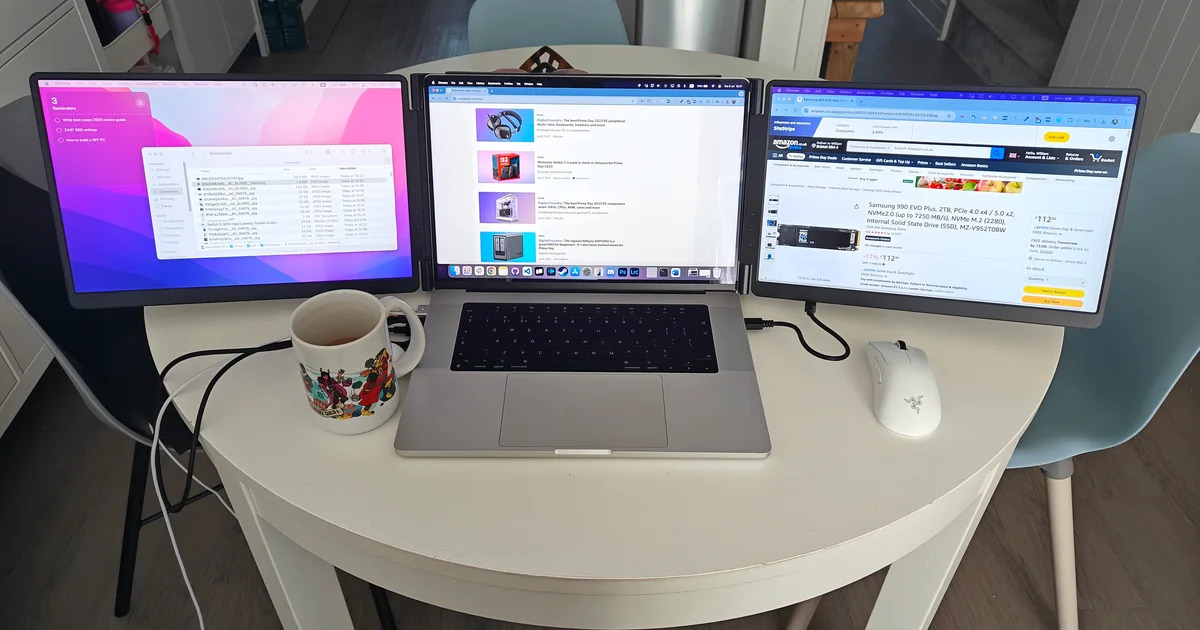
I’ll always have CES 2017 in my mind. The year before, shortly before I joined Digital Foundry, Razer turned heads with a three-screen gaming laptop concept called Project Valerie. Jump ahead eight years, and I’m using a remarkably similar setup to run Eurogamer’s Prime Day deals coverage—and it’s every bit as fun and effective as I expected back then.
This is the Monduo Pro Duo 16, a £600 add-on that clips onto 16-inch laptops such as the MacBook Pro 16, bringing two extra 16-inch displays—one positioned on each side of your main screen. Digital Foundry has looked at portable monitors for years, but Monduo has clearly made meaningful progress here. You get a foldable design that slips into a typical mid-sized backpack, a flexible frame that works across different laptop dimensions, and specs that are genuinely impressive.
Let’s start with those details. Each of the two panels is 16 inches with a 2560×1600 resolution, a 16:10 aspect ratio, and a 144Hz refresh rate—though my 2021-era MBP appears to cap that at a still perfectly respectable 120Hz. You connect everything through USB-C, and the box includes two USB-C to USB-C cables. It also provides two extra Mini HDMI cables for older devices that can’t handle both power and video over a single connection.

The end result isn’t quite as seamless as that Razer display, with visible cables between each screen and the side of the MacBook, but it still frees up a USB-C port for me to plug in a mouse. And just to be clear, we’re not chasing 4K here either; after all, this MacBook generation wouldn’t let you run a pair of 4K displays above 60Hz. Even so, the overall feel is polished enough to justify both the effort and the price. These are IPS panels, so you get wide viewing angles and accurate color rendering—just not quite matching the MacBook Pro—and the 120Hz refresh rate helps everything feel smooth and responsive.
The biggest drawback I’ve noticed so far comes down to power consumption. The typically excellent MacBook Pro dropped to under 10% charge after just a few hours, rather than comfortably lasting a full day the way it would when using only the main display. That test was with two 16-inch screens running at maximum resolution, refresh rate, and brightness, so where you use this setup will likely be a place where you can plug into mains power.
You’ll also want to remember to remove the Monduo before storing your laptop, since it adds a noticeable amount of load to the MacBook’s hinge—even with the small support strut at the bottom. Still, I found it straightforward to attach and detach, and it takes only a few minutes each time; with a bit of practice, it should be even faster. The screens fold down into the unit for protection, and each display includes a cloth, so you should feel reasonably confident slipping the whole thing into a backpack.
I haven’t yet been able to run my usual set of benchmarks on these displays for response time, color accuracy, or gamut. Monduo does state a 95% coverage of the demanding DCI P3 color standard, and from what I can tell by eye, the output looks very consistent with the MacBook’s built-in screen.
I also still need to dig deeper into the Monduo app, which says it can sync brightness between the secondary displays and the primary one. That feature seems to work reliably enough, though I’m not sure I’d rather fine-tune brightness manually using the touch-sensitive controls on the inner edge of each screen—these provide access to a standard monitor-style OSD.
All the same, after a few days of real use, it’s left a strong first impression—and it genuinely feels like the nearest you can get to that groundbreaking Razer idea, all these years later.
If you’ve read this far, what would you like to know about the Monduo 16? What do you think I should test next? Leave your thoughts in the comments below.