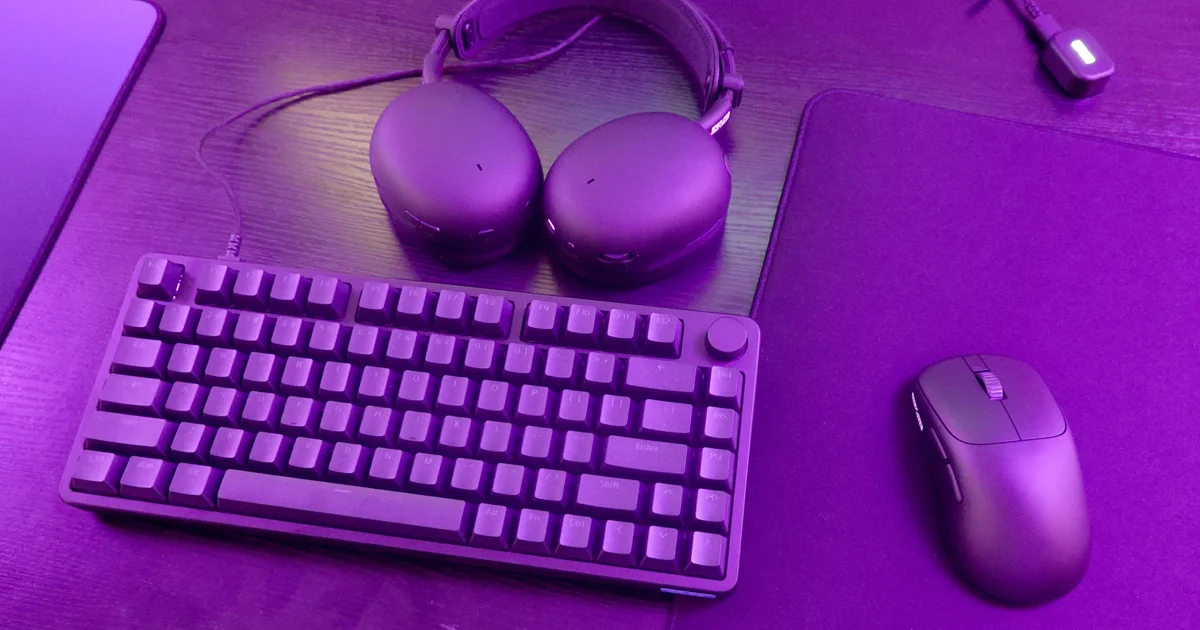
At an unusually hot event held next to Gamescom on Tuesday evening, Sony unveiled a handful of real upgrades for its Inzone line of gaming gear. This gaming sub-brand launched in 2022 with a lineup of smart-looking gaming headsets, before expanding into gaming monitors such as the 2024 Inzone M10 S and M9 2. Sony’s Gamescom 2025 announcements go even further, introducing a full set of PC accessories. Highlights include a flagship gaming headset featuring ANC, along with the company’s first keyboard, a mouse, a wired in-ear headset, and one or more mouse pads.
Sony describes its direction for the Inzone range as being “crafted to conquer”—meaning premium, high-performance equipment designed for serious competitive PC players who are willing to invest heavily in their setups to gain an edge. Sony representatives also said they drew inspiration from, tested with, and collaborated with the UK esports organisation Fnatic. That’s an interesting development, especially since Fnatic previously produced its own branded accessories some years back—items like keyboards, headsets, and mice, which we still recommend.
For this latest Inzone refresh, Sony drops both Fnatic’s distinctive orange glow and the bright PS5-style white from the first Inzone generation. Instead, the lineup adopts a cooler matte black finish—though it can look slightly purple in our on-site images, likely due to Sony’s continued fondness for RGB-lit screens. The result is a sharper, more aggressive look that fits naturally into a modern battlestation, particularly when paired with the Inzone M10 S monitors used on the demo stands. Some products are also offered in white, but they weren’t shown there. Overall, the focus appears to be on performance, and it seems Sony has packed these models with higher-end components and features to match their equally premium price tags.
Sony Inzone H9 2

The first announcement is the updated Inzone H9 2, the second-generation version of the flagship Inzone headset. It brings a number of meaningful refinements aimed at meeting the needs of professional players, while also being built for everyday flexibility—an evolution that began with SteelSeries’ Arctis Nova Pro Wireless, and has since been echoed by flagship offerings from brands such as Razer and Alienware.
The most noticeable change is that it’s now around 70g lighter than the original, landing at 260g. During my time at the event, I noticed the comfort straight away thanks to the reduced weight, plus a newly reshaped headband informed by Fnatic. This design uses more of a suspension approach, similar to SteelSeries and other comparable brands. Sony has also moved to a spring-hinge setup, taking cues from Fnatic’s input, to make adjustments easier. First impressions are positive, though only longer play sessions will confirm whether comfort holds up over extended periods.
Fnatic also helped shape the headset’s onboard controls and their layout, creating a balanced mix of buttons and wheels for volume, media playback, and managing active noise cancellation. These headphones do include ANC, and given Sony’s track record, I went in with high expectations. The lively testing environment seemed like a good place to judge it, and in most cases it successfully reduced a large portion of surrounding noise—though higher-pitched sounds weren’t handled quite as effectively. There’s also an Ambient mode for situations where you need to stay aware of your surroundings, but I found it a bit artificial compared with a more natural sound. As with anything new, this is only an initial takeaway, and I’ll be able to assess it more accurately after longer use.
On the audio side, the drivers are updated too. The second-gen H9 uses the same 30mm carbon composite drivers that Sony has also included in its WH-1000XM6 flagship noise-canceling headphones. Sony says these drivers provide crisp detail, strong punch, and a natural overall character. From my brief time in Counter-Strike 2 and Apex Legends, they struck me as delivering solid bass weight—especially during grenade explosions and gunfire—while the stereo imaging and ability to show the direction of footsteps and enemy voices were just as impressive.
Other key elements Sony discussed, but that I wasn’t able to test on-site, include a claimed 30 hours of battery life and the idea that a five-minute quick charge should yield an hour of playtime. The headset can also be used while charging, and it supports wireless via 2.4GHz using a receiver, along with Bluetooth LE, plus a 3.5mm jack. Sony didn’t share any finer compatibility details. The microphone uses a detachable boom design, and Sony claims it includes AI noise reduction, along with a very wide bandwidth to capture more nuance. (That said, it didn’t particularly impress in our recent review of the Razer BlackShark V3 Pro.) As expected, there’s also software support through the Inzone Hub app, along with 360 spatial sound.
The overall feature list is clearly impressive, but whether it fully earns the £300/€350 price tag is still up for debate. After all, the premium gaming headset space is notoriously difficult to break into.
Sony Inzone E9
Alongside the H9 2 (and, technically, the older H3 headset in black), Sony also unveiled the E9: a pair of in-ear monitors aimed at delivering accurate audio along with standout passive noise isolation. With these, Sony says comfort and sound quality are the priorities, and it’s positioning the E9 for professional gamers and streamers. As is typical for IEMs, the design wraps over the ear for a secure fit, helping you wear them for longer without the fatigue that often comes with traditional gaming headsets.
Inside, the drivers have been tuned with Fnatic’s input, with an emphasis on clarity, precision, and fine detail for FPS titles. In my sessions with them across a handful of rounds of Counter-Strike 2, I’d say they do meet those expectations. The sound felt especially exact, with strong directional audio and imaging—making it easier to track where footsteps and gunfire are coming from. The audio was crisp, yet still delivered plenty of punch at the same time.
Additionally, while in-ears typically
They aren’t my usual pick over standard over-ear options, but I was genuinely impressed by how comfortable the E9s felt. Once I had them seated over my ears, I barely noticed they were there. Sony throws in two sets of tips: one pair is built to reduce noise, while the other is a “hybrid” style. I can’t say for certain which tips I used, yet the passive noise blocking was among the strongest I’ve tried.
The E9 works only in wired mode, using either a direct 3.5mm cable or a USB-C adapter. The “audio box” handles software-based customization, including multiple presets, an adjustable EQ, and spatial audio. The package also includes a tournament case to help keep everything neatly stored.
At £130/€150, the E9 is a compelling option for anyone specifically after a fully wired, accurate in-ear monitor-style experience—particularly because not many alternatives offer something comparable.
Sony Inzone KBD-H75
Moving away from Sony’s typical lineup, the company’s first gaming keyboard is here: the aptly named Inzone KBD-H75. Its specs indicate that they’ve pulled together many of the popular elements you’d expect from high-end gaming keyboards heading into 2025, including magnetic switches with fast actuation, an 8000Hz wired polling rate, a compact form factor, an aluminum chassis, gasket mounting, and more.
It’s fair to say the lineup isn’t entirely original—we’ve already seen comparable approaches from companies such as Razer and Wooting. Even so, it’s encouraging to watch Sony move into this space with a product that could be competitive right from the start.
After a first look, there’s plenty to like, alongside a few drawbacks. The upper case is made from aluminum for durability (and I didn’t notice any bending or flex in the deck), but the keyboard itself felt a touch lighter than I expected. The keycaps are PBT, which should hold up well over time, and they also have a nice texture that improves grip while typing.
The 75 percent layout—essentially a compact tenkeyless design—signals a Fnatic-style focus on saving desk space without cutting key features. A volume dial sits right up in the upper-right corner for easy access.
Inside is where it starts to get really interesting, since magnetic switches with rapid triggering feels like a foregone conclusion. I asked a Sony representative what switch type is used, and they confirmed they’re pre-lubricated Gateron KS20 HE magnetic switches. Sony also says the keyboard is technically hot-swappable, though removing and installing switches would void the warranty.
Those pre-lubricated switches provide a smooth, satisfying key feel, and the internal gasket mounting adds a slightly bouncier, more responsive sensation. Key travel is also reduced to 3.4mm, instead of the more common 4mm you typically get with traditional mechanical switches—something that can translate to faster performance.
That speed is supported by the rapid-trigger system, which allows near-instant inputs by letting you adjust both the actuation and reset points for each switch. If you want to, you can set the actuation range from 0.1mm up to 3.4mm through the software. I tested the keyboard at first with this disabled, then turned it on for movement during an Apex Legends demo in the Inzone Hub software. Setup was straightforward, though the software itself is fairly limited beyond RGB control and button remapping.
One notable omission on the KBD-H75 is SOCD (Simultaneous Opponent Control Device) technology—sometimes referred to as “Snap Tap” on products from Razer, Wooting, and SteelSeries. That feature is designed to enable exceptionally quick lateral moves, and it has been connected to bans in games like Counter-Strike 2. According to a conversation with Sony, they chose not to include this technology, though they noted it could potentially be added in a later software update.
The Inzone KBD-H75 is due to launch at £250/€300, with the ANSI US layout initially available as shown, and additional layout versions for the UK, France, Germany, and Pan-Nordic regions planned for Spring 2026.
Sony Inzone Mouse A
Just when I thought I’d seen everything, Sony also unveiled Inzone’s first gaming mouse—the Inzone Mouse A. This model marks their entry into the fast-growing category of ultra-light gaming mice, matching the direction many competitive and casual players have been heading toward.
The headline feature is its exceptionally low weight of 48.4g, which is genuinely impressive, and Sony even suggested it might have weighed even less. For comparison, the newly released Razer DeathAdder V4 Pro comes in at roughly 57g, while the Logitech G Pro X Superlight 2 Dex is a bit heavier at 60g. In my hands, the mouse felt extremely light, and even though it’s light, the plastic quality still gives a solid, premium impression.
There aren’t many onboard controls or extra buttons, and instead Sony uses a more contoured shape that comfortably supports my standard palm grip. The mouse’s front edge is also positioned low against
designed to enhance grip. Its lightweight build and overall form are the outcome of a partnership with Fnatic, which contributed heavily to how it feels in hand.
It comes with a custom PixArt PAW 3950IZ sensor. Sony says this setup lets the mouse hit an impressive 30,000 DPI, though most players will probably rely on much smaller values, or fine-tune their in-game sensitivity to match. From my own use, I landed on 1600 DPI to improve accuracy in both Apex Legends and Counter-Strike 2. It also supports an 8000Hz wireless polling rate, using a wireless receiver-in-cable design akin to the DeathAdder V4 Pro (it can be used wired as well). On top of that, there are internal optical switches aimed at delivering fast, responsive performance. Out of everything that’s been shown so far, this is the product I’m most excited about.
It seems the Inzone Mouse A doesn’t offer Bluetooth support, and the battery is rated for up to 90 hours—putting it in the same competitive range as major alternatives. I can’t say exactly how the polling rate affects battery longevity, but I do expect a noticeable drop if you push it. Customization is handled through the Inzone Hub, which feels a bit basic at first glance. It still provides the essentials, including DPI and polling-rate adjustments, plus options for mapping buttons.
When it comes to cost, the Inzone Mouse A looks like the strongest-value item across the range at £150/€180, which sits close to what Razer and Logitech offer. That said, the included mousepads don’t carry the same level of pricing competitiveness. The £90/€100 Inzone Mat F is aimed at precision-focused tactical FPS games such as Valorant and CS2. It features a 6mm thickness, well-made stitching, and a non-slip underside. By comparison, the £50/€60 Inzone Mat D is built for battle royale shooters like Fortnite, emphasizing quicker movement with a slimmer 4mm profile, while still including premium stitching and a rubberized anti-slip base.
And that’s the rundown—Sony’s new Inzone peripheral lineup, which has genuinely impressed me during my brief hands-on session so far. If they keep their momentum and make smart choices, it could turn into one of the most remarkable launches in recent times once the range goes on sale in September.