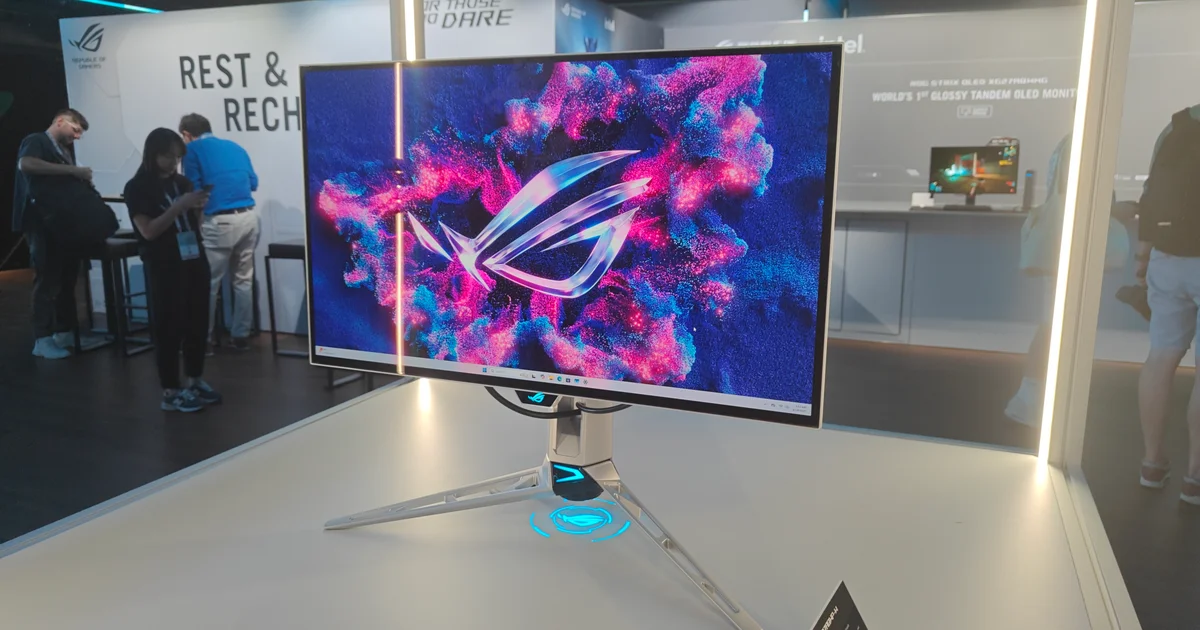
Asus has just introduced two brand-new tandem OLED monitors at an event running alongside Gamescom 2025, featuring a standout model that can reach an astonishing 720Hz (!)—but only at a reduced 720p resolution. Alternatively, it can deliver an equally impressive 540Hz while using its normal 1440p resolution. For display fans, the long-held goal of 1000Hz OLED has been the ambition, and in that sense, we’re now meaningfully closer to making it real.
The tandem W-OLED panels used in both the flagship PG27AQWP-W and the more budget-friendly XG27AQWMG are also worth highlighting. Asus claims they bring a 15 percent jump in brightness—one of OLED’s persistent weak spots—plus a 25 percent wider color range and a 60 percent longer operating lifetime versus earlier W-OLED iterations. The company attributes this to lower power requirements.
I had the chance to try both screens directly—well, “by sight,” more accurately—and I was genuinely impressed. The improvements in color range and brightness are tricky to assess in the intense lighting of an expo hall—that’s also why we follow up with a colorimeter for our reviews!—but the smoothness in motion from these extremely high refresh rates on an OLED panel is obvious right away. In fast titles such as Counter-Strike 2, where players routinely track and aim at rapidly moving targets, the difference shows immediately.

Trying to describe the visual outcome in person takes a bit of effort, but the key takeaway is clear: the motion blur artifacts—often described as overshoot and undershoot—that typically show up with quick-moving scenes are essentially absent at these refresh rates. Everything looks fluid, with far more intermediate frames filling in between updates. Sure, you can find even faster 750Hz TN panel monitors, but LCD-based models don’t match OLED’s quick pixel response times—nor do they come close in terms of color accuracy, contrast, or viewing angles.
Of course, to get anywhere near 720fps in older esports games, you’ll still need a capable gaming PC. For a lucky few, though, that’s a notable milestone. Asus has also equipped these displays with a full 80Gbps DisplayPort connection, so you can use the complete specification without relying on Display Stream Compression (DSC). The cheaper XG27AQWMG is designed to deliver the tandem OLED advantages without calling for an ultra-powerful system, offering a 1440p resolution at 280Hz. That makes it a solid fit for most enthusiasts, and it uses standard HDMI 2.1 with DSC.
Both monitors also add a fresh panel finish Asus calls “trueblack glossy.” The goal is to combine the appealing look of glossy screens while still preserving deep black levels across different ambient lighting conditions. At the show, testing with a phone flashlight showed concentrated reflections rather than the more spread-out reflections typical of matte surfaces. At the same time, darker content still kept a noticeably richer black—quite a long way from the dark purple you see on QD-OLED panels when they’re turned off.
The design on the higher-end PG27AQWP-W is especially eye-catching, thanks to a semi-transparent rear casing that reveals part of the circuitry inside. As someone who grew up with G3 iMacs and a purple translucent Game Boy Color, I’m genuinely drawn to this look. Asus has also skeletonized the monitor’s stand—likely not just for style, but reportedly to reduce the amount of metal used. By contrast, the XG27AQWMG seems more conventional, though it does include a smaller rectangular desk stand that should free up more room for a keyboard and mouse.
A number of extra features round out the package. Alongside the usual lineup of measures intended to reduce burn-in risk, Asus adds a presence sensor that can automatically turn off the display when you step away. “Did I leave my OLED on?” has almost become the modern version of “did I leave the oven on?” for OLED monitor owners. It’s a practical extra option—assuming it dims rather than fully shutting down, so it doesn’t interrupt window layouts or throw off active programs.
Asus didn’t share pricing during the same session as the rest of the specs, but I’d expect the flagship PG27AQWP-W to cost at least £1300. The XG27AQWMG could land closer to £1000, even with its less demanding display and lower-bandwidth ports. OLED monitors are slowly getting more attainable, but tandem OLED technology likely won’t be cheap—at least not in the near future.
On that topic, Asus claimed at the event that it’s the top manufacturer of OLED gaming monitors. Still, the company largely relies on LG and Samsung to produce the actual display panels. As a result, it’s hard to imagine we won’t soon see (possibly cheaper) alternatives from other brands using these same fourth-generation W-OLED panels.
Based on this early look, though, tandem OLED seems just as promising for desktop monitors as it does for the high-end TV space—despite price levels that are just as steep.
Disclosure: Asus covered travel and lodging expenses to Cologne for Gamescom so that we could experience their new products firsthand.