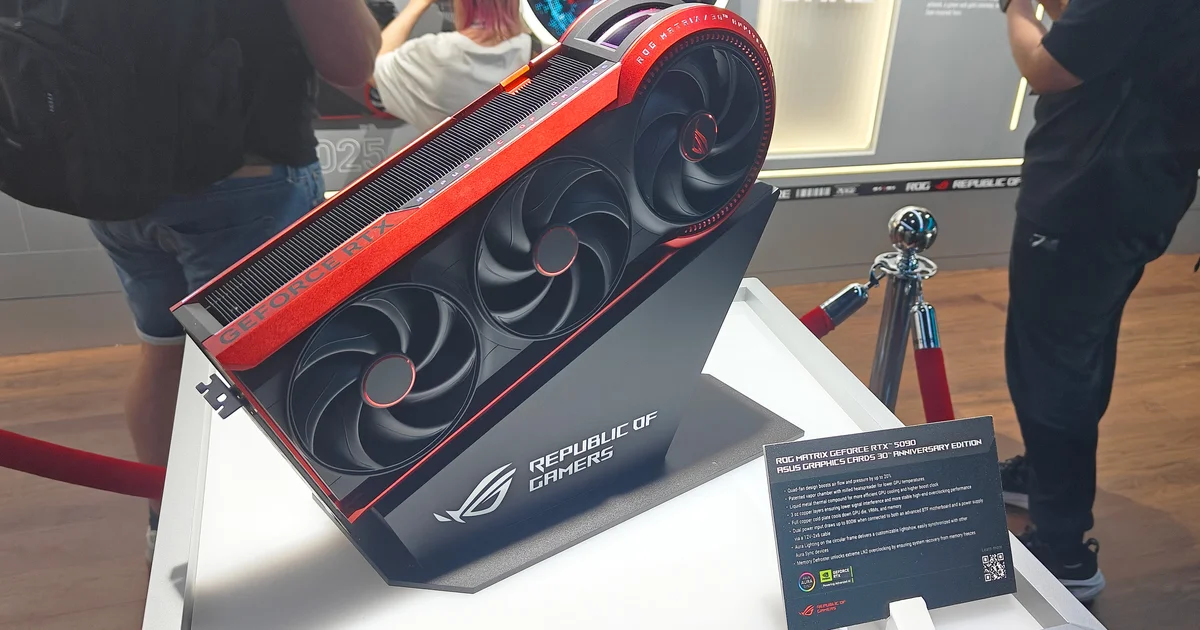
Alongside a transparent 720Hz tandem OLED gaming panel, Asus unveiled a graphics card with a throwback look that can draw as much as 800W—an increase of 200W over the strongest RTX 5090 options and 215W beyond the base model. A single 16-pin power lead is rated for up to 600W, so the ROG Matrix leans on both the proprietary BTF connector built into Asus motherboards and the regular 16-pin power socket. If all of this holds up, it could end up as the most powerful consumer graphics card on the market by a wide margin, and the way Asus has put it together is genuinely interesting.
At its core, Asus wanted to pay tribute to its own design history with a 30th anniversary version that goes beyond the usual “recolor a standard GPU” formula for limited models. That spirit is visible in the distinctive circular frame at the back end, reminiscent of a card Asus released in 2008, yet under the surface it also borrows manufacturing and engineering choices from later generations: 3mm copper PCBs, vapor chamber cooling, liquid metal, four fans, and more.

For the well-heeled, overclocking-focused buyers this limited card is intended for, Asus has gone a step further by placing sensors on each wire of every power connection to make sure none of them is drawing too much power. With an available 800W, this already pushes into territory that a “normal” graphics card rarely reaches.
There’s even a sensor designed to track the card’s tilt, alerting you if it starts to droop. GPU enthusiasts previously spotted this sensor on other high-end Asus models, but now the feature will be surfaced through Asus’ own software.
With power rising by 33 percent, you’d naturally assume performance would rise by about the same amount—correct? RTX 5090 Ti, more or less! But the story isn’t quite that straightforward. Asus says the card delivers roughly 10 percent better frame rates, even when running at a listed boost clock of 2730MHz—against 2407MHz for the standard 5090. It also isn’t clear whether memory clocks receive any meaningful improvements, though the GDDR7 used on Maxwell-based designs generally overclocks fairly readily.
Of course, an 800W rating is far beyond the usual power comfort zone for this generation—and even if power limits were truly unlimited, keeping the GPU die, mini motherboard, and VRAM/power sections properly cooled under an 800W load would still be a major challenge.
That all points to this being near the ceiling of what a true RTX 5090 Ti could realistically deliver, which may be one reason Nvidia hasn’t announced plans for such a model.
The ROG Matrix 5090 disassembled into its components.
Even with a deep wallet, the ROG Matrix 5090 is likely to be extremely difficult to track down. Asus says it will produce only 1000 units, though you can still enter the contest to win one on their Gamescom 2025 page. No pricing has been revealed yet, but it’s probably set well above the mid-four-figure mark, especially since a regular 5090 sells for $2000 or more—even months after launch.
More widely available—and more budget-friendly—are Asus’ special edition 5080 cards. These include a Hatsune Miku model (part of a fairly extensive lineup of branded peripherals and components) and a Noctua edition that comes with the well-known Austrian company’s fans.
Either way, I’m glad the Matrix 5090 exists, pushing technical boundaries to pretty wild heights. I can’t wait to see what overclockers can squeeze out of it—go for the liquid nitrogen!—and the nostalgic design is genuinely compelling. I just hope this GPU doesn’t foreshadow the upcoming arrival of an 800W-rated RTX 6090.
Disclosure: Asus provided flights and accommodations in Cologne for Gamescom.