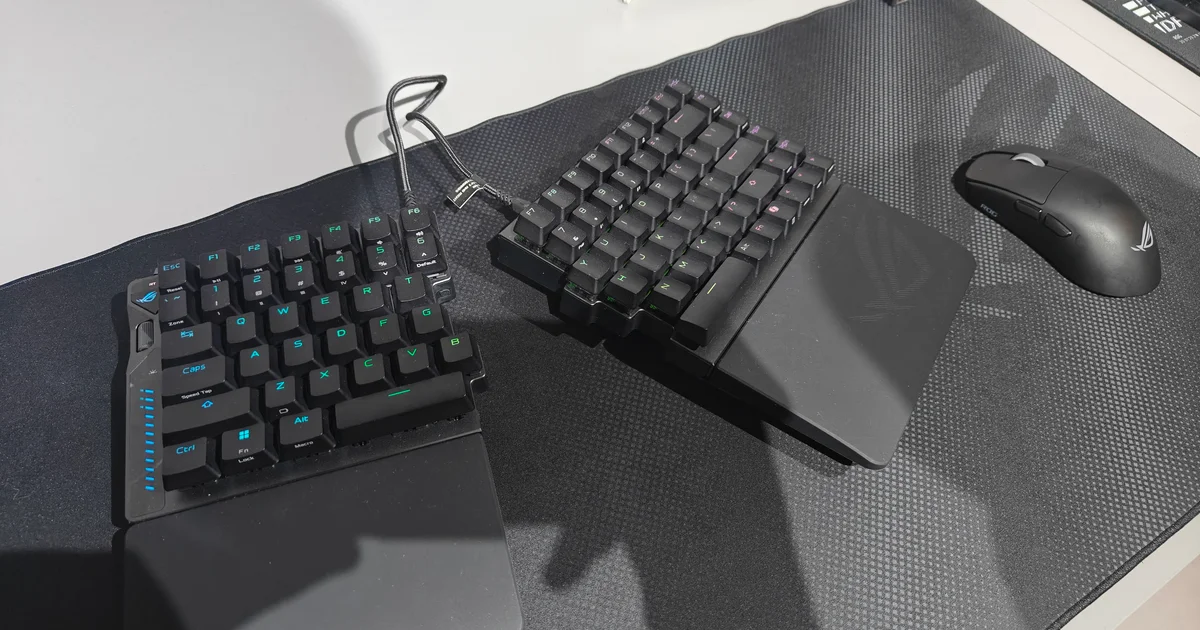
I’d like to highlight my most memorable moment from Gamescom. It isn’t the Xbox Ally X, it isn’t an active sim racing brake pedal, and it isn’t even that 720Hz tandem OLED screen. What caught my attention is a keyboard—an unusually designed one, with a single clear downside. Let me walk you through it.
The Falcata is just another Asus keyboard, and like models such as the Falchion or Claymore, it’s named after a weapon. In this case, the name refers to a sword shaped like a falcon and used in the Iberian Peninsula. I didn’t realize a “falcon” could be translated into a sword silhouette, but here we are. The keyboard itself isn’t actually shaped like a falcon (thankfully); instead, it looks like a fairly standard 75 percent keyboard. Still, it’s a little odd at first glance, especially because there’s a loop of USB cable along the top that links the left half to the right.
That layout makes it possible to pull the keyboard apart into two sections, which opens up some interesting use cases. The left half houses all the internal hardware, so you can run it on its own as a keypad—giving you a surprising amount of mouse space even when your desk is tight. You can also leave the right section attached and spread the halves outward, angling them into a more comfortable typing position. On top of that, there’s a convenient gap created between the two pieces, ideal for setting down a hot cup of tea.

Beyond its split, ergonomic structure, the Falcata feels good to type on. The biggest difference is that it uses four layers of sound-dampening poron and silicone, which softens the keyboard’s noise while delivering a deeper, more satisfying sound profile. It also includes PBT keycaps, which tend to last longer than ABS alternatives and usually have a more pronounced texture, plus removable wrist rests on both sides.
For gaming, the Falcata holds up as well, with a broad set of features aimed at a “best mechanical keyboard 2025” style of experience: magnetic (Hall Effect) switches, rapid trigger (keys register instantly when pressed or released, rather than only responding after passing certain actuation depths), SOCD (simultaneous operation key disablement, handy for side-strafing in FPS titles), and 8000Hz polling (helping reduce battery use to limit input lag). It supports both 2.4GHz and Bluetooth connections, pointing to an integrated battery, and you can even run it in wired mode. In wired and 2.4GHz modes alike, you still get 8000Hz.
Getting your keyboard set up could take anything from a few minutes to a few hours, depending on what you want to do—but you won’t have to install any dedicated software for the Falcata. Instead, you can rely on web-based tools to remap keys, adjust the RGB lighting, or build macros. This is a common direction these days, and since I’m contractually stuck with a large collection of peripheral drivers and programs on my computer, I honestly appreciate having this kind of flexibility.
Now we reach the moment where I may lose the reader who was otherwise interested: the Falcata costs £376 or $420, roughly 50 percent more than I expected. It’s a genuinely steep price, even when you consider the premium specifications and feature set, but ergonomic keyboards like this often come with a hefty markup. The keyboard isn’t available yet, so I’m hoping that price can drop before launch—or that a cheaper wired alternative will show up. Either way, it’s likely we’ll see more budget-minded knockoffs fairly soon. And maybe one of those models will end up as my favorite piece of tech from Gamescom 2026.
Disclosure: Asus covered flights and accommodation to Cologne for Gamescom, so we could try out their latest products first-hand.