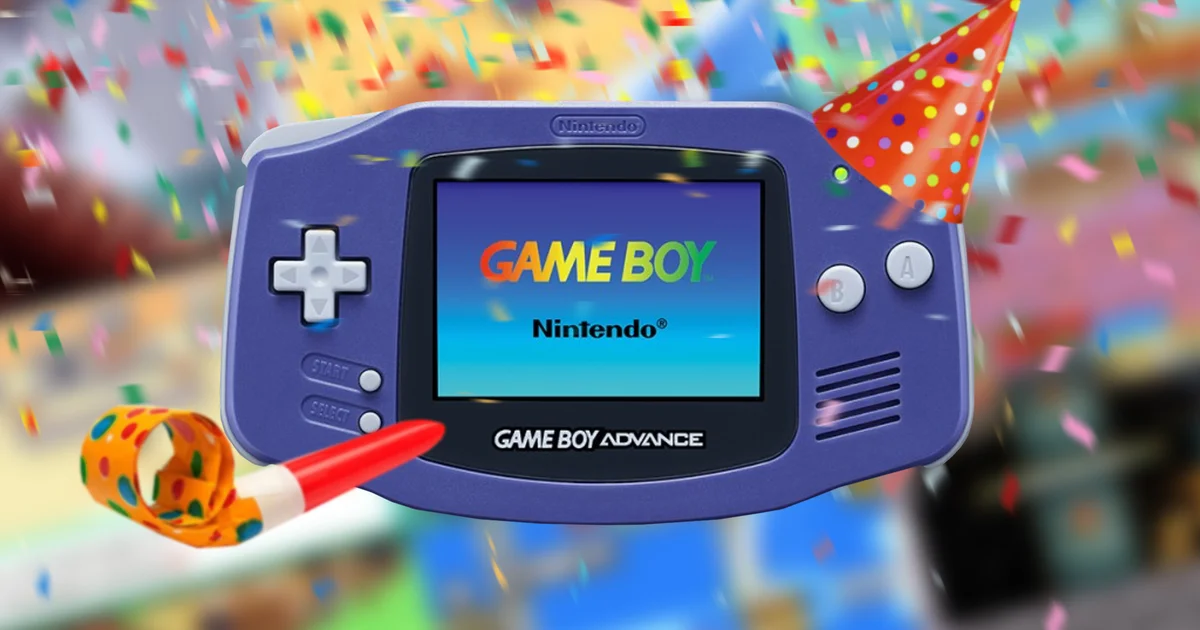
Happy birthday, Game Boy Advance! It’s been 25 years since Nintendo’s handheld range burst onto the scene in lively 16-bit color. Nearly two and a half decades later, and after shifting an impressive 81.5 million units, this pocket-sized system has earned a truly legendary reputation. Its catalog is massive, packed with lots of well-known video game heroes, and it also gave rise to several series that would go on to become just as beloved.
To mark GBA’s 25th anniversary, we’ve taken a trip through a rosy fog of nostalgia to highlight some personal picks that are still easy to find today via Switch’s eShop or Switch Online + Expansion Pack (with the caveat that this is more of a nod to the GBA games we grew up with than a serious attempt at a final, definitive greatest-hits lineup). We’ve also added a few lesser-known favorites that we’d genuinely like to see return and make their way onto Switch. Of course, with a back catalog this rich, it’s inevitable that some entries will slip through the cracks (sorry to Metroid fans!), so why not grab your party hat and share your own GBA memories in the comments below?
Let’s start with the ones you can play on Switch…
The Legend of Zelda: Four Swords (Switch Online)

On the GBA, Four Swords came bundled with A Link to the Past, which made it an easy, sure-to-delight package. Link to the Past is often considered one of the series’ most polished and satisfying Zelda entries—an authentic puzzle-box adventure where two connected maps click together in satisfying, maddening, and surprising ways. It’s genuinely brilliant.
Four Swords does something delightfully different. It turns Zelda into a cooperative experience for as many as four players, leaning mostly into action while still sprinkling in puzzle-solving. The game features randomized dungeons and a range of hurdles, but, as I remember it, the greatest pleasure comes from collecting more rupees than the people you’re teamed up with.
Quick confession: I played Four Swords on GBA just once—during a train trip from London to Brighton—when a couple of friends had GBAs and the right cables to connect everything. Still, that session, neatly packed into a fast 54-minute commute, has stayed with me as one of my all-time favorite gaming memories. It’s great to share a game like that with others, and to lean into the kind of mess and mayhem that always seems to follow Link. Now that it’s on Switch, I should really give it another try—though I suspect it might not feel as magical as I remember it – CD
Castlevania: Circle of the Moon (Switch eShop)
Even though there was plenty of excitement around the GBA’s arrival, one of the most frequent criticisms of the system was its lack of a backlit screen. To me, it was hard to think of any game that showed the trouble caused by that more clearly than the excellent GBA launch title, Castlevania: Circle of the Moon. When I was younger, I thought it was stunning—full of beautifully animated sprites and richly detailed pixel-art backgrounds that made the idea of a “next-gen” handheld feel real, especially after the Game Boy Color. The problem was that in anything like typical lighting, the gameplay became almost impossible to read. (I sometimes wonder whether anyone at Konami actually saw the game running in its real-world conditions before it released—especially since later GBA versions added a noticeable glow around moving elements.)
I’d bet Circle of the Moon sold more of those goofy clip-on front lights than any other launch title. Even though I remember it being pretty awkward to play unless the light was just right, that flaw also created one of my clearest memories from gaming: countless hours sitting on an uncomfortable garden chair, trying to catch as much summer sunlight as possible on the GBA’s tiny display (which conveniently launched in June in Europe), just so I could enjoy Circle of the Moon a bit more. You could argue it isn’t the best Castlevania on the GBA—its successors refined the Metroidvania formula—but as the game that pulled me into the wonderful world of GBA, Circle of the Moon still has a special place in my heart – MW
The Legend of Zelda: Minish Cap (Switch Online)
When Minish Cap finally arrived, Capcom had already proved it knew how to make Zelda games. I still have a soft spot for the Oracle titles on the original Game Boy, so it’s a real treat to be able to experience both of them on Switch now.
That said, Minish Cap feels like a step forward. It leans into the charming, cartoon-like style associated with GameCube’s Wind Waker, and it delivers an adventure that’s just as exciting and genuinely moving as any other Zelda entry. It also smartly uses the classic overworld/world approach. The reason is simple: in Minish Cap, Link can shrink down, becoming a tiny, wobbling cluster of pixels that still looks like the familiar hero in green.
You can also roam the world from Link’s small perspective, and some areas appear in two different ways: the normal presentation, plus a closer, more detailed view that uncovers a whole batch of fresh details. It’s The Legend of Zelda with Hooke’s Micrographia—and honestly, it’s every bit as charming as it sounds.
One more highlight: Minish Cap’s collectibles are some of my all-time favorite items across the entire Zelda series. They show up as stone fragments that you can link together or merge to unlock exciting rewards. I still remember how much I enjoyed them back then, and in my view, they’re far more engaging than Korok seeds – CD
Wario Land 4 (Switch Online)
Be honest: Mario’s time on the GBA felt a bit odd. He wasn’t completely missing, but he also never quite seemed fully “there.” Instead of offering
…their iconic mascot with a proper new platformer on GBA, Nintendo instead chose to reissue four of the plumber’s (undeniably excellent) SNES adventures as part of the Super Mario Advance lineup. Yet even if Mario had landed an all-singing, all-dancing, brand-new adventure on GBA, I honestly think I would still have picked Wario Land 4.
Back then, Wario was deep in his hero phase, and that alone made him a go-to choice for me—his earlier, oddball platform outings on Game Boy and Game Boy Color had already stuck with me. Still, Wario Land 4 felt like a genuine step forward. To start with, it looked stunning: it’s like a cartoon brought to life right on the small screen—and I’ve never forgotten its opening moment as Wario barrels across the desert in his purple Cadillac, chasing ancient treasure. It may not be an especially deep platformer, at least not in my recollection, but it’s wonderfully addictive. I spent ages happily playing beneath the peculiar shadow of that pyramid, grabbing collectibles before scrambling out of each stage once the dramatic mid-level twist arrives. And yes, the soundtrack is wildly offbeat in the best way too—MW
Golden Sun (Switch Online)
Golden Sun is one of those games that doesn’t sit in my head as a tidy sequence of memories so much as a lingering, unmistakable feeling. The plot is mostly a blur, especially with some looming alchemical disaster hanging over everything, but I clearly remember how captivated I was by how much more expressive its tiny characters became. Those little animated speech-bubble emojis popped up over their hands as they talked (I wasn’t particularly taken with RPGs back then, so it may not have been groundbreaking, but it still struck me as a pinch of real magic).
I also remember the Djinn system that, in spirit, felt a bit like Pokémon’s—one that could boost the cheerful cast in all kinds of intriguing ways. Then there’s the smart way Psyenergy magic wasn’t limited to fights, but used for puzzles instead (and if you want a bit of silliness, you can even “read” the thoughts of most NPCs). What stands out most, though, is how light and breezy the whole experience feels. It moves quickly and feels full of energy, yet it’s delivered with a gentleness that sets it apart from many of the grimmer RPGs around it—like an entire universe of charm and curiosity squeezed into a small cartridge. Now that I’m writing this with it sitting readily available on Switch, I’m wondering whether it’s finally worth returning to—MW
Mario & Luigi: Superstar Saga (Switch Online)
This isn’t the first Mario RPG, but if you ask me, it’s the best. It’s basically a comedy-style adventure, with the two Mario brothers teaming up to fix things and requiring you to steer them together as a pair. That means even the simplest move in a Mario game—jumping—ends up needing to be relearned. On top of that, it delivers clever set-pieces like skipping-rope sections and lots of broad, slapstick-style comedy as the brothers constantly tangle with each other.
It’s a story with real substance and genuine laughs, building on the same idea first explored in Super Mario 3 and Super Mario World: the brothers are traveling through a complicated, segmented land with its own distinct regions and traditions. Every time Mario heads somewhere new, he’s asked to show off his signature move for the audience, and the locations themselves are bursting with colour—particularly strong in those pink-and-purple tones.
Plenty of sequels followed, and they’re all good, but none of them—at least for me—come close to this one. And maybe that isn’t entirely fair. The truth is, Superstar Saga is the kind of game I first played during a Christmas break, so it’s stuck in my mind next to tinsel and wrapping paper—CD
Pokémon FireRed and LeafGreen (Switch eShop)
It’s genuinely great that we can get these back again on Switch and Switch 2 at last. Of course, there are a few downsides—something that seems to come with everything, really. You can’t rename your rival to Mr. Arse anymore, and they’re also a bit pricey, since they’re sold separately, especially when you compare them to many of the earlier options included with a Nintendo subscription. Still, these two are among the finest and most important games ever made, reshaped into what feels like the perfect Pokémon version, rendered in vivid 16-bit style. (And yes, even though I’m a big believer in owning physical copies, try finding a physical release for either and then tell me that 17 quid isn’t costly).
The best part—and I mean that sincerely—is that because they were remade so early on in Pokémon’s life, right around the third generation, they kept a lot of those strange little traits from the original. The physical/special split (that was the term) was rolled back, so you’ll need to retrain your muscle memory. Instead of categories, you’re aligning your Pokémon’s stats with attack types. And the version differences are strict: if you play Green and skip choosing Charmander, you’ll be stuck with almost no genuinely useful Fire-types for quite a while. While the later Let’s Go games tried to bring Pokémon to younger players, I don’t think any of them truly captured the same essence as these do. This is Pokémon at its most distilled—at its most awkward, most impressive, and most challenging—CT
And now for the titles we’d love to see return…
WarioWare Twisted!
Twisted might not be the best WarioWare in my books—I could easily argue it’s Touched!, mainly because the Ashley track is so strong—but it’s still my clear favourite. It manages to do everything a WarioWare game should: it chops the action into short, five-second bursts of brilliance, then ties those moments together like you’re flicking through a playful, ludic TikTok.
Sorry for bringing up TikTok. Still, beyond that, Twisted! also shows you a fresh bit of hardware. And that’s a real accomplishment, especially because the game was created for the
GBA. It achieves this by building a substantial gyro sensor right into the cartridge. As a result, WarioWare turns into a game centered on physically rotating the GBA—presenting the concept in clever, unusual ways, from a quirky toilet-paper-roll style riff on Mario 1-1 to prizes that come out like capsule toys from a real dispenser.
The dispenser’s crank handle draws inspiration from the one part of Twisted! I love more than anything—its unmistakable corrugated rumble, built into the gyro sensor. That rumbling has a satisfying feeling of motion up and down. My own unit’s battery gave out a few years back, and I still can’t stop wishing for it!
Twisted! was never released in Europe, and the claim that it was withheld because the cartridge contained mercury appears to be untrue. It’s a real shame that so many people never got the chance to play it.
Spyro: Season of the Ice
Since I’ve talked about Spyro so often, it won’t surprise you that every Spyro title lands among my favorites, yet Season of Ice still stands out as my top pick.
Grendor has trapped fairies inside ice-crystal-like cells, and Spyro’s job is to move through each realm, freeing them with his flames before finally facing their captor. Every area you visit offers its own set of hurdles to overcome.
This was among the first games I ever played, and it also showed me how video games can help create a stronger connection with an older sibling. At the start, it was their game, but as my curiosity grew, they let me hang around—first to watch, then eventually to play alongside them, with their support as I got older.
That single Spyro adventure sparked a bond that still holds to this day. With younger relatives now in the picture, I’d love to see it show up on the Switch 2 so we can share it with them too. And so, to my favorite little purple dragon—thank you for the treasured memories – MP
Pokémon Emerald
After having FireRed and LeafGreen, it feels like the right time for Ruby, Sapphire, and—especially—Emerald to be playable again, not only through the fake copies floating around on eBay, but also through the authentic versions being sold for outrageous amounts.
Emerald was—and for some, still is—the peak of the classic Pokémon formula. It brought a huge number of environmental puzzles and sprawling dungeons, along with plenty of legendary Pokémon, cross-game features, and distinct crossovers. It also introduced the Battle Frontier, which has grown into the most beloved post-game spot for endgame play, plus a range of new breeding mechanics; this era also added elements that became essential later on, including Abilities.
Still, what really defines Emerald is its fantastic run of boss-versus-boss encounters, particularly the Rayquaza-based finale, which felt much grander than that tiny, dim screen could ever suggest. I kept playing these games until the GBA’s little battery indicator flipped red so many times that I’ve truly lost count. I’ll always remember the experience of getting turned around, stuck at points, and watching someone try to explain braille to an 11-year-old – CT
Rhythm Tengoku
Rhythm Tengoku is one of the rare Japan-only titles I’ve ever imported (the other two being Osu! Tatakae! Ouendan and Taiko no Tatsujin with its drum add-on—so you can probably spot the theme), but the instant I saw its trailer, I knew I had to get it.
Rhythm Tengoku captures a similar vibe to WarioWare—if not an exact copy—since it was created by the same inventive team. It sweeps you through a surreal parade of musical mini-game situations, each one presenting its own distinct low-fi visual style. It’s not as frantic as WarioWare (at least until you reach the later MegaMix stages), but it still carries that same unrelenting drive for strange, imaginative ideas, leaning heavily into call-and-response-style challenges.
In essence, as you progress through a level, recurring sounds or musical cues tell you the button-timing pattern to follow. A big part of the fun is how ridiculous it all feels: you might pluck hairs from an onion’s chin, smash baseballs while your bedroom shakes through space like a thunderstorm hits, or steer a line of dancing robots and samurai-sword yokai as they bounce onto the screen. The brilliance is in how each challenge ramps up—adding more elaborate call-outs or even vanishing visual hints that force you to rely on your rhythm instincts, like when your baseball-themed bedroom suddenly gets reduced to the size of a dot.
Today, Rhythm Tengoku is available in the West under the name Rhythm Heaven/Paradise (its sequel received localization on the DS, and they have been localized ever since). While later versions are still enjoyable, I often find them a touch too complex for my tastes, especially with additions like stylus taps. I’d love to see this excellent original GBA game finally get its chance in the spotlight on the Switch – MW
Drill Dozer
Drill Dozer is a 2D action-platformer made by Game Freak. It’s also one of my absolute favorite finds: a strange, faceted cartridge in deep red that sticks out just a bit from the GBA slot once you insert it.
The reason is that the cartridge includes its own rumble hardware, which makes it one of only two GBA games to use this feature—the other being WarioWare Twisted! Here, the vibration is used brilliantly to support the gameplay as you steer a mech armed with a drill bit capable of chewing through walls. Getting through walls is always enjoyable, but Drill Dozer really shines in delivering every shake and tremor. It’s an enchanting example of tech done right.
The game itself is enjoyable, of course, but for me it was really all about the cartridge—plus maybe the fact that the on-screen UI is bigger than it needs to be. “Unnecessary” is the best word, even though Drill Dozer can start to feel less like a straightforward game and more like a machine you’re learning how to operate, and the UI likely plays into that. These days, I find myself wanting to return to it again – CD