Warframe’s upcoming update, The Shadowgrapher, is getting close to launch. As the sci-fi MMO takes a different direction, players will soon have to slip through tight corridors and shadowy routes in its first horror-focused game mode. Still, the real question remains: how do you make an experience built around bullet jumping and space ninjas feel genuinely terrifying?
As you might expect, the answer didn’t come easily. In a conversation with Eurogamer, design director Pablo Alonso and community and live ops director Megan Everett explained that the mode went through major changes—from an early Gary’s Mod-style Prop Hunt inspiration to the suspenseful version fans see now.
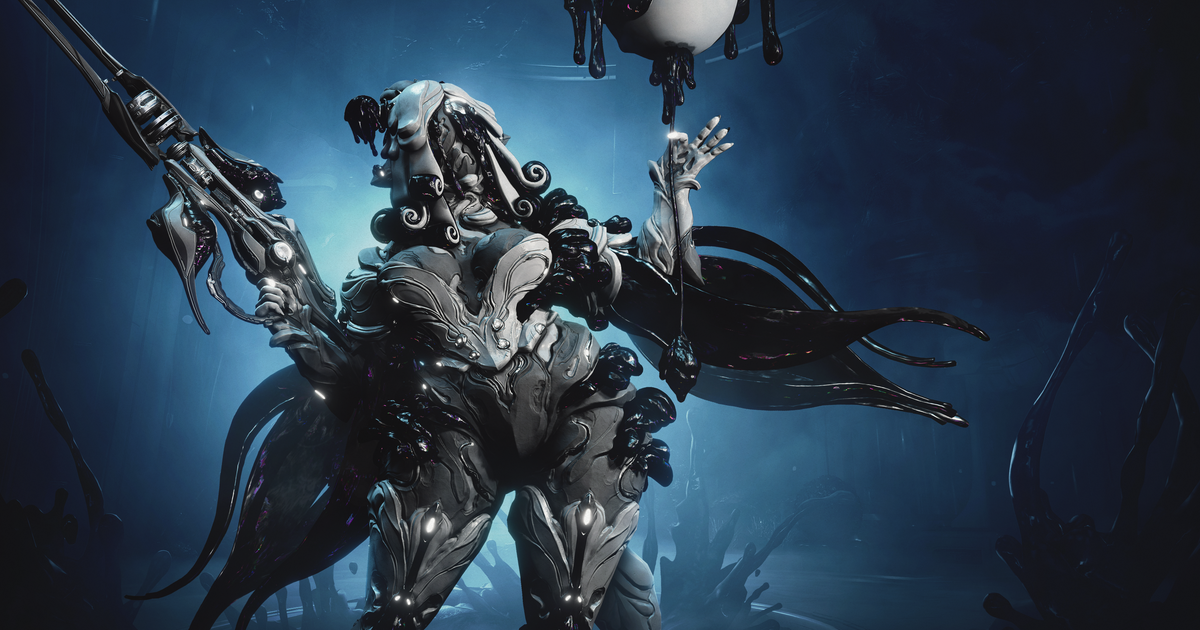
Named Follie’s Hunt, the mode started out in a way that felt familiar for Warframe updates—beginning with the warframe itself. Artist Michael Skyers created Follie years earlier, and that character became the backbone of the entire update’s direction.
“The design was always in black and white, featuring the balloon and the eerie clown aesthetic,” Alonso noted. “So we concluded we should lean into that unsettling atmosphere, which pushed us toward a horror mindset.” This warframe—rendered as a monochrome figure that moves through paintings while pouring thick black paint—needed an appropriate setting. While the Solar system is now crowded, several less-than-ideal areas still matched her mood surprisingly well.
“At first, we considered placing it in the haunted relay, and from there we saw that we’d need slimmer hallways, plus a more open central area,” Alonso explained. The relays were destroyed between 2014 and 2015, leaving behind broken pieces of those former player hubs scattered across the in-game galaxy. If you weren’t around during that time, they’ve essentially become odd reminders of events that have long since passed. Follie’s requirement for a home gave the team a way to “connect them to these historical occurrences.” Alonso also added, “it really fit the update’s themes, since many people died there. So there’s significance behind it.”
At this point, you have the warframe and the location. After that, the game mode still needed to be built. That’s where Prop Hunt comes in—it was the initial foundation for The Shadowgrapher update. As Alonso described to Eurogamer: “One player would play as Follie, while everyone else would hide nearby. You’d become a barrel or something along those lines. We enjoyed it because it was a playful, completely different way to do it. But once the artwork started rolling in, it became clear we required something more unsettling than Prop Hunt on its own could deliver.”

One of the defining traits of Warframe is repetition—the ability to replay missions to earn warframes and weapons without burning out. That same principle created a serious problem for the early Prop Hunt approach, since the team found it stopped feeling compelling surprisingly quickly. Because of that, Follie—controlled by players—was replaced with regular AI-controlled threats that hunt players instead. This change meant they wouldn’t need to “dampen” player abilities the way they’d originally planned. Players work together to gather paint and deliver it to a canvas, all while an unstoppable killer clown relentlessly gives chase.
Yet that decision brought up a new challenge. Warframe doesn’t naturally come across as scary. Part of it is that you’re playing as a space ninja with all kinds of abilities and a huge toolkit, so you typically don’t feel especially fragile (outside of a few narrative moments). When you’re landing brutal critical hits and sprinting at full speed, it’s hard for fear to take hold.
With that in mind, the team tried ways to tone down player power and bring more dread into the experience. The first attempt failed completely: “our initial try didn’t work at all,” Alonso said. “When you picked up the paint your warframe held it, but if you jumped or sprinted you started dropping paint. We were trying to get players to slow down, but muscle memory would take over. They’d reach the painting and think, ‘where did all my paint go?’
“Then we moved to stopping players from jumping and sprinting, and that felt awful. In the end, the approach that worked was asking players to pick up the paint as the operator; the operator already moves at a slower pace and has limitations on their abilities. We found that this made you a bit more vulnerable, while still leaving you some control over what happens.
“Even so, we still ran into problems, because players would see Follie and rush straight at her. That still happens—new players who are used to charging enemies will do that and meet their end. But after a few tries, they figure out what’s going on and adapt.”
After plenty of back-and-forth testing, they finally landed on a setup that delivers the kind of intimidation they were after. As Everett puts it: “This is the first time an enemy chasing you is completely invincible. The objective is to avoid running into her (laugh). But as time goes on, she becomes faster and stronger, which ramps up the fear. It’s different from the usual rhythm of Warframe missions—where you can take out opponents and earn rewards for doing so—because it also brings a deeper sense of vulnerability. It’s an interesting twist.
“We understand what our players love: the excitement of bullet jumping. After 15 years, we know what our players dislike, and we obviously need to dial that back a bit before reaching the point of ‘I don’t want to play this game mode.’ But we still have to keep introducing something fresh as we move forward. Realistically, Follie’s game mode might not resonate with everyone, but it will be there for players who are hungry for new experiences.”
Given all of this, why does it matter to try unconventional ideas like Follie’s Hunt in a long-running title such as Warframe? I’m guessing that if it had been introduced alongside a visually distinct take on a familiar mode—like defense or extermination—many players would have been fine with it. Pablo, though, believes variety isn’t only a perk; it’s also part of why live service games like Warframe stay interesting for both players and developers.
“As game developers, it’s difficult to keep building the same experiences over all these years. So we have to make sure things stay fresh to keep our energy up. And we know that if we’re excited to work on it, players will be eager to jump in as well. That’s how we see it working, and in general, for any project, I try to bring in people who genuinely care about whatever that key element might be.”