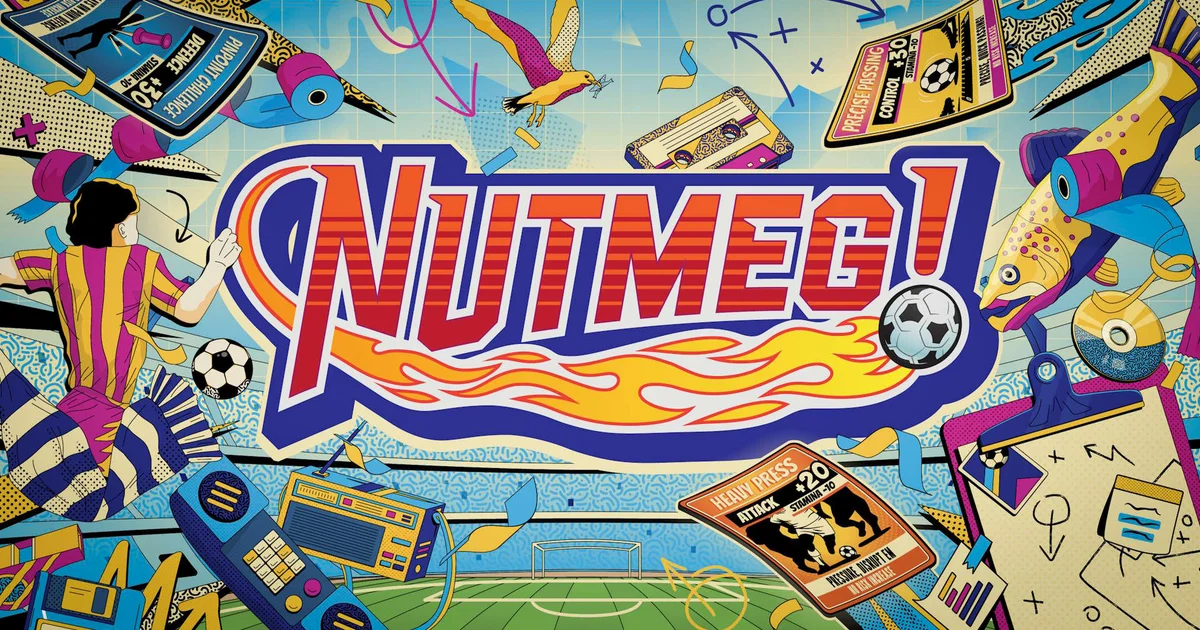
I haven’t tried a football card title quite like this before. I don’t recall ever getting into a game that works in quite this way. It’s genuinely refreshing to see a football card game that isn’t dragged into the chaos of penalty-box-style microtransactions, names left unmentioned. There’s no veiled gambling taking place, and you won’t find the relentless corporate money-grabbing that so often shows up in today’s football. Instead, you’re greeted by the scuffed pages of a 1980s Panini football sticker set, fluttering through the air like a reminder of simpler days.
Nutmeg is, first and foremost, a card game—meaning you’re not stepping into live match action the way you would in a football title like International Superstar Soccer (I’m leaning on some old references today). It also wears a second hat as a football management game, which you’ll recognize immediately: you can purchase and trade players, train them, upgrade your stadium, choose what merchandise you sell, and negotiate with the board. Of course, this isn’t modern football you’re dealing with. You’re revisiting the sport from the 1980s (a time when it felt like the best things were born, cough cough), when the game seemed rougher, and the players felt so close that you could almost catch the smell of their kits.
The retro look and feel here are spot-on. Your headquarters comes across like a cramped office that somehow doubles as a museum full of outdated technological relics. Welcome to the 1980s football manager’s desk. There’s a fax machine ready to send contract offers to players, a chunky square television running Ceefax for news and match results, plus a computer limited to just two colours on-screen. You’ve also got a heavy metal filing cabinet—so solid it could flatten a cow—along with a rotary-dial landline (can you believe it?), an FM radio, a worn intercom, and a flip board… In this place, it almost feels like technology reached the end of its road. Still, it’s all here and fully functional, with everything clearly tangible. Tap or click on something and it responds. It’s a tactile retro control room for your management work.
Now, let’s put aside the charm of those details for a moment and turn to the card game itself, because that part really is distinct. The first standout feature is that you don’t micromanage every match. In fact, you can’t manually play every single one. You only get control of roughly one out of every five—give or take. You can “broadcast,” which is what the game calls it, once per month, so choosing which match to handle becomes a tactical decision. All the remaining fixtures are settled automatically by the computer, which weighs up each team’s overall card-point strength and runs calculations you never directly see. As you’d expect, you can improve your results by training your squad and bringing in new players. The second unusual twist: when you’re playing cards, you don’t actually play with player-cards themselves.
During each match, you’ll see a chain of moments represented by cards placed in the middle of the screen. The flow moves from defence to attack, and at every step, both sides get a chance to sway what happens next. If you’ve got possession and launch an attack, the other team can respond by defending—just like you’ll get a shot to make your action succeed. Those percentage chances are what gets boosted by your buffs. For example, if you’re lined up in front of goal but you only have a 30 percent shot at scoring, that’s still workable. Just add a 30 percent buff and watch that advantage ripple forward.
It’s an unusual setup, but it works. Every time the sequence escalates, the music swells and climbs in pitch, matching your rising momentum as you push toward the goal. Even though the cards themselves don’t move around, the artwork does plenty to carry the mood, and the overall energy combines into something that feels close to a football match in motion. There’s also something oddly satisfying about altering the outcome of a crucial moment—it feels a bit like you’re intervening at the right time. And speaking of divine intervention: there’s a real “Hand of God” card, inspired by Maradona, that can greatly improve your chances of scoring while also potentially putting a yellow card on the line. So yes, there’s plenty of personality and cleverness here. I even find myself enjoying the cry of pain that comes when I pull off an ankle-breaking defensive move—maybe because it mirrors the way I used to play for real. Not exactly so friendly now, though, is it?
Boosting a percentage chance is easy enough to understand. What’s trickier is figuring out how you can influence the hand of cards you’re given to use. More cards clearly means more tactical freedom and a bigger ability to steer match events. Sure, playing lots of cards costs stamina, but you can swap players to manage it—though back then you only had one substitute available, so you’ll want to be careful. Still, while I was running York from the fourth division (you start in the fourth division, so that’s fixed), I often felt stuck with only a small number of cards. That left me fairly powerless to meaningfully shape what unfolded, which was frustrating.

So many tech treasures from my younger days! Just imagine hearing that sharp fax-machine shriek.
To be fair, that’s at least partly a skill question, I suspect. I get that things like team training shape which cards show up for you, since before each match you’re handed a card pack based on your training. A defensive training setup, for instance, brings more defensive cards. Your team tactics also affect the cards you draw, alongside your chosen formation. Lean more aggressive and you’ll see more attacking cards. I also have a feeling certain individual players might unlock their own buff cards, though I’m still trying to fully make sense of it. Bottom line: I can see that there are tactics available to improve my options, but I don’t feel like I have a clear view into a deck I can directly steer and develop. Instead, I’m working with temporary sets that I’m dealt for each match—and I don’t love that feeling of restriction.
That said, is Nutmeg truly a card game? I’ll admit it revolves around cards, but if you don’t have usable cards during a match—or if the computer decides the results for you—you aren’t really actively playing. You’re watching while an unseen group of computer analysts calculates the outcome, which starts to resemble a classic football management experience. And even when you do play cards, it doesn’t come across as especially deep or complex as a card game. I don’t think you can place more than one card per turn, and beyond some card-drawing moments, I haven’t spotted many combo-focused keywords.
I’m still fairly new here, so I might be overlooking elements, and I appreciate what Nutmeg is trying to do as well as the cheerful tone it brings. This feels more like a playful peek into football management than a fully detailed simulation. By requiring you to take control of only one match in five, it also cuts down the boredom of powering through an entire league, dramatically speeding up your progress. As a result, you’ll make money sooner, and your players can grow faster through training—so you get to spend more time on the most important and enjoyable parts of games like this: buying and selling, improving your stadium, and making the big calls. And honestly, I’m on board with that.
Playing Nutmeg feels like discovering that Panini football sticker book you forgot about, buried in some old box, and flipping through it—taking in all those ridiculously short-shorted players you once worshipped. It’s a warm reminder of another era of football and gaming, though it’s blended with something new. It’s charming. It’s fun. Whether it offers enough strategic depth to keep things interesting over the long haul, I can’t say yet—but for now, I’m happy to play it without any stress.