Not far from the rain-soaked White City tube stop sits the Wood Lane Generating Station. Its weathered, timeworn brickwork was once a key part of the energetic local network that powered the surrounding district. Today, London doesn’t really have much need for the place, since a huge, multi-storey shopping complex has sprung up around it on every side. Still, those days it may be a bit too sprawling. And a bit too expensive.
After all, not everyone has forgotten the value of smaller-scale projects. This space is where the London Games Festival hosted its New Game Plus event, with the historic generating station acting as a temporary haven for indie creators looking for breathing room away from the harsher side of the games industry beyond the walls. Some came seeking publishers, others used the time to gather early reactions to their first builds, and plenty simply enjoyed much-needed human contact.
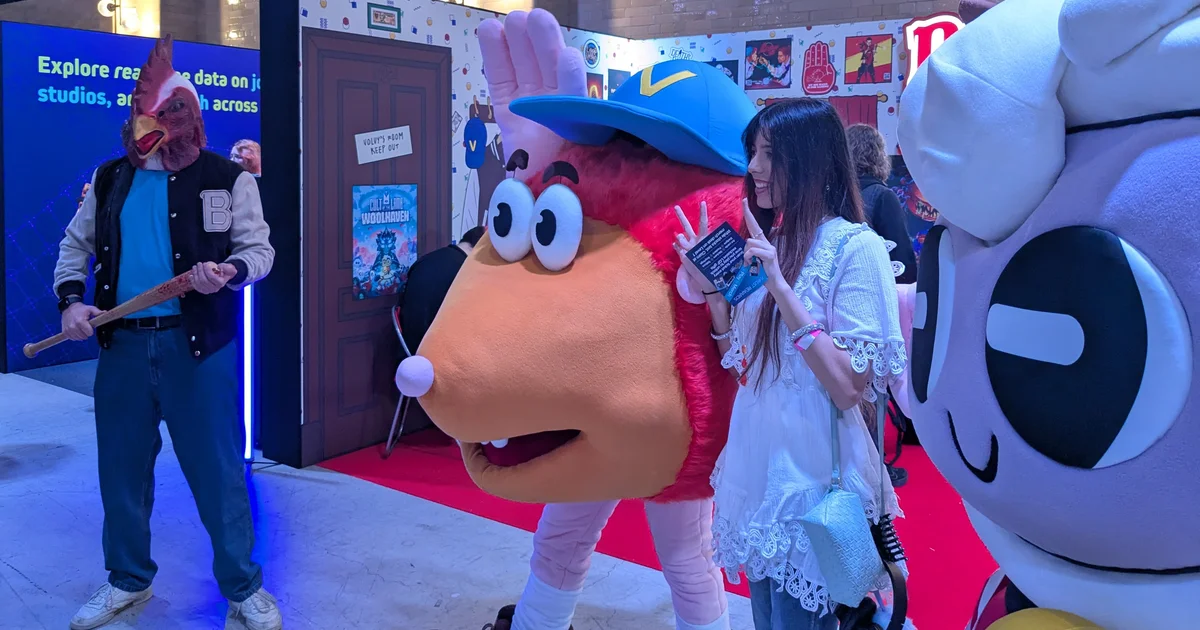
Devolver Digital was impossible to miss. It claimed the biggest stand in the venue—if this were E3 or something similar, you could liken it to EA or Bethesda relative to the other names on show, a comparison its own team probably wouldn’t mind laughing off. Creators and characters from Cult of the Lamb and Hotline Miami drifted between demo stations, jokingly trading swings of a baseball bat with attendees. The two games on display—Dark Scrolls and Heave Ho 2—kept drawing new groups throughout. I then moved toward a restricted upper section to speak with Bridie Roman, Devolver’s senior business development manager, and Robbie Paterson, its communications director, and I asked: Is the future indie, as so many people seem keen to claim?
“I’ve heard that argument a lot before—years ago, back when Devolver was still getting off the ground,” Paterson said, pointing to Steam’s early rise as a PC platform. “But we were also told that in 5-6 years the indie bubble would be ready to burst, so I don’t think those predictions deserve much weight.”
“Then people said streaming would be the next big thing, and now fewer folks feel like streaming games. Subscriptions are the future. VR is the future. Each of those could happen, but for us as publishers the sensible approach is to lean into what we’re good at. We’ve lasted this long because we’ve stuck to our original mission. Sure, the industry could keep growing and more games could arrive, but if you stick to that mindset, I don’t see the point of chasing trends just because they’re hot at the moment.”

“I’m also pretty wary of people making big claims about an industry that’s still fairly young,” Roman added. “We’re talking about only a few decades. So when someone says something is ‘the future,’ that’s one viewpoint. Alternatively, you can choose your own direction—make something you genuinely want to build—and hope others will want to play it too. Ideally, it will find its audience. Of course, there’s a financial side to it: larger games often struggle to recover their investments and turn a profit, but there are also bigger projects that completely contradict that. So don’t take your cues from anyone issuing predictions on the social platform you prefer. Listen to your instincts.”
Plenty of smaller teams have, in fact, been doing exactly that—and with real results. Slay the Spire 2 launched brilliantly, just as Hollow Knight: Silksong did. Smaller efforts like Peak also struck gold, along with Content Warning, which rose above the “friend slop” wave.
Yet despite these standout wins, they’re still a clear minority. With an ever-growing number of game releases on Steam every day, and more money that used to go into games moving instead toward gambling and other formats, the overall odds stay tough. Many developers who were on hand at the event voiced a kind of unease about where things stand now; the increasing stream of high-quality releases makes success harder to reach than it has ever been. The concern around smaller games made on sensible budgets feels real, but whether players will actually back them financially is another matter entirely.
Paterson calls it the “continuous dilemma” of video game publishing, while Roman sums it up with: “You basically need a crystal ball to make sense of any of this.” As we were discussing it, a sweaty attendee carried a decapitated Cult of the Lamb mascot figure into a quieter corner of the venue.
“Unfortunately, it’s all unpredictable,” Paterson went on. “There were periods when it was possible to make a reasonable guess about a third-person action game on Xbox 360 selling a few thousand copies, simply because those games were enormously popular back then. These days, there are so many options. Trying to place a bet on something that will explode upward and bring in revenue is, in essence, a shaky approach.
“What you can do is focus on what genuinely clicks for you and give it a shot at financial success. Whether you’re talking about gamers who are there in person or not—it’s complicated. There are a few paths you can explore, depending on the situation. Pricing is one of them. How does your pricing shape your strategy? What does it do for the game’s results? It’s uncertain! We might think a game is worth $20—we understand the content, the time and effort, the craftsmanship. But then there’s the follow-up: do we launch at a discount? Does that pull in more players? And in doing so, you might accidentally reduce how much value people think they’re getting.”
Even a relatively well-known name within the indie scene like Devolver isn’t protected from that kind of uncertainty. One title from Devolver’s 2025 lineup illustrates the point for Paterson.
“It’s just true that not every game we put out ends up doing well. It’s annoying, but it happens. There’s actually a title that came out recently and didn’t take off: Forestrike. It has an
It was a compelling concept, along with a striking visual approach. Sadly, it didn’t land the way we expected. We put more effort into our marketing, refreshed the demos, and even brought it to events. For reasons we can’t quite explain, it simply didn’t click. I can’t really offer guidance to developers at this point, but if there’s one bit of advice worth taking, it’s to chase what you genuinely believe in. It’s a little cliché, sure—but you know.
In a market that feels tough and constantly shifting, what is Devolver aiming for? The two games on display at the event—Heave Ho 2 and Dark Scrolls—could hardly be more different. Heave Ho 2, which you can enjoy in a group of four with unfamiliar players perched on beanbags, is a cooperative game. Everyone steers goofy, chubby characters to solve puzzles—grabbing awkwardly at objects or even at each other—to build huge burgers or to pilot spaceships, somewhat like a more gaseous version of Mount Your Friends.
Meanwhile, Dark Scrolls 2 was being shown on a compact CRTV with SNES controllers. It’s an especially punishing fantasy side-scroller that nods to older favorites. For people who love the genre, the small details were all there to dig into. My partner, whose name is not being shared, kept meeting their end—then returning as a ghost—sometimes even corralling me into traps set by the hazards.
Paterson, who described Devolver’s approach to publishing as “character-driven,” was keen to talk about how long its relationships have lasted with the creators behind both Dark Scrolls and Heave Ho 2, noting that it had already published their earlier work over the past decade.
Roman, in turn, echoed words attributed to Devolver founder Nigel Lowrie: “It’s games that get us buzzing—an instinctive, you-know-it-when-you-see-it feeling. Figuring out what exactly makes a Devolver game can be difficult. Usually it’s the sort of thing that ends up being profitable, largely because we want developers to see revenue. And above all, it’s the games we want to keep coming back to—offering something fresh, exciting, and pulling it off with skill.”
“We’ve been lucky to kick things off 15 years ago with a few titles that have gone on to become timeless. That brings a certain level of [prestige],” Paterson went on. “We’ve used that to keep growing and to keep succeeding over the years, moving toward bigger and better accomplishments. We launched Fall Guys—that’s a major one, right? But it’s not the whole story. What defines us is variety. We want people to recognize Devolver through different projects, to see a Devolver game and think it’s something worth trying.”
At London Games Fest, worries about financial pressure were clearly present—just as they’ve been at nearly every in-person event for the gaming industry in recent years. Still, the drive to keep pushing forward with the work is hard to ignore. Slumped shoulders and the occasional sigh don’t get the last word over consistent determination. If there’s one thing that isn’t guaranteed—and no company, whether large or small, has a crystal ball—what does that mean for the industry as a whole?
Paterson’s answer was unmistakably Devolver in spirit: “Oh, who knows? That’s the most unpredictable part. That’s why we’re all dealing with hurdles. There are some things we can go after now because of the reputation we’ve built, but we try not to lean too heavily on the whims of whichever algorithm decides what shows up on different platforms. Whether it’s a storefront, a smartphone, or social media, you’ll lose your mind trying to game the algorithm.
“One of the ways we’ve managed to stand out is that we’ve taken a highly people-focused approach to marketing. We wanted to have fun, and nobody was going to stop us. Back in the early days, it felt a bit like the wild west, and we’ve worked hard to keep that energy alive.”
Roman wrapped up her thoughts with a more optimistic outlook: “The reason the industry might be struggling—I’m not sure it truly is—is that games have been doing really well, which encourages more people to want to make more games. It used to be a smaller community, but now there’s massive competition. And that’s actually a good thing: there are so many games and so many developers. They might not partner with us for their very first game, but maybe their next one.”