Thick as Thieves seems built around a story to tell. And it’s not only concerned with talking effigies and mysterious diamonds that surface throughout its relatively brisk run. It also ties into its sudden move away from PvP, the trimmed-down state at launch, and a few issues that were handled with patchwork fixes that feel a bit hurried. Still, despite all that, this offbeat little co-operative first-person stealth adventure delivers a genuinely pleasant surprise—one that isn’t solely thanks to its thrilling eight-minute countdown.
To be clear, Thick as Thieves is the work of OtherSide Entertainment, a studio guided by Paul Neurath and Warren Spector—industry veterans and two major names in the immersive sim space, responsible for enduring favorites such as Thief: The Dark Project, System Shock, and Deus Ex. So when OtherSide introduced Thick as Thieves in 2024 as a stealth-first immersive sim with a PvPvE twist, it naturally drew plenty of attention. The plan was for players to explore elaborate layouts to find randomized artifacts while going head-to-head with others trying to do the same. That’s why it was so unexpected that, just weeks before release, OtherSide announced it had removed every PvP component, saying it was “having more fun with solo and co-op play”.
Honestly, I felt a little relieved. While Thick as Thieves’ multiplayer pitch was intriguing, my own preferences lean more toward co-op than PvP. Even so, the extent of that late-stage pivot left me uneasy: if you pull the game’s central idea so close to launch—turning a title shaped around stealthy multiplayer rivalry into a strictly two-player co-op or solo experience—would it end up feeling hollow? Unhelpfully, the answer after roughly five hours is a complicated yes and no. The key is that when the stars align, Thick as Thieves becomes an unexpectedly satisfying game.
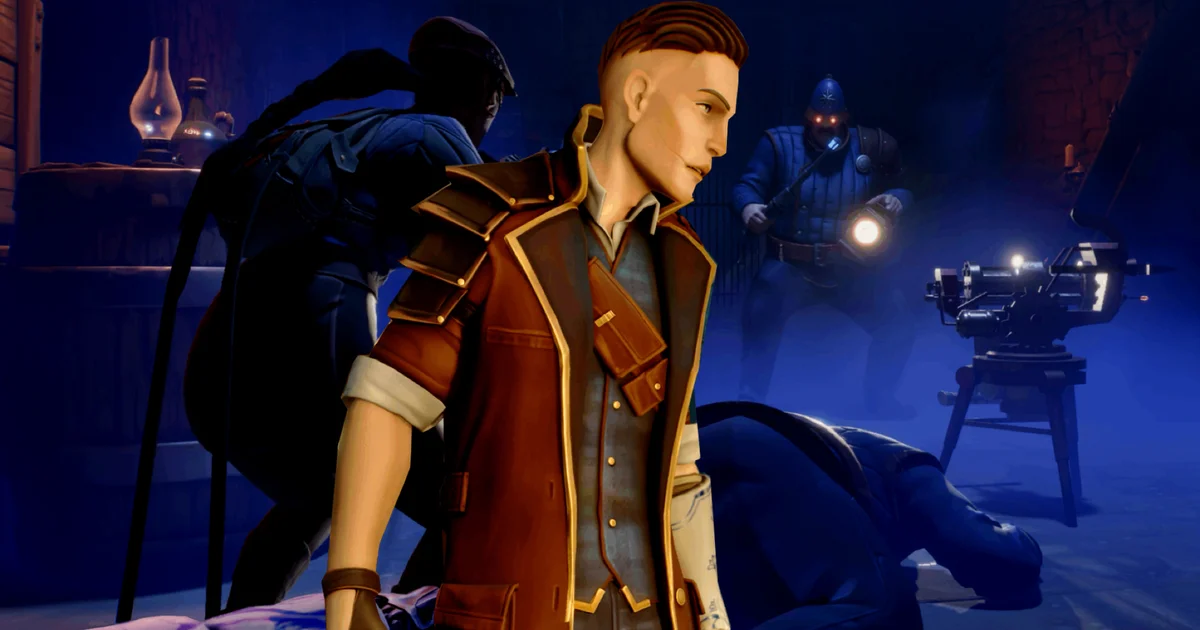
Welcome to Kilcairn, then: an alternate-history Scottish city imagined somewhere in the 1910s, with a touch of Dishonored’s Dunwall. It’s a delightfully cartoonish place, packed with shadowy cobblestone lanes and tall, precarious buildings stretching as far as they can into a dull, grey skyline. You can also feel a steampunk undertone—suspension trains rattling overhead against a neon glow, and copper-plated security turrets that clatter into action when disturbed too carelessly. Yet it’s also a world of magic, complete with portal-like, door-shaped travel options and disembodied eyeball sentinels that keep scanning the area, plus troublesome fairies and eerie patrols.
At least, that’s the Kilcairn we get inside Thick as Thieves’ two current maps. This revised take on OtherSide’s original concept is smaller than what was suggested in 2024, a shift reflected in its budget-friendly price. Along with a pared-down selection of levels, Thick as Thieves only includes two of its previously announced three classes: the Spider, armed with a grappling hook, and the Chameleon, who specializes in disguise. It also offers a notably limited catalog of tools that are genuinely useful, and it keeps enemy variety equally restrained. On paper, that may sound unimpressive—and in a few ways it really is. But it also makes the most of what’s there. That starts with its pair of broad maps—surprisingly big, intricate spaces packed with stealth possibilities and plenty more.

Your stealth missions take you through the dim interiors of the Constables Guildhall—moving between banquet spaces and libraries, luxurious office areas and bleak dungeons—then into the long-ago grand halls of Elway Mansion, topped by a massive clocktower. Each map is laid out with thoughtful complexity: doors, windows, air ducts, balconies, secret corridors, and shortcut routes work together in a way that feels smooth and continuous. That planning helps ensure you have several options, so if something unexpected forces you to switch tactics quickly, it doesn’t yank you out of your rhythm. Thick as Thieves also leans into variety beyond layout. When you start a map, certain elements—like the ambient weather—are shuffled so each run has its own flavor.
Main-campaign objectives (which deliver a surprisingly engaging plot, even though the game tells it only through text) stay consistent, but they’re always paired with bigger mission goals that are randomized every time you load back into a map. You might be assigned to swipe a particular high-value item, collect loot until you hit a required total, or track down multiple objects scattered across far-flung locations. The result is a solid foundation that feels nicely varied. There’s more, though: the items you need won’t always be found in the same spots, and other important pieces—like a vault key—can move around as well. You could push through objectives with brute force, but because the levels are roomy and the clock is always moving, it’s often smarter to hunt for clues (also randomized) that point you toward the right direction. These hints are just vague enough to give the experience a satisfying detective vibe and encourage broader exploration—especially helpful for co-op—since you can split up to cover more ground and then regroup to tackle the tougher sections.
Even though you’ll likely get comfortable with the structure sooner than you might want, the overall setup keeps the mission flow in an entertainingly unpredictable rhythm. Still, the core gameplay loop will feel familiar right away for anyone who’s spent time with stealth games. You’ll crouch in darkness, and when hiding spots run thin, you’ll cut the lights or snuff out flames. You’ll slip behind patrols to pin guards in place, or steer clear of sweeping sentry beams, getting close enough to hit their comically obvious “off” switches. You’ll dodge lasers and weave around pressure plates, throw smoke grenades to cross heavily protected areas without being seen, grapple up to ledges, pick locks and doors, slide down dumbwaiters, or sprint across rooftops—while grabbing as much loot as you can. But since you’re also racing the clock toward a mandatory goal that rarely plays out the way you expect, the game adds extra pressure to keep moving forward, creating a compelling push-and-pull inside the stealth genre. That becomes even clearer as soon as the eight-minute countdown begins.
Once an objective
is locked in—or when only eight minutes remain on the timer—an escape portal appears without warning somewhere inside the level. You need to get to it before the countdown hits zero if you want to stop those last 30–45 minutes of effort from feeling wasted. This is an extraction-shooter-style feature that looks like it may carry echoes of Thick as Thieves’ earlier direction (likely starting as a way to funnel players into one final, chaotic standoff), yet it’s still clear that nothing sharpens your attention like a countdown.
All at once, what used to be a calmer trek through the shadows can turn into a nail-biting scramble. You’re trying to finish your goals and leave as quickly as you can, while still sticking to the stealth rules—now noticeably less strict than before. There’s even one mission where this pressure hits while you’re moving a magical statue that delights in hurling insults and drawing the attention of nearby guards. The stakes feel even higher when two players are working together to sync up their escape, and I honestly can’t recall a single run where those final eight minutes didn’t feel intensely tense.
It’s a structure that, surprisingly, works well, but—at least early on—it can also feel slightly off. Before that eight-minute countdown begins, the tension may seem a little too relaxed, too continuous, as if it’s missing sharp, rhythmic bursts that keep you constantly on edge. You might even imagine that this is where opposing players would have previously had a role: delivering sudden moments of chaos when plans clash and fights inevitably break out.
And you really don’t have to dig far to spot the traces of Thick as Thieves’ earlier identity. Your HQ map labels missions as “matches,” while dying triggers unnecessary respawn delays and sends you to safe rooms placed in awkward spots that interrupt the pace of exploring. The slow reload time on your grappling hook feels like a carryover mechanic meant to discourage escape-spam, and you leave calling cards whenever you take items—likely intended as a lighthearted way to provoke other players. When you play as the Chameleon (oddly unlocked pretty late), the ability to hide from others makes far more sense as a defense against people than as a method for concealing yourself from the basic AI of NPCs. On top of that, progression is built around a steady XP leveling grind, tied to tools and cosmetics you can unlock; that approach fits more naturally in a multiplayer title geared toward keeping players engaged over time. You get the idea. Thick as Thieves stays genuinely enjoyable, but it’s hard not to wonder how much stronger it might feel if OtherSide had taken more time to properly refine the underlying mechanics—rather than releasing it in the world in its current, slightly cobbled-together state to match its new direction.
For a while, those compromises, the visible adjustments, the uneven tempo, and the rough edges—ranging from floating geometry to animations that don’t quite line up—left me feeling entertained, though not entirely convinced. Still, as I stuck with it, and as returning to levels started to get more layered, I became more persuaded. That shift is especially noticeable now that I’ve begun unlocking the tougher difficulties (and again, it’s strange that these aren’t available from the start). Suddenly, guards and security setups show up more often, and their positions are randomized, which adds yet another layer of uncertainty to work through. Time limits grow harsher, and with each step up in challenge, the looseness of those pre-climax moments gets squeezed tighter. The whole experience speeds up, turns more intense, and demands more from your planning and problem-solving—making it feel both more gripping and more satisfying. In the end, it’s simply a fun stealth game.
But does that “little” in the description carry real weight? Even with mission design that evolves in clever ways, I do find myself questioning how long two levels can keep pulling you in. In some ways, it’s a moot point—you can’t really argue that getting a fiver for more than eight hours of entertainment is bad value. Still, with such a strong and engaging foundation in place, I genuinely—and maybe a bit greedily—want more. I’m eager to see how OtherSide can polish it further. Encouragingly, the studio has already said it plans to expand its “setting and its narratives across future content.” Now that I understand its stealth systems better, my initial hesitation about PvP has eased, and I’d genuinely love to try the game in its original form if OtherSide ever thinks about bringing back a competitive mode.
So, Thick as Thieves—arriving in its unusual way and starting modestly—really does feel like it has a story worth telling. It’s an engaging first chapter that follows that slightly confusing opening, and I’m interested to see where the rest of its tale goes. Hopefully, more is still on the way.