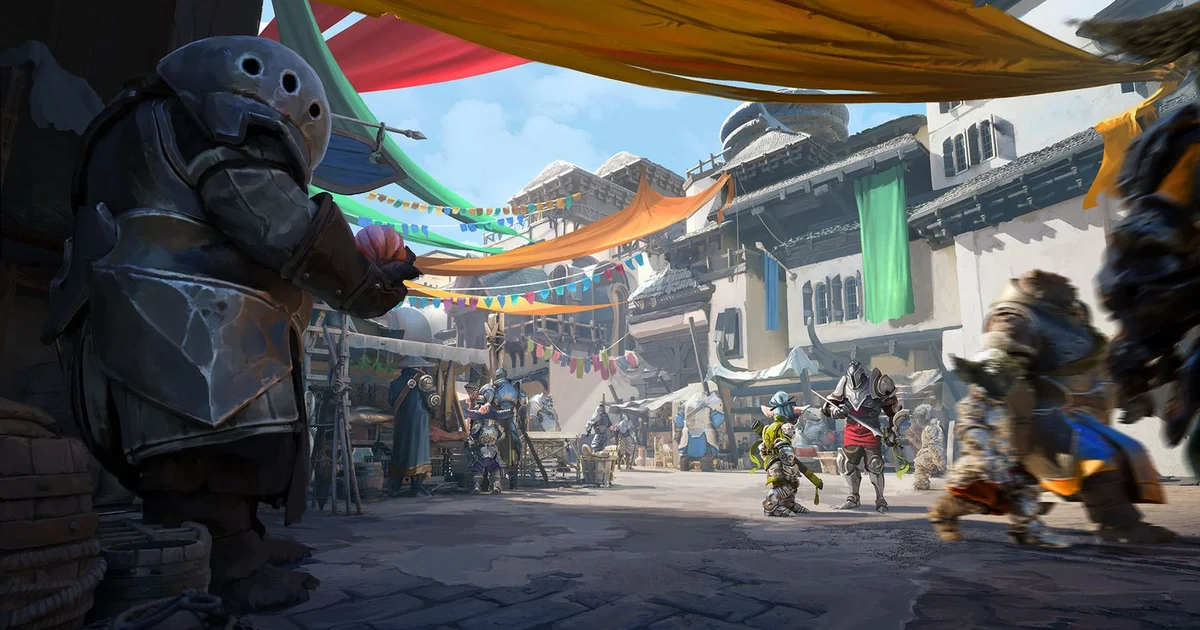
ArenaNet, the developer behind Guild Wars 3, has released a mission statement after the game’s surprising debut at Summer Game Fest earlier this month—and a launch that players have generally embraced. What are the headline goals? Avoid pay-to-win systems, skip subscription charges, and aim to reshape what the MMO format can be.
The message, published on the official Guild Wars 3 website and written by studio leader Colin Johanson, carries the title “Our Guild Wars Philosophy.” It looks at the thinking behind several major decisions the team has already made, while also laying out where it wants to go next, based on four guiding principles.
“When we set out to build Guild Wars 3, we didn’t first ask ourselves what a sequel ought to look like,” Johanson said. “We began with something more basic: the central philosophy that has steered our game-making at ArenaNet for the last twenty-one years. The philosophy is simple. When we develop a new game, we review the genre as it exists at the time—taking stock of both what it does well and where it falls short. Then we identify what players struggle with, what frustrates them, and what limits them, and we ask: how can we respond to that?”
Johanson added that Guild Wars 3—like the first two entries in the series—won’t include a subscription requirement. He argued that a standard buy-to-play approach is a better way to bring players in. He also noted that, in today’s MMOs, subscription fees have largely shifted into paid battle passes and seasonal content. Because of that, those features won’t appear in the game.
There are also no pay-to-win elements, with Johanson emphasizing that any microtransactions will be restricted to cosmetic items and personal style options, rather than tools that raise a player’s overall strength.
The third principle focuses on respecting players’ time and effort, reflecting a widely held idea that MMOs can feel like a “second job.” “Players now have far more choices than ever,” Johanson explained. “Many current gaming experiences let people see a meaningful return on the time they spend, without running into major hurdles to having a satisfying experience. So our obligation isn’t just to produce content—it’s to ensure that the hours people put into the game actually feel worthwhile.”
Finally, Johanson tackled the difficult challenge of pushing the MMO genre forward through innovation. Much of what he said here echoed earlier remarks from interviews around the Summer Game Fest reveal, and it also continues a line established during Guild Wars 1 and Guild Wars 2.
“The MMO scene today is much different from the one we faced when we created Guild Wars or Guild Wars 2. Player expectations have shifted,” Johanson said. “Advances in technology have changed what’s possible. People connect with online worlds in more ways, and with more variety. And the boundary between an MMO and a live-service game has started to blur. As players’ libraries of games have grown, the amount of time they can dedicate to any single title has gone down.”
What Guild Wars 3 will ultimately become is still up in the air, but Johanson maintained that it will sit somewhere between Guild Wars 1’s small-team, instanced gameplay and Guild Wars 2’s open-world, large-scale play.
The statement wrapped up by encouraging early supporters to get involved—asking those who are already invested to share feedback about what they’ve experienced so far.
With a Guild Wars 3 beta planned for the end of 2027, ArenaNet and players eager to try it will have a long wait. Still, based on first reactions, Johanson and the team are offering encouraging promises. The remaining question is whether those goals will come to life in practice.
Guild Wars 2, which reflects many of these same ideas, has endured even while other MMOs have lost momentum. The big issue for Guild Wars 3 will be whether it can achieve comparable staying power—a challenge every new live-service game must address.