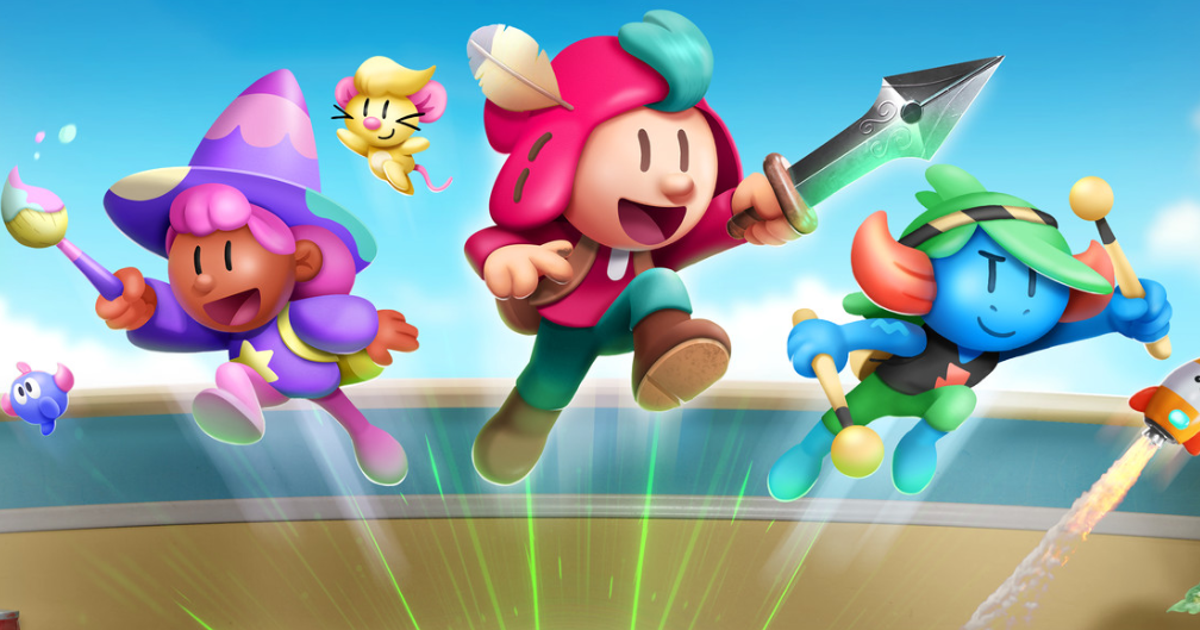
The distinctive, almost hard-to-describe appeal of The Plucky Squire doesn’t come from its visuals or its presentation alone. Rather, it comes from how smoothly the two are intertwined—so well done and so inventive that it’s difficult to treat them as separate things.
Put simply, it isn’t merely an action-adventure where the hero is handed a bow and arrow by a charming elf. Getting that bow and arrow means the protagonist has to wander through the believable mess of a child’s desk—then step into a cardboard castle. From there, perched on a tower fashioned from well-loved books, the hero and the elf clash inside a makeshift Magic: The Gathering card.
This is genuinely fantastic—and it’s only one of the scenes from the preview build I’ve been playing over the last few days, a moment that instantly sparked that mix of amazement and delight. A showdown inside a trading-card! Then I walk out holding a shiny bow. That’s the Plucky Squire, without question. Yes please.
Since its reveal, The Plucky Squire has stuck in my mind—something I believe happened at a non-E3 event not long ago. While many briefing showcases were crowded with sequels and violence, this felt like a jolt of fresh air: cheerful, playful, and surprisingly wholesome. The Plucky Squire feels like it belongs to a children’s storybook, and his adventures appear to unfold right in that kind of narration. One page can show a forest packed with slimes, and the next can suddenly reveal the road toward a castle. Moving between those illustrations on a genuine page, fighting and solving puzzles in a world made of ink—honestly, that alone was captivating.
Still, that was only part of the concept. Every now and then, The Plucky Squire gets forcibly pushed right out of the pages. (At this point, I can share that the culprit at first is a threatening wizard, and honestly, that tracks perfectly.) Suddenly, he isn’t a 2D hero living in a 2D world. He becomes a 3D figure stepping into a room filled with oversized everyday objects: pencil sharpeners, paint sets, paperclips, and Post-it notes. It’s a nursery-style environment imagined through the lens of Claes Oldenburg. He quietly slips past real-world bugs, learning how to climb mountains built from wooden blocks.

It can feel like a lot at once. Whenever that shift happens—when the experience swings between the storybook pages and the wide-open space of the bedroom desk—I keep coming back to the same thought: this is nearly too much. So it’s worth remembering that even before you fully leave the book, when you’re safe inside the kind of world the Plucky Squire understands, there’s still plenty going on.
There’s a principle longtime fans of children’s storytelling talk about—something I picked up from a Mac Barnett talk—called “meaningful page turns.” In essence, a strong writer tries to make the simple act of turning the page feel important. What waits beyond it? A twist. A change in direction. Something you didn’t see coming.
That’s exactly where The Plucky Squire shines. For instance, you might start walking toward a castle—and then the next page shows it clearly, with its doors thrown wide. Great already. But then a later page might drop you into combat with goblins or something similar from a top-down perspective, and soon you’ll work through steps that lead beneath the surface. Flip the page again and you’re underground, roaming through darkness where a moving shape seems to drift among shadows, all while caught in the middle of a 2D platformer.
It brings Zelda 2! vibes, which is incredibly gratifying. Of course, that’s only the start. Maybe a bridge is out and you need to find a way across. The book’s narrator—showing up as a steady presence in the game, with a calm assurance reminiscent of the Stanley Parable narrator during his quieter stretches—will write the needed text onto the page. The bridge is broken. But what if you lift that word, “damaged,” and replace it with another term taken from somewhere else in the book? The bridge is “gigantic.” The bridge is “rock.” There has to be something you can use to get across, and in a children’s story world, words matter for everything you see on the page.
This is the kind of ingenuity you run into by the time you’re first pushed out of the book and into the desktop space beyond it. And from there, things only become more layered. You can move objects between the two worlds, transferring them from 2D to 3D. So a dice might simply sit on the desk in 3D space, yet still work perfectly as weight for a switch back inside the book. A bounce pad may belong in the 3D area where it helps you scale some blocks—but to reach those blocks, you’ll temporarily have to drop back into the 2D version and move through a stretch of children’s artwork pasted along the desk’s side.
Those world-hopping moments are signposted with a green swirl, but there’s still room to figure out what to do in each situation. Even after The Plucky Squire finds its stride, it keeps delivering a mix of experiences: stealth that becomes a puzzle, then stealth that turns into clearing out nearby bugs. Time in 2D, time in 3D. A boss encounter. And then, it keeps going.
Onward! That really is the magic. I’m still playing through the early part of the game, and in both of its settings I’m eager to find out what comes next. I want to keep exploring inside the children’s book, and I’m curious what other surprises are waiting for me across that huge landscape of a child’s desk. I’m all in—and I can’t wait to see what unfolds.