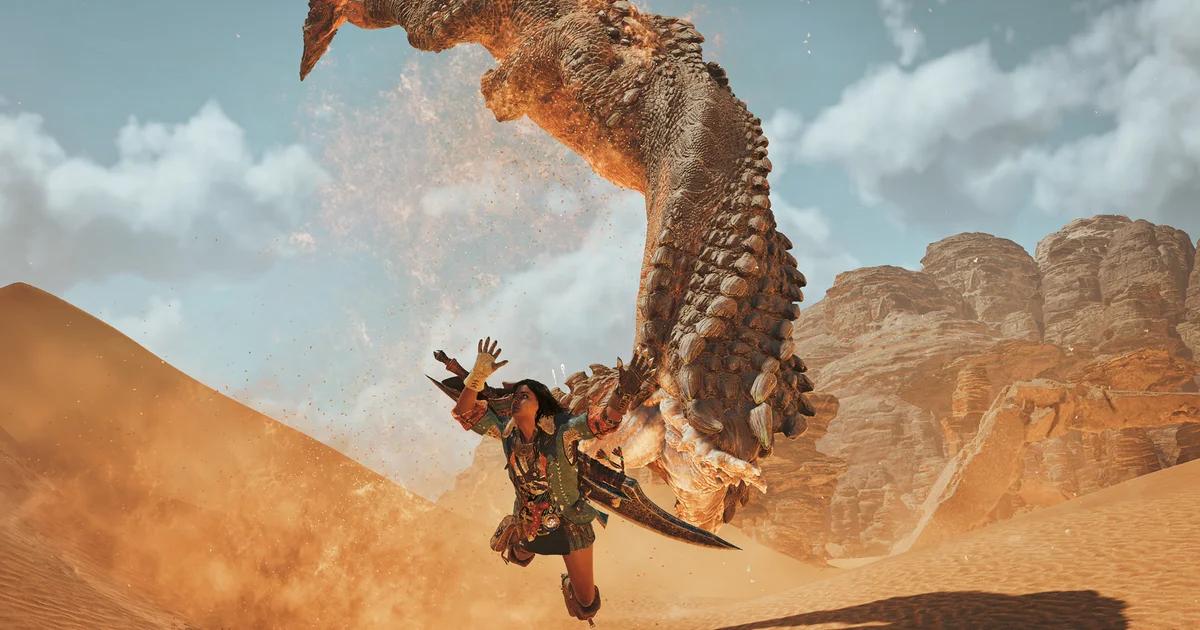
I’m tracking down a Chatacabra, an unusual lizard–frog hybrid with a seriously impressive tongue. I’m also riding my Seikrat, a bird-like companion that carries me fast as I close in on my target. And I’m not completely by myself either: I’ve got three fellow hunter companions with me, though they’re not actual players.
In Monster Hunter, SOS requests aren’t new, but in this game they’re far easier to initiate thanks to the radial menu. If nobody joins you online, three reserved spots are filled with NPCs that help recreate the vibe of cooperative play—while you continue the hunt solo, along with your trusty cat partner. In other words, in Monster Hunter Wilds, you aren’t truly alone unless you decide to be.
Adding NPC allies feels like only one piece of a larger set of improvements in this latest entry. It comes across as the most welcoming, beginner-friendly Monster Hunter release yet. That’s been a steady theme across the series: each new Monster Hunter game usually refines the clunky parts of the previous one, helping broaden the franchise’s appeal—and Wilds makes that clear.
Now, back to my session. My Chatacabra run is just a taste, because the second demo segment is a complete hunt—this time against a Doshaguma, a gigantic bear-like monster with massive claws. Before heading out, I ducked into a tent to choose two different weapons and get ready some tasty steaks to boost my hunter for the expedition. Then, after a quick press on the d-pad, my Seikrat scooped me up and automatically tracked our quarry as we smoothly left the wide camp area (with cooking cats present, though the dango song is missing) and pushed into the desert. While mounted, I can swap weapons with ease, drink potions, and line up for the fight without losing momentum as I chase the target.
In earlier games, a lot of this Seikrat time used to happen back at camp. Here, you can adjust your loadout almost in real time, cook meals from practically anywhere, and even use healing potions while riding away from danger. The Seikrat cuts down the busywork so you’re constantly on the move and focused on the hunt. On top of that, refilling your health is just as streamlined: open the radial menu, pick the right potion, and you’re back in business—no fussy detours through menus.
One particularly intriguing addition in Wilds is that some monsters gather in groups, and you’ll need to separate them from the cluster. The Doshaguma is one such case. Naturally, the separation is triggered by throwing dung. The stench is enough to discourage the group and push the Doshaguma’s leader into pursuit—kickstarting the quest through your actions instead of having to rely on conversations back in camp.

That leads directly into combat, which has also been tightened up. You can naturally land injuries by repeatedly hitting the same parts of a monster’s body—almost like you’re truly hunting rather than just attacking at random. Once a wound shows up, you can turn on focus mode to automatically aim at weak points. I mainly use a bow, so I was often firing at the Doshaguma’s head until a wound appeared; then, by holding the right bumper, the wound automatically came under a homing-arrow targeting sequence for heavy damage. Bow users can even shoot a tracer at any body part to set up focus attacks, which adds an extra layer of impact.
Beyond focus mode, the controls felt familiar if you’ve played Monster Hunter: World or Monster Hunter: Rise. That familiarity made it easy to slide back into a comfortable rhythm as I unleashed a barrage of arrows and pulled off last-moment dodges. The overall flow feels quick and smooth, especially compared to how awkward it has sometimes felt in the past, and moving around on the Seikrat makes the experience even better. For new players, there’s also a quiz to point you toward the most appealing weapon style—though I still suspect there’s a fairly steep learning curve for brand-new hunters. I switched, without much trouble while mounted, to the insect glaive to test the new acrobatic options, but I’ll admit my effectiveness dropped quite a bit.
Monsters also interact with one another in plenty of ways. While I was chasing the Doshaguma, it got caught at one point by a sandworm-like Balahara, and a second Chatacabra showed up as well. Even more intense was the region’s apex monster, the lightning dragon Rey Dau, which didn’t just focus on my quarry—it also summoned a storm that darkened the sky and churned up the sand. With weather effects, towering monsters, and whole herds of creatures on screen, the action is constantly shifting and there’s a lot to watch—plus plenty for the hardware to keep up with, more or less.
Conveniently, you’re supported by Palico cat companions, and customization is back once again. My small black, fluffy pal even showed off an adorable moustache. In fights, Palicos can be very useful: they distract enemies and provide healing, and this time their intelligence has been boosted to make them even more effective—another quality-of-life upgrade.
Capcom may not label the game as open world, but it certainly feels seamless as you move from the hub area straight into exploration. This desert region is noticeably bigger than the ones seen in Rise, sprawling far outward. Still, the Seikrat makes getting around feel effortless as it barrels across the desert and hops over rocky outcrops. Character models are rendered with sharp detail, from the monsters’ bared teeth to the hair and armor worn by NPCs.
This comes through especially clearly during cutscenes. The demo’s opening focused heavily on storytelling: my character and a group of hunters set out to help a village under siege by monsters. That led to a mostly linear chase sequence across the sand, where Seikrats sprinted ahead of a rampaging herd of sand worms, kicking up dust as they went. It was a striking visual moment, but in the end it felt like a flashy, surface-level burst of action. It’s clear Capcom wants to reach a broader audience, but Monster Hunter really shines when players get full control.
Taken as a whole, Monster Hunter Wilds strikes a solid compromise between approachability and deep combat. It keeps the familiar excitement of the hunt, the ability to personalize your character (the new armor designs look fantastic), and the intensity of its fights. All of that sits inside a fresh setting that’s ready for cooperative play—even when NPCs are doing the teaming. When you combine that with smart tweaks that streamline the experience and shift attention toward action instead of cumbersome menus, there’s a strong chance this game will successfully bring in a new generation of hunters.