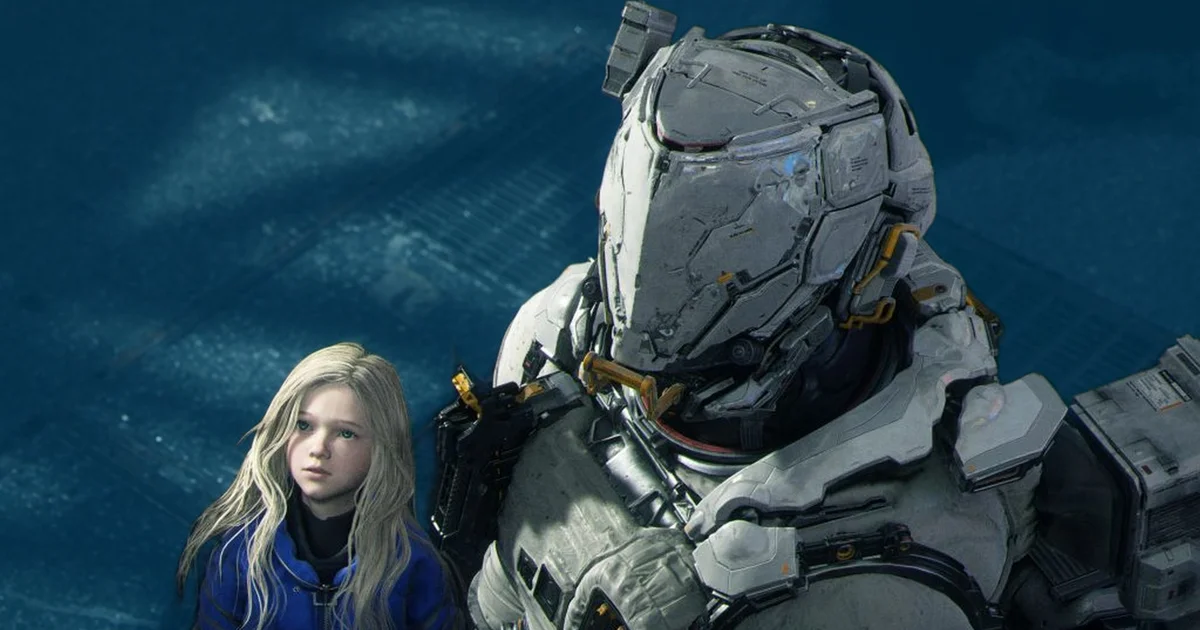
As we’ve already said once, and yet here we are again: Pragmata captures Capcom at a strangely fearless height—an experimental, offbeat moment that feels almost peak for the publisher. To me, it sits naturally alongside Exoprimal and Kunitsu-Gami: Path of the Goddess, titles that demonstrate Capcom’s willingness to let its studios try just about anything they can imagine. Even if those two didn’t land major mainstream impact (and in Exoprimal’s case, didn’t win much critical praise either), I think Pragmata has a better shot at drawing in a wider audience thanks to three key strengths: it’s a shooter, its protagonist is framed as a fairly ordinary guy—Hugh Williams, of all people—and it delivers one of the most exciting genre mashups I’ve run into in quite a while.
During a recent presentation at Capcom’s headquarters before Gamescom, I got to try a new build of the game—essentially a slightly improved version of the Summer Games Fest demo Alex covered in the preview above. The biggest change came in the form of a boss encounter with a mechanized walker that stomped through an arena shaped like an elevator, echoing Lost Planet, Vanquish, and maybe… Watch Dogs?
Like I noted earlier, it’s a genuinely odd mix of genres paired with what looks like a plot that would benefit from more scaffolding to feel at least minimally complete. Still, that part matters less than you might expect. Honestly, I don’t think players are going in expecting anything like a Hugo-worthy tale of redemption and sorrow. With Pragmata, what you get is unmistakably a video game experience. Moving left and right while fighting a boss that feels like it came straight out of Metal Gear’s editing bay—and doing it alongside a young girl who’s also an android, as she breaks into its systems—lands right in that classic video game sweet spot. For me, that’s a real plus.
Every part of the demonstration screams peak video game. Hugh stomps about with gruff, offhand murmurs as he works through simple environmental puzzles, trading brief, hard-to-pin-down lines with Diana (the android). At intervals, a security setup that feels similar to GLaDOS wakes up and releases robot henchmen, which you have to take out before you press on. The enemy robots come with shields, so Diana needs to hack them before you can shoot. On top of that, it looks great: a sleek space-station sci-fi vibe, and it also works as a strong opening space to learn the third-person shooting and hacking loop before you get to the boss.
Alright—boss time. This is where the two sides of Pragmata start to braid together into something like a showpiece, hinting at where the game wants to go. As the walker smashes around the platform and you dodge incoming missiles and AoE bursts, you have to use one of your three weapons (it looks like four will be in the finished version) to deal damage. You’ve got a pistol that hits relatively lightly and reloads slowly, but it offers unlimited ammo. There’s also a shotgun with strong damage per second, though it’s limited to six shells before you need to reload. And then there’s a stasis net that slows your target while ticking away damage over time.

It’s a satisfying set of three weapons. The intent is to swap between them in a way that maximizes damage while keeping your exposure low, and the whole fight eventually plays like a combat puzzle you solve on the move. It may not line up with Halo, but that Lost Planet comparison I mentioned earlier becomes clear here. The walker-type boss has weak points (Diana identifies them as you line up your shots), and in this fight the key target was a fuel tank sitting on its back.
After you get comfortable with the arena and spot where you want to “spend” your limited shotgun shells, you cast the stasis net, reposition to the rear, and start the assault. I caught myself laughing a bit during my preview—once it was pinned down by the net, I unloaded a full shotgun volley into the tank while directing Diana to hack the machine. That immobilized it, and we used some of her resources to further lower its defenses. The way everything clicks into place under your control feels immediate, like muscle memory—even though, naturally, I haven’t actually done it a dozen times before. This whole setup is just wildly strange.
You take aim and fire with the normal trigger controls, then use the face buttons to handle a simple puzzle that lets you hack an opponent during the fight (there’s the Watch Dogs nod). You can also jump and dodge with the shoulder buttons, which makes your hands work the controller in a jumpy, frantic rhythm. It’s intense—almost chaotic—but in a way that taps the same corner of my brain that Vanquish hit back in 2010. Once the controls sink in, that back-and-forth between hacking and shooting ends up feeling surprisingly smooth.
Looking back at my footage, I don’t believe what’s on screen truly reflects Pragmata. This is the kind of game you really need to hold and play to grasp fully. I’d love to see Capcom put out a demo (for its own good), since the premise could feel a little too obscure for some people. Still, it highlights Capcom’s certainty, and it follows the same general mindset Dead Rising embodied back in 2006: start with a well-known genre, break it down, and rebuild it in a way that’s genuinely fresh and innovative.
That said, there are a few outdated design decisions lingering in Pragmata (most of the story comes through text logs scattered around the abandoned moon base or through projected holograms—very reminiscent of 2006). Those elements sit alongside newer concepts and genuinely compelling genre combinations. Pragmata is fascinating. I’m convinced that games like this capture Capcom at its best: experimental, quirky, and ready to step out of the usual triple-A template in pursuit of something that feels unconventional, slightly odd, and a touch more forward-looking. In the end, it’s trying to land on something even better because of that choice.