It’s been 11 long years since the franchise’s underwhelming reboot, yet the Thief series is finally back with Thief VR: Legacy of Shadow. This installment invites hopeful would-be thieves to lean on virtual reality to make their quiet, sneaky missions feel even more effective than they did before. Legacy of Shadow is the fifth entry in the line-up, and its team says it takes place 200 years after Thief: Deadly Shadows and another 200 years ahead of the story in the 2014 reboot.
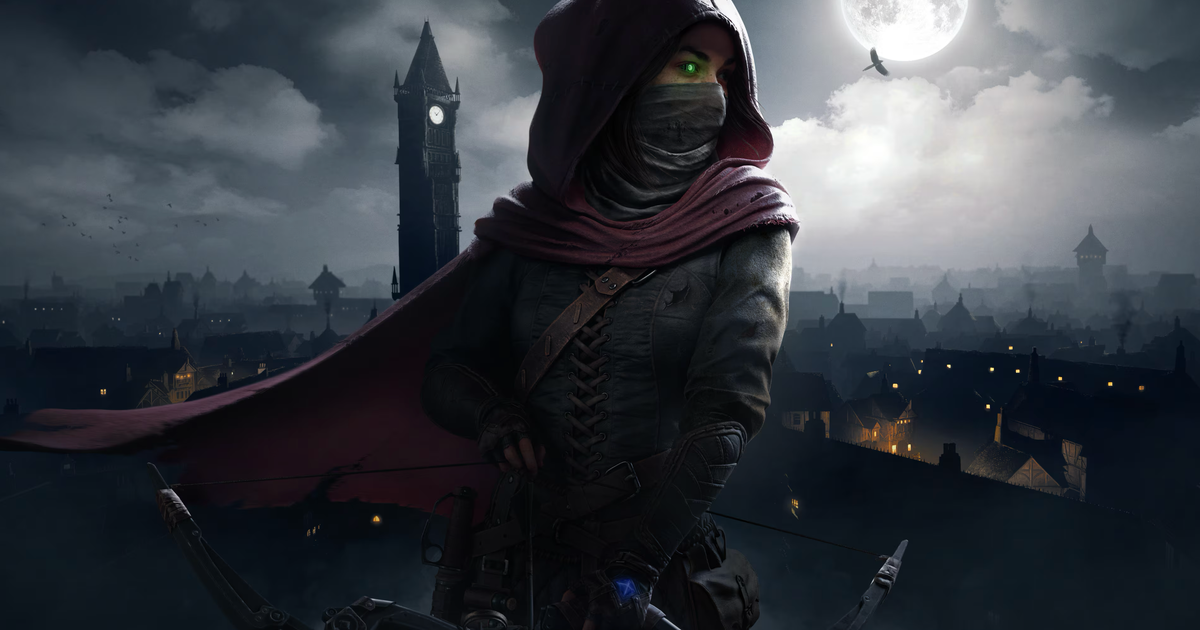
In Legacy of Shadow, players take on a brand-new protagonist, Magpie. At one point, she obtains Garrett’s well-known mechanical eye—an item he receives following the dramatic ending of the original game. The eye lets Magpie use a mechanic called Glyph Vision, which draws attention to nearby foes and points of interest. It also lets long-time fans enjoy Stephen Russell’s familiar performance as the original Garrett, whom Magpie starts to hear in her thoughts once she has the eye.
I recently had a chance to try two sections of the game on PSVR 2, starting with the tutorial stage, Stonemarket. That opening introduces Magpie and gives you another look at The City, complete with its watchful guards. After wrapping up the tutorial, I was taken to Ravencourt Manor, a far more classic Thief-style heist, where I had to sneak into the Manor to steal a puzzling prize called the Glyph Stone.
Visually, Legacy of Shadow leans hard into a gloomy, heavy-handed atmosphere that feels distinctly Steampunk. The PSVR2’s HDR shines particularly in darker areas, and the craftsmanship shows up in both the outdoor scenes—where you can appreciate sweeping views across the City—and the indoor spaces and set pieces. The game also has a semi-realistic look, enhanced with a cel-shaded style. That blend fits the world well and keeps it closer to the modern Thief reboot than the earlier early-2000s releases.
Lighting is another standout. Bright street fires throw clear shadows of guards onto nearby walls, which made it easier for me to keep tabs on their movement without having to step out from safety. Like much of the rest of the presentation, Magpie’s hands and gloves carry the same highly detailed comic-book look. Still, players hoping for full body tracking may feel let down, since you can only direct two floating hands here.

When it comes to hand-based interactions, how well do those key VR actions work? In my view, the effectiveness of the range of items you can grab, adjust, and touch can either elevate or dilute the overall VR experience—though there are plenty of things to mess with. You can open drawers, eat food, put out candle flames, reach vents, and pocket, break, or throw many props to create distractions. You also get a physical inventory pouch for gear like keys and quest essentials, along with a lockpicking system that feels satisfying, relying on gentle wrist movements to find the sweet spots inside each lock.
Even so, the feeling of being in a truly solid, surrounding world doesn’t come across as strongly as in games such as Batman Arkham Shadow. That title managed to nail responses to even the smallest surface details—for example, your virtual fingers would react to rough textures, sliding along the shape of ledges or walls. In Legacy of Shadow, when I tried something similar, Magpie’s hands barely showed any noticeable differences. It doesn’t ruin gameplay, but it does slightly reduce immersion.
For many players, the Thief reboot is widely seen as the weakest chapter in the series, largely because of its level design. Instead of crafting well-planned spaces built for stealthy thievery, it leaned into linear parkour-style action. Fans wanted more chances to observe locations carefully and move through complex interiors under the radar, rather than sprinting from point A to B across beams and climbable surfaces. So where does Legacy of Shadow land? There’s both good and bad to consider. The first tutorial level didn’t just look like a throwback to the fourth game—it also used very similar level design. Even without parkour, with fewer climbable walls and fewer looping areas (including a sewer segment to pass through), it still felt fairly linear.
To be fair, that initial mission was probably scaled down to help people ease into the mechanics. The next section I tried, Ravencourt Manor, swings much harder toward a richer layout more in line with the classic Thief games. You can approach the Manor through several entry points, take different routes as you move around inside and outside, and the building is spread across multiple levels—encouraging careful stealth, exploration, and better strategic choices. I should also add that this Manor felt a bit smaller than the iconic Lord Bafford’s Manor from the first game, though the updated visuals gave Ravencourt a more grounded, lifelike presence.
A Thief title can’t fully live up to its promise when its stealth systems aren’t handled well—one reason the reboot struggled to win over long-time fans. Fortunately, Legacy of Shadow appears
to head in the right direction, mainly thanks to the use of VR tech, which boosts the feeling of crouching behind cover and glancing upward from storm drains. While the Thief reboot came with a ‘Peek’ button, Legacy of Shadows turns your neck into the peek control, so every moment of hiding and checking your surroundings feels far more authentic—you’re genuinely pulled into the experience.
Staying out of sight in the dark is key to slipping past guards once again. Magpie’s glove includes a light meter that lets you know when you’re being illuminated, along with a range of practical options for killing sources of light—water arrows included, plus the ability to snuff out candle flames with a pinch. One of the standout tricks lets you blow out candles for real using your headset microphone, and it can double as a distraction method. Turn the option on, and your mic will pick up your voice, letting you shout at guards to split their focus or even draw them toward you. Still, if you’re planning to stream and provide commentary, you may want to leave this feature off, since ongoing talking can give away your position over and over.
During my time with the game, several stealth highlights really stuck with me. In one sequence, I worked my way around a room where a guard was dozing, quietly opening drawers and reading notes until I worked out the steps to unlock a cell door and reach the treasure inside. In another, I accidentally alerted two soldiers positioned to guard the exit while I was trying to climb up out of the sewers. They quickly zeroed in on me, so I backed into the sewers, resurfaced through a different manhole, and sprinted straight through the exit once it was left unattended.
Beyond that, the game’s stealth toolkit includes pickpocketing, a bow and arrow for long-range takedowns or eliminations, and—if you feel like being a bit cheeky—many objects placed around the level that you can throw at sleeping guards right before you make your escape.
If you’re trying to reach the exit after pulling off a successful heist, moving efficiently matters, and Legacy of Shadow’s controls feel very responsive. There’s no teleport option—movement is fully continuous, though you can choose click turning or smooth turning if you tend to feel queasy. In the demo I tried, this was the only movement approach on offer, so crouching had to be triggered with a button press rather than by physically lowering yourself. That seems like a smart compromise, since playing without a click-to-crouch alternative could be rough on the knees. Exploring didn’t pose any problems for me, and there are also plenty of routes up—whether you’re using ladders to reach higher ground or slipping onto conveniently placed bricks that tend to hide excellent loot caches. When it was time to climb, my grip felt accurate, and I didn’t have trouble pulling myself up or vaulting through windows.
Of course, even with solid movement, it’s possible to round a corner at the wrong moment and land in a patrolling guard’s line of sight—that’s when combat becomes relevant. That said, I didn’t get much of a chance to try combat, since I was specifically encouraged to avoid being detected at all, particularly because death happens quickly once you’re spotted. You can use a blackjack weapon, something familiar to long-time series fans, and it’s meant for knocking enemies out from behind, though it doesn’t work well in direct, face-to-face encounters. The only truly lethal weapon I attempted was the bow, which, in my experience, was a little awkward to aim. It doesn’t seem ideal for very long distances and appears to deal only limited damage, so it’s probably best viewed as a support tool for your stealth plan rather than a dependable weapon.
Overall, Thief VR looks like a strong addition to the franchise, blending elements from both the original games and the reboot into a substantial VR stealth experience. It should please longtime fans, while also bringing the series up to date for newcomers. Seeing Garrett return will likely make fans happy, and it’s easy to imagine players who don’t use VR being disappointed they can’t try this without first getting a headset. In terms of polish, it falls behind Batman Arkham Shadow, which is still the height of VR immersion for me—especially since that title was exclusive to Quest 3—but it still seems set to deliver a crafted, challenging Thief experience. In my opinion, stealth games are noticeably more fun and exciting in VR than on traditional flat screens. So, if you want to fully immerse yourself in Thief, you’ll be able to do it on PlayStation VR2, PC VR, Meta Quest 2, 3, and 3S later this year.