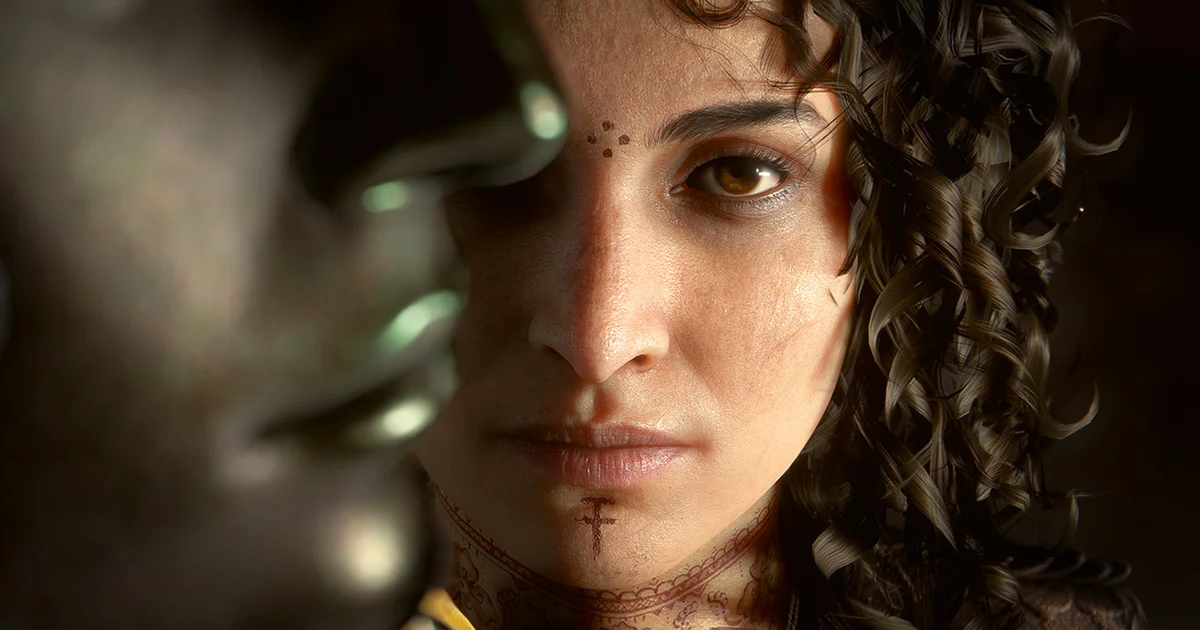
In Resonance: A Plague Tale Legacy, everything seems to shift. This series—long recognized for its stealth focus and for the tender, hard-earned emotional arcs of siblings Hugo and Amicia through a plague-haunted France—now moves in a completely different direction. Stealth is gone, Hugo and Amicia are not part of the story, and the setting is no longer France. Still, having a real soft spot for the Plague Tale line and spending roughly an hour with this new entry, I can say with confidence that Resonance keeps the soul of a Plague Tale game, while also showing real promise.
The protagonist is now Sophia, introduced in A Plague Tale: Requiem as an adventurer who served as a mentor figure to Amicia. In that earlier installment, we only really learned that she’s a fighter, she comes from Greece, and during her childhood she escaped a convent in search of her father. That naturally leaves plenty of space to round out her history. In Resonance: A Plague Tale Legacy, the game jumps back 15 years, with Sophia investigating a temple on the Greek island of Crete—somewhere she’d been dreaming about vividly since she was young. Those dreams connect to a wider legend, and, more specifically, to the Macula’s plague: the rat-driven curse and the rats themselves.
“Legend” matters here, especially the Greek legend of Theseus and the Minotaur, which forms the core of this story and unfolds through a double timeline. At certain points, Sophia wanders through the temple, but the game pulls us away from her point of view and places us a few thousand years earlier—right in Theseus’s position. In practice, you get to experience his story as if it’s happening to you, including his trials.
Near the end of the fourth chapter, I saw a moment where Sophia approaches a gigantic inner chamber dominated by a monumental Minotaur statue. As she steps closer, the perspective swaps to Theseus, arriving at the very same spot. For Sophia, the chamber looks empty and broken-down; for Theseus, it’s alive with onlookers, all eager to witness a gladiatorial duel that you’re about to take part in. And what do you get for it? A showdown with what I assume is the Minotaur—though it never appears on screen for me.
Playing as Theseus means using a totally different set of moves. The action turns into a broad, brawling kind of fight, featuring spartan-style kicks that knock opponents off a ring-shaped platform, plus swordplay that carves through enemies until you’re the one left standing. It’s a genuinely exciting display—backed by heavy drumbeats, a booming announcer, and a sense of ceremonial intensity in the air. That energy forms a stark counterpoint to Sophia’s slower, more deliberate exploration of the ruins during her timeline.

Of course, Sophia isn’t new to fighting. One of the biggest differences in Resonance: A Plague Tale Legacy is how heavily the game leans into combat. In the previous titles, Amicia and Hugo generally depended on stealth to steer clear of danger, but Sophia welcomes direct, up-close encounters. There’s no stealth system in this game. Even so, producer Eric Chort hints at additional mysteries during our interview, saying, “I can’t reveal too much about that! There are some enigmas. There will be something…” Just remember: Amicia is born in the same year this adventure is taking place, so she won’t show up as a playable character.
Bottom line: this is a combat-first game, and it’s surprisingly strong at delivering it—especially since Asobo’s first step into this kind of action. It pulls cues from the rhythmic fighting styles of Ghost of Tsushima, Batman: Arkham, and Marvel’s Spider-Man, and I really enjoy that approach. If you can get your timing down, Sophia cuts through fights with an impressively deadly blur of steel and force, landing a satisfying set of finishing moves. The animations, too, are crafted with exceptional care.
The combat system also has meaningful depth. On the surface, you’ll find blocks, parries, dodges, and regular attacks. Beneath that foundation, there are charged strikes, moves that break guards, and a smart rope technique that lets you challenge enemies from a distance—interrupting their approach and bringing them closer (or dragging them toward whatever fate waits below). There’s also a modest skill tree you can grow as you level, adding extra options, plus the ability to pick up swords that enable different combo finishers and combat styles. Theseus has his own buildable moveset as well, and during my session I unlocked a powerful area attack that feels wonderfully destructive.
In short, combat offers plenty of ways to deal with groups of foes. Enemies don’t just rush you in a simple line—they arrive in tougher formations, which can be frustrating when you’re surrounded, particularly once sturdier mini-boss types join the fight. Still, there’s a rhythm to it, and once you learn that cadence, maneuvering through a packed battlefield with razor-precise accuracy becomes incredibly satisfying. Overall: it’s excellent.
Fighting makes up a major slice of the experience, but it’s far from everything. Here, the spotlight is on mysteries and exploration, and it comes as no surprise that Eric Chort points to Uncharted and Tomb Raider as major influences. There’s also The Last of Us, which consistently feeds into the Plague Tale series—praised for its moving storytelling—and that same emotional authenticity carries through just as it did in the earlier entries.
This time around, the puzzles center on light, much like in earlier Plague Tale games. Still, rather than trying to fend off swarms of ravenous rats, you’ll be cracking riddles to push further into the temple—an impressive, sprawling location that made me feel genuinely awestruck, the same way A Plague Tale Requiem did. The route downward seems never-ending, winding deeper into the earth as you move from one huge space to the next. The design keeps expanding, growing more monumental and elaborate with every stretch. Some areas look as though they were conceived by Gaudi, with walls twisted into organic shapes and mosaics crafted with meticulous care. The game’s level of detail stands out across the board, from the characters to the environment itself.
One thing I truly value is that these puzzles don’t simply hand you the answer. There’s a clear push to think things through for yourself and to lean on the clues found in Sophia’s journal—something that feels very close to Nathan Drake’s journal from Uncharted, right down to the small sketches that point you in the right direction. Two puzzles stand out in my memory. The first had me crossing a room full of spike traps under real pressure. Sophia carries a light-emitting tool that exposes a safe route, but unexpected shadows can block it, forcing you into a quick, desperate mental scramble to recall the path. At the beginning it’s still manageable, yet as you progress, the challenge turns more stressful. The second puzzle asked you to match symbols inside the inner sanctum where Theseus fights in his timeline—an arena built for gladiatorial battles. That one really left me stuck.
Luckily, Leni came to the rescue. She’s a new companion and a close ally of Sophia, traveling with her (and it’s been suggested that more characters will appear at different points, with some possibly familiar). Leni also fills an important mechanical role, offering help only when you find yourself needing support. I make that distinction because you aren’t required to take her up on it—you’ll only get access to her suggestions after you agree to prompts that show up following a stretch of inactivity. They’re entirely optional, and that feels like a smart, thoughtful design decision.
There’s a lot that makes Resonance: A Plague Tale Legacy stand out—really, it’s a bold step forward for the franchise. Still, the signature traits of the Plague Tale series haven’t been lost. Once again, you’re pulled into a lavish, otherworldly adventure, steeped in emotion, and delivered with cinematic storytelling, flair, and style. The excitement of playing someone shaped by a major destiny—set off on a journey to extraordinary locations that no one has visited in millennia—keeps carrying you onward. While the atmosphere and setting may come across a touch brighter than in earlier Plague Tale stories, it’s unmistakably still A Plague Tale. I’m looking forward to its release on August 27th.
This article is based on a press event in Paris, with travel and accommodation provided by Focus Home.