In the last few years, we’ve seen a clear rise in the number of budget-friendly direct drive (DD) racing wheel options. Fanatec and Moza, in particular, have introduced more affordable models that still deliver the quick, accurate, and long-lasting force feedback you simply can’t get from cheaper gear- or belt-driven alternatives.
Thrustmaster is now targeting the same segment with the T598, a PlayStation/PC direct drive wheel package that includes a wheel base and pedals, priced at £449/$499. That places it in the same ballpark as the PC-only £459/$599 Moza R5 bundle and the €399/$569 Fanatec CSL DD bundle—so the key question is: how does the T598 measure up? And, just as importantly, what has changed versus the pricier T818 we reviewed earlier?
We’ve spent several weeks testing the T598—along with the upgraded HyperCar wheel, which you can add as an accessory—to find out what it’s really like. Keep reading for our full review, or use the quick links below to jump straight to the sections that matter most to you.
Thrustmaster T598 wheel base review: direct axial drive vs traditional direct drive
One interesting point is that the T598’s DD motor may be more advanced than the one in the higher-priced T818. Instead of using the usual “direct radial drive,” it relies on a “direct axial drive,” with the magnets arranged parallel to the wheel shaft rather than set perpendicular to it (see the diagram below). In theory, that layout helps the wheel generate torque more efficiently, wasting less energy as heat, reducing magnetic interference that can take away precision, and using less copper during manufacture. Thrustmaster also says the T598 can “overshoot,” meaning it can output more than its stated 5nm of continuous torque for short bursts.
That said, the design comes with trade-offs. The housing is physically taller but slimmer in width, at 210x210x120mm, which could block part of your forward view and also calls for a different bolt arrangement to fasten the base to your desk or sim rig—small issues, but still worth noting with the T598. (A mounting bracket is included to help with wider, potentially more compatible mounting holes for your setup… though it also adds to the height of an already tall wheel base. Table clamps are provided as well.) There’s also a slight vibration and a faint crackling sound coming from the base when it’s idle—a behavior I haven’t noticed on other direct drive motors, though it’s reportedly typical for this particular design.

When it comes to the force feedback performance itself, Thrustmaster has delivered something notable. In games with strong force feedback support—such as Assetto Corsa, Assetto Corsa Evo, and F1 23—this wheel feels excellent, with firm force feedback and plenty of detail. If you clip a curb or start to slide, you’ll notice it right away, and it’s easy to react. I also liked the smoothness through cornering, with no cogging—the small, slightly uncomfortable jolt often associated with entry-level and mid-range direct drive motors, caused by the sensation of passing each magnet.
Still, compared with other wheels I’ve used around the same price—particularly from Fanatec or Moza—the T598’s feedback can feel a bit less steady. In some titles, including Project Cars 3 and Forza Motorsport, the wheel can feel almost stripped of force feedback in comparison. You’ll also feel a subtle vibration when the wheel is sitting still, which may stand out more than the cogging you’d typically notice in conventional DD setups. The overshoot feature can also cut both ways: the sudden torque bump may feel a little out of place in certain moments—for example, when you’re heating up your tires by weaving in F1 ahead of a safety car restart.
Overall, it’s hard to argue that the upsides outweigh the downsides by a huge margin. The result is force feedback that’s undeniably strong, clearly more convincing than non-DD wheels, yet not dramatically better than more established radial direct drive designs. Depending on the games you play, either direct drive approach could be the better fit. It’ll be interesting to see whether Thrustmaster can smooth out some of these weaker points through firmware updates—or through upcoming products that keep using this same technology.
Outside of the innovative motor, the rest of the wheel base is fairly straightforward. There’s a small colored display at the top for tweaking settings and showing in-game information such as a rev counter, four oversized round buttons (L3, R3, Mode, and Settings), the usual Thrustmaster quick release mechanism for locking your wheel rim in place, and a small power button on the back of the unit
base on and off. Power ports, USB, and the connection points for extra accessories such as pedals or shifters are placed along the rear.
Oddly enough, the PC version of the Thrustmaster Panel app doesn’t offer any way to change settings. Instead, it only shows a message saying the feature is “coming soon!” For now, you can therefore use it solely for firmware updates, running button tests, and switching between profiles.
Rather than relying on software menus, you’ll make adjustments using the built-in display. It does the job, but it doesn’t provide much depth, so you’ll likely stick to the four standard pre-set profiles—checking the manual or searching for suggested setups online instead of expecting helpful inbuilt prompts.
You still get the full range of settings here, which naturally works well for PS5/PS4 users, since they wouldn’t expect a fully developed software experience. PC players, though, may feel let down by the lack of a straightforward desktop interface. I found that the Boosted Media YT review of the wheelbase is useful for understanding which options you might want to tweak away from the factory defaults.
Thrustmaster T598 Sportcar wheel review: a practical default pick
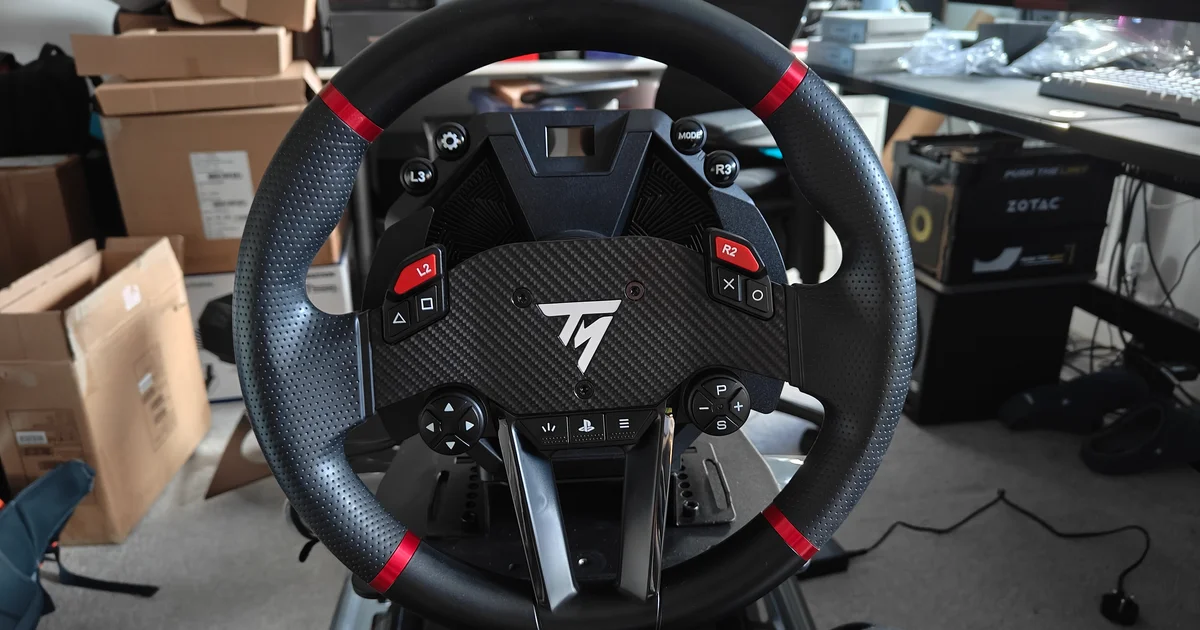
The included “Sportcar” wheel is a bit less visually striking than the base unit, with a plastic feel and slightly soft buttons—though the paddles respond in a pleasing way. The standard PS-style face buttons are grouped into two clusters at the top, with L2 and R2, which feels a little unusual. Meanwhile, four separate directional buttons sit at the bottom left, the start/select/PS buttons are in the lower middle, and four configuration buttons occupy the lower right.
These configuration buttons need some context. The P button on top switches between four different pages, marked by different colored LEDs, letting the other three physical buttons control up to 12 different functions. (For comparison, the Fanatec GT DD Pro includes dedicated five-way controls for each of its four functions. That approach costs more to manufacture, but it also means you can use the controls without looking down to see which colored indicator is currently active.) There are no rotary encoders or extra controls, so PC sim racers who want deeper complexity may feel that this streamlined, budget-minded solution falls a little short.
At 815g, the wheel is a good size, and its 300mm circular shape works especially well for drifting, rallying, and truck driving—though it’s certainly usable for any style of driving and racing. The rubber grips are comfortable enough, even if you can feel the seams in a few spots. In the end, the wheel might be the least remarkable part of the bundle, but it’s still fully functional and meets expectations for its price bracket.
Thrustmaster Hypercar Wheel Add-On review: real premium feel
Thrustmaster also supplied the £339/$350 Hypercar wheel rim for testing. It’s an upgrade that uses significantly better materials—leather, alcantara, aluminum, and carbon—and it adds a wide selection of extra controls (25 buttons in total, including four rotary encoders and two sets of analog paddles). The oval shape feels quicker and more responsive for high-speed titles (such as F1 cars), where you need to change direction fast, though drifting and rallying may not feel quite as natural. It works across the same PS4, PS5, and PC platforms as the standard option, but the buttons don’t have printed labels to guide you.
The jump in build quality is immediately apparent, with noticeably improved tactile feedback from the buttons and a huge number of additional controls for fine-tuning things like ERS deployment or brake bias. Each control is positioned logically, even though the T-shaped layout for the face buttons takes a moment to get used to. The shift paddles for gear changes and clutch engagement also stand out as particularly well executed. I also found the wheel easier to hold, thanks to the flattened profile, better-quality materials, and the lack of seams or bumps in the areas you’re most likely to grip.
Overall, it’s a major upgrade in both feel and features—exactly what you’d expect from a rim that’s nearly as expensive as the entire T598 bundle. As an add-on, I think it’s a worthwhile option, though it may be most sensible for T818 owners who’ve already invested more into the Thrustmaster ecosystem. Still, during my time with the T598, this is the rim I primarily used, and the wheelbase felt significantly better after upgrading.
Thrustmaster T598 Raceline pedals review: strong feedback, but no clutch and no load cell upgrade available right now
The pedals that come with the T598 are more impressive than you might expect. They include an accelerator and a brake pedal (with two spring choices), and they don’t come with a clutch pedal. Each pedal’s spring unit can be set in one of three positions to change the pre-load—making the pedal slightly easier or harder to press—and the pedal plates can also be adjusted vertically. The thin metal wheel plate made it impossible to mount it directly in the center of the Playseat Trophy
I tested it, though the installation ended up slightly off-center, it still performed well enough. Since the connection uses a non-USB approach, it isn’t compatible with other wheelbases.
Using the middle distance setting, along with the brake’s stiffer spring choice, I noticed…
The T598 delivered solid results, matching—if not edging out—other metal-bodied Hall Effect position sensors (that is, non-load cell) pedals I’ve tried, including the Moza SR-P Lite and Fanatec CSL. The braking side matters most, because you need to recognize when the brake has truly hit its physical limit and also be able to fine-tune how you press it. The T598 pedals make that feel effortless. They aren’t difficult to engage, so you don’t have to hard-mount them to a sim rig to get good performance, and the carpet spikes included do a great job of keeping the pedals anchored.
It also seems realistic that a load cell brake pedal could be added later, turning it into a more proper—if slightly cramped—three-pedal layout. For the F1-style racing I prefer, I don’t usually use the clutch, so it wasn’t a deal-breaker for me. It’s also pretty common to see companies like Moza and Fanatec leave out the clutch pedal in similarly priced competitive bundles. In that sense, Thrustmaster isn’t really lagging behind.
Thrustmaster T598 final verdict: a strong £450 option with real potential
Priced at £449/$499, the Thrustmaster T598 offers excellent value as a direct drive wheel and pedal set for PlayStation and PC, even with a few small quirks. The wheelbase feels substantial, highly detailed, and responsive across most games, bringing some benefits over standard DD designs while also introducing a couple of trade-offs—most notably, a taller overall shape and a faint hum or vibration when the unit is sitting still. Conventional DD systems from makers such as Fanatec and Moza often deliver steadier force feedback across a wider range of games, cars, and tracks, and they pair that with better PC software. That said, Thrustmaster has a clear opportunity to improve here.
The included wheel has a budget-like feel, with a mostly plastic build, squishy buttons, and a slightly unusual button layout. Still, the fact that it’s a full circular shape and that it supports complete PS5/PS4 compatibility is a major plus. Switching to the HyperCar wheel upgrades the materials, improves tactile feedback, and adds more controls—though it costs a premium at £339/$350. If you plan to stick with the T598 for years and you can afford the extra spend, it’s a worthwhile upgrade.
The Raceline LTE pedals included were the biggest surprise for me. You get an accelerator and a brake, with moderate adjustment options and a relatively small base plate. Even so, they feel great in use, are built from solid metal with HE sensors, and only really come up short when compared with far more expensive load cell designs. For an entry-level DD bundle, they’re a smart addition, and I’d like to see Thrustmaster offer a load cell brake pedal later so people can evolve the setup into a more advanced three-pedal configuration.
Overall, this feels like a promising first step for Thrustmaster with the T598 and its direct axial drive. I’m interested to see how the company and the technology develop from here. With Fanatec still working through rebuilding after Corsair’s acquisition and with Moza products sometimes hard to buy online in certain regions, Thrustmaster is in a favorable position to grab attention in the mid-range and entry-level sim racing space—and the T598 is a strong starting point.