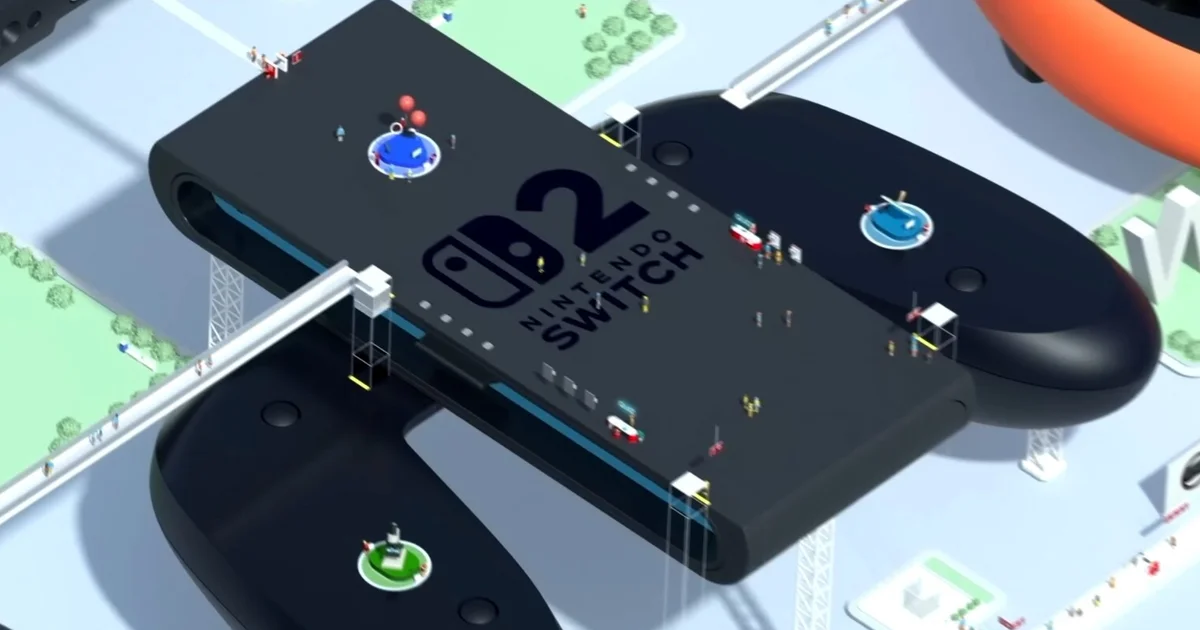
Every so often, Welcome Tour feels like Nintendo’s Fantasia.
Nintendo Switch 2 Welcome Tour costs £7.99, and for a while it can seem like you’ve paid someone to parade their carefully curated collection of 5K achievement trinkets. One major part of the experience is a stamp hunt. You play as a small character moving through display dioramas built from oversized versions of the Switch 2 itself and its accessories. Whenever you come across a new element—whether that’s a button or a port—up pops a tiny stamp station where you can grab another stamp.
I like collecting stamps, but here it can feel a bit too much. Just last night, I ended up wandering through an enormous model of the Switch 2’s Joy-Con 2 Grip Controller, taking my time with the rubber pads that help ensure a secure connection. I’ve had far more excitement with other Nintendo releases. I’ll admit I’m asking myself the question again: have I stumbled on a more genuinely Nintendo-style experience than this? We’ll see.
Because of that structure, the stamp hunt sometimes turns out to be a grind, particularly since you have to collect every stamp in one area before you’re allowed to move on. On top of that, the quiz sections didn’t really land for me. They toss out a handful of facts about elements of the new console, then test you on what you’ve just been shown. Even when some of the alternate answers are amusing, it still feels like the kind of corporate eLearning they make you sit through—even if your only job is to process forms—so you remember not to accept jewels from foreign royalty.
In general, I’d rather do almost anything than endure eLearning, and I still remember being especially annoyed when I realized I was getting some enjoyment out of the quiz portion. This is similar. I might snort at one of those clever alternate responses and then feel like my own brain has staged an ambush against me.
Still, there’s the twist. The longer I played Welcome Tour, the more I had to admit I was having fun. A number of the mini-games, designed to showcase both the console’s familiar foundations and its newer features, are genuinely enjoyable. For example, there’s real curiosity around whether players will understand the mouse-like controls for the Joy-Con controllers, and the game gives you plenty of chances to experiment with them in different ways. One mini-game has you steering a ball through an electric maze, another is built around putting golf balls, and yet another tasks you with dodging spiked asteroids. Each section you visit includes several of these activities, and while many don’t do much, a surprising number are actually great.

What I enjoyed even more than the mini-games, though, were the demonstrations. They feel less like games, but they’re still packed with playful energy. To get hands-on with HDR—a concept I’ve struggled to fully understand for years, mainly because I tend to switch off whenever it’s mentioned—I started a series of fireworks and then paused as they burst into constellations of sparks across the sky. I could toggle between HDR and its alternative (I still lost focus a bit), and it was genuinely captivating. The upscaling demo worked the same way: I could look at the same object in two different resolutions and, at times, even spot a UFO streaking past. You can slide the divider back and forth using the Joy-Con. It’s all delightful, low-stakes fun.
Then, things began to go a little further, and I felt like I was picking up something genuinely interesting. Not really about the Switch 2 and its technology on a technical level—I still had to slog through the game’s final-boss quiz about six times because I wasn’t paying close enough attention to the details—but about the spirit of this odd little company. It’s the same company behind such inventive games and hardware, and it asks you to pay for something as slightly extravagant as Welcome Tour, which perhaps ought to have come bundled in for free.
That fingerpost was paired with a rumble showcase, which the Switch 2 labels as HD Rumble 2. In that part, the game asks you to quiet the console and remove any background noise—then what? You just listen to the rumble as the game walks you through different rumble patterns and speeds. Why does it matter? Each pace produces a tone at a different pitch. Eventually, you can even hear a Mario coin sound. You could likely “replay” it in your head as I type these words, because that kind of brand imprint is strong enough to stick—delivered solely through rumble.
Let’s pause there for a second. Two thoughts stand out. First, in my view this captures the Nintendo difference: a particular variety that can feel everywhere in Nintendo’s games, yet is hard to pin down. Other platform makers have talked about rumble before—I remember Microsoft, for the Xbox One, urging players to feel trigger rumble without any visual signposting distinguishing a fireball from a golf swing. But with Nintendo, there’s a moment when the company’s own curiosity seems to take over, turning a rumble demonstration into something closer to a child-like exploration of what a feature can do—often even in areas that seem a bit irrelevant. Ah, that rumble makes fascinating sounds. Can we treat it like an instrument? That sort of open-ended whimsy feels baked into a lot of
what Nintendo is aiming to accomplish.
Nintendo Switch 2 Welcome Tour.
There’s also another idea—one you could describe as the Fantasia effect. In Disney’s Fantasia, there’s a moment where Deems Taylor introduces the soundtrack against the middle of the screen: the literal visual soundtrack that runs with each stretch of film. He explains that sound movies include a shaky, pencil-like line along the edge of the image, a line that contains the information for all the audio. Then the orchestra begins, and this magical Disney-animated line starts to throb with the sheer wonder of sound—of course, turned up significantly—producing ripples, drawings, and fractal shapes before it finally disappears. It’s that feeling of curiosity and awe about how things work, and about the way Disney builds its experiences, that makes Welcome Tour pop into my mind. It’s indulgent, sure, but it also captures a sense of amazement, confidence, and the urge to show off how exciting the creations you’ve just made really are. (Even if you’d prefer to charge people for the experience—well, that’s very much in line with Disney and Nintendo, after all.)
This also brings me back to the stamp rally, along with my thoughts about those rubber pads. Nintendo clearly spent time thinking through the best possible position for them. The teams must have known something belonged there—but what exactly? Pads? What kind, and where should they go? And now Nintendo was ready to tell everyone. Even inside the stamp rally itself, there are proud little moments like this that can feel oddly intoxicating, simply because the features you’re examining might seem minor or even silly. Later on, I moved across the surface of a controller and noticed that I could glide over the edge in one spot, but not another. That difference came from the industrial design: it starts with a gentle curve, then tightens as it goes, until it creates a small raised barrier. You’d never spot it unless you were one centimeter tall and walking on the controller’s actual surface. And I was!
Nintendo Switch 2 Welcome Tour.
What does this put me in mind of? I can think of two things. First, I remember being a university student in the mid-1990s. In one of the computer labs, there was a truly awful dot-matrix printer that would turn out anything we printed—our essays included—in the most streaky, pale, greasy-looking lettering imaginable. It would even shred the paper’s edges as it ran. That printer was the one most of us would inevitably approach to print our essays—work we’d often put a lot of effort into. Why would we do that? Because it was important that it look like we hadn’t tried very hard. It mattered that we seemed naturally brilliant, as if we’d produced everything with little or no concern. In the middle of the nineties, caring too much about your own work was about as unfashionable as it gets.
Welcome Tour fixes that—though, at the time, I didn’t realize it was a problem that needed fixing. It’s a celebration of diligence, thoughtful design, and the satisfaction people feel when they place a rubber pad just right or carve the edge of a controller in precisely the right way. Maybe that’s meaningful. I’m not fully sure.
The second thing: when my friend picked up a Mega Drive in the early 1990s, he would spend countless hours just admiring it. He appreciated its elegance, its distinctive shape, the sturdy feel of its plastic, the smoothness of the edges, and the branding charm that seemed to read “16-Bit” or something along those lines. He’d lean back on the couch and move it back and forth above him, bringing his eyes close until it looked huge and almost unreal—like the Starship Enterprise sweeping into view. Welcome Tour has a strong Starship Enterprise atmosphere. It’s a nonstop experience of looking closely.
In the end, that’s what initially struck me as so unusual about the whole thing. For a long time, part of me has believed that Nintendo doesn’t really care about technology in any direct sense. The company makes games that feel as though they’re constructed from paper and cloth, and when it moved into VR, it did so with cardboard. So it’s a little surprising to see Nintendo talking up HDR and, in the later sections of the stamp rally, actually going inside the Switch 2 console itself—letting you walk through its battery and its heat pathways, along with all the details that come with that. It can feel like Nintendo spends a lot of time acting as if none of this is really about technology. It’s all make-believe and whimsical flair.
Then it finally clicked. Nintendo values technology only in terms of what it makes possible—not just because it’s chasing the newest frontier for its own sake. It likes the curiosity that comes from exploring, even when that journey doesn’t chase the absolute cutting edge. Labo was an experiment in technology, sparked by the idea that cardboard could be a great medium for VR and for all sorts of quirky console add-ons. Gunpei Yokoi’s most well-known—but often overlooked—technical ideas focused on what neglected, misunderstood technology could deliver: what it could do if you looked at it from the right angle. That’s the path to rumble. Something more useful than simply producing a vibration in the controller. And HDR? It gives fireworks just a bit more pop. I suppose I’ve learned something after all.
Code for Nintendo Switch 2 Welcome Tour was supplied by Nintendo.