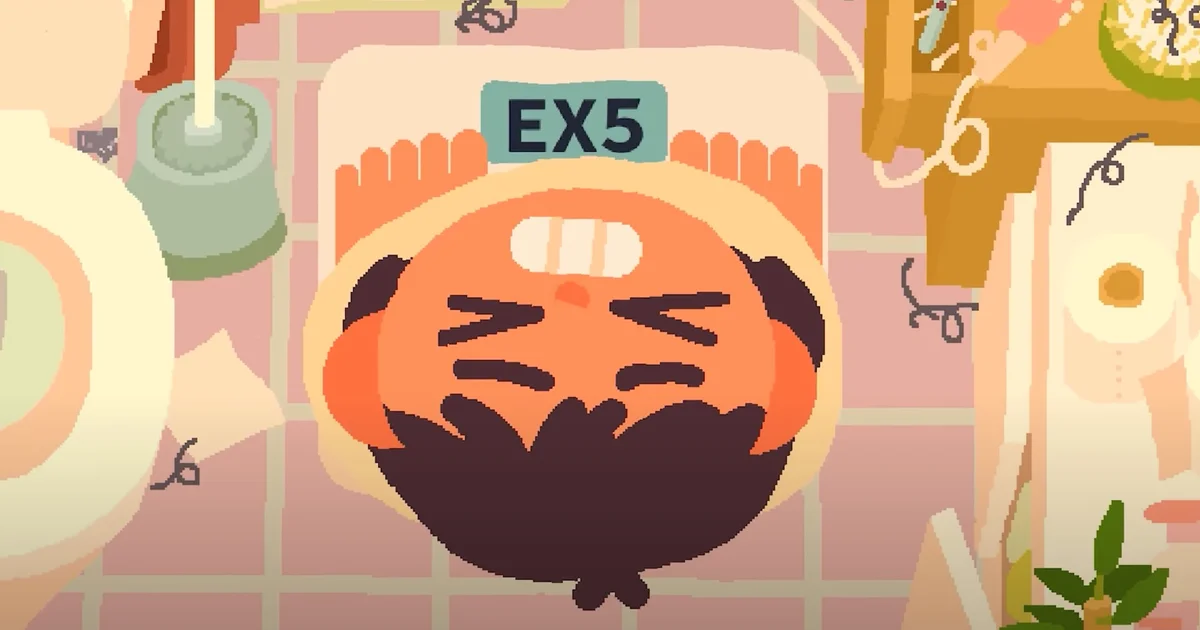
Jenny Jiao Hsia’s sharp, semi-autobiographical account of life as a teenager finds both comedy and tenderness in its WarioWare-style oddities, even while it confronts tough topics.
“Think of it like a video game!”, Jenny—Consume Me’s increasingly overwhelmed lead—tells herself early as she prepares to jump into dieting. The last stretch of school is fast approaching; adulthood waits just around the corner. And on top of that, her controlling mother’s comments—how will Jenny ever meet a partner if she doesn’t lose weight?—keep circling in her head. It would crush anyone, particularly a teen who’s still trying to figure out where she fits.
Consume Me is a semi-autobiographical endeavor from co-designer Jenny Jiao Hsia, and it faces difficult subjects head-on, including dieting, eating disorders, and fatphobia. While that might sound like a hard proposition, Jiao Hsia’s slice-of-life approach uses a structure that hooks you right away. It’s a lively, pastel-colored show of fast-paced split-screen scenes, slapstick WarioWare-esque mini-games, and time-management challenges that (“Just think of it like a video game!”) smartly borrow the medium’s habits—its loops of repetition and routine, its tendency to crank up the pressure—to echo the hurdles Jenny deals with every day.
Those moments when your attention drifts while studying become a mini-game in which you try to snap your rapidly spinning focus back to the pages of your book as thought-bubble interruptions appear; where folding laundry turns into a test of lightning reflexes, and even walking the dog transforms into a playful routine of dodging litter and grabbing cash as you move through New York City streets. And all of this intentionally silly mini-game action is tied together by a narrative that’s presented with nonstop drive, real warmth, and a distinctly genuine sense of humor, charting Jenny’s increasingly intense slide into young adulthood.
Each chapter in Consume Me revolves around the familiar coming-of-age milestones (summer pool parties, first sparks of romance, high school rivalries, and college applications) that—at least from the vantage point of adulthood—often seem rather minor. Still, many people carry lingering traces of teenage trauma, when everything felt cataclysmic and intensely consequential, making it easy to understand Jenny’s downward spiral and to feel the force of expectation almost as sharply as she does; even if your relationship with food isn’t as complicated as hers.
For all its bright tone, Consume Me is ultimately about the unhealthy, unsustainable routines people can get trapped in while chasing standards that never seem achievable—whether those demands come from other people or from within. In Jenny’s case, that shows up most clearly as an obsessive fixation on her weight and what she eats. Her early wins—confidence in her swimsuit body! A sweet partner!—quickly harden into something she believes must be kept going, so no matter what else starts to go wrong in her life, careful control of food remains a constant. As she puts it, “If I can’t control this one element of my behavior, then everything collapses.”

Every day, you’ll carefully assemble another meal, trying to fit tetronimo-shaped items into Jenny’s grid-like stomach in a Tetris-like way. Every piece comes with a Bite value (Consume Me explicitly steers clear of the word ‘calories’), and your job is to fill Jenny’s Guts while sticking to the Bite limit for the week. It’s an exceptionally effective—and surprisingly succinct—way to pull players into Jenny’s headspace, where food is framed as something to defeat rather than something to enjoy.
This kind of design craft shows up repeatedly across Consume Me, where experiences—and even emotions—are communicated as much through play as they are through story. The clearest example is its overall time-management structure: you’ll have to use Jenny’s limited free hours as wisely as possible to complete each chapter’s checklist. At first, her responsibilities—studying, chores, and maintaining her diet—sound manageable, but with only a few hours of downtime each day, keeping up quickly turns into a difficult (and stressful) juggling act. One mistake can trigger big repercussions; if you go too far in a single day, for instance, you’ll suddenly need to spend a precious hour exercising to return to your Bite limit. On top of that, the game tracks your shrinking mood, energy, and guts meters, which means you’ll need to manage everything carefully just to avoid being blocked from important activities later in the day. You can probably guess where that ends up.
When Jenny’s vacations end and the school year begins, things spiral further as the demands on her grow more intense—essay writing, college applications, a long-distance romance, and even taking on high school rivals—stacked on top of everything she already had to handle. Before long, you’ll see yourself slipping into unhealthy (and harmful) habits, like guzzling energy drinks and burning the midnight hours to carve out a few extra moments each day, and the mental effort required to keep Consume Me’s many tasks moving can wear you down. That, of course, is exactly the intention.
It’s difficult to offer a fair critique of something as deeply personal and deliberately designed as Consume Me, especially since Hsia and co-developer AP Thomson have made very deliberate choices to communicate a specific story. Even so, it’s hard to miss from Consume Me’s unexpectedly accommodating difficulty curve and its playful presentation that—no matter how intentionally taxing its repetitive cycles are—the team wants players to keep going until the end. I just can’t say it always strikes the right balance. For me, even with its relatively short eight-hour runtime, it started to feel drawn out, continuing to inch forward toward the next unavoidable escalation well after its central message had already landed. I can’t help wondering whether it would’ve hit harder if it wrapped sooner.
Still, when I look back on my time with Consume Me, what stays with me isn’t the pressure. It’s the game’s energetic wit and inventiveness, its sharp design choices and welcoming attitude (even the most hostile characters feel thoughtfully built), and above all, the striking truthfulness of its voice. As ridiculous as it can be at times, it captures both Jenny’s troubles and her wins so well—so convincingly—that even a portion introducing her relatively brief encounters with religion felt genuinely moving. And I say that as someone who has long been uncertain about the whole church situation. The pacing didn’t always work for me, but it remains a captivating, thought-provoking, and impressively assured creation. And I can’t help admiring its approach—and its message.
A copy of Consume Me was provided for this review by Hexecutable.