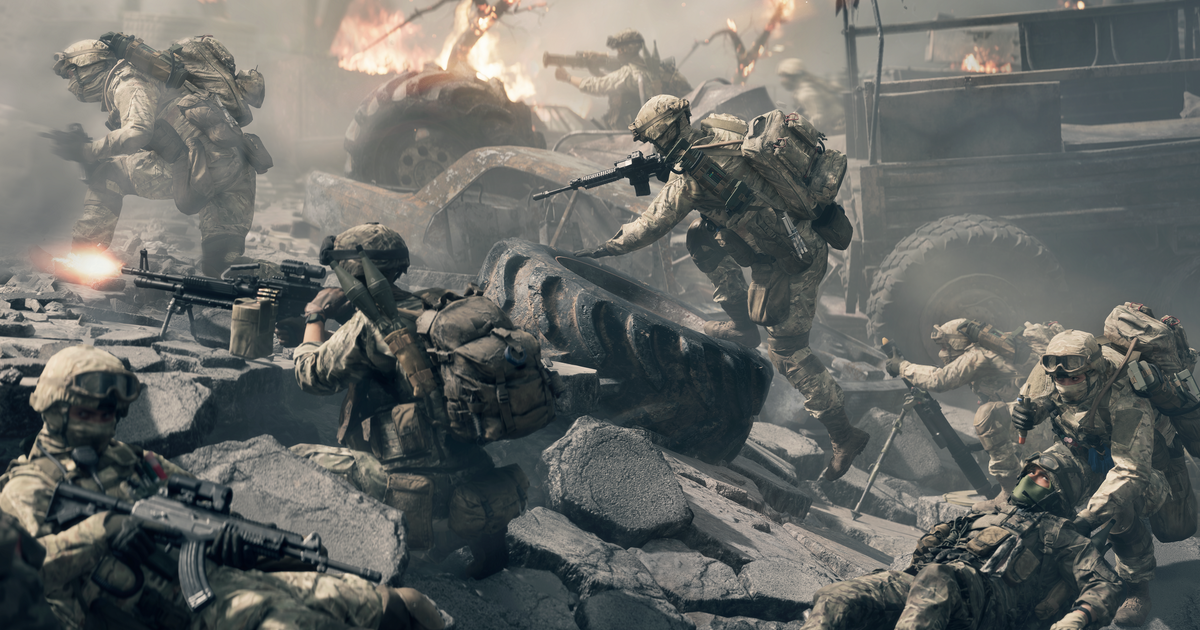
Battlefield 6 brings a striking multiplayer refresh and a solid, though fairly routine, single-player offering. Still, it leaves a lingering question about what truly defines Battlefield.
After the turbulent swings in Battlefield 2042 and the watered-down feel of its firefights, Battlefield 6 was presented as a return to what made the series feel like itself in the beginning. For the most part, it follows through. The bulky 128-player battlefields that stretched the action of 2042 too thin are gone, as is the semi-future look paired with flashy hero-shooter-style perks. In their place, you get fast 64-player battles, a more grounded lineup of soldier roles, a lower-case modern warfare setting, and even a single-player campaign. These changes are paired with a striking burned-orange palette and a stronger spotlight on crumbling, billowing destruction.
When everything is running as it should — jets roaring overhead, rockets streaking past your head, and building fronts splitting at the seams right in front of you — Battlefield 6 is outstanding, and without question the nearest EA has come to the franchise’s peak moments in a decade. Yet behind that confident surface, the series is still searching for its footing. Battlefield 6 suggests a wish to appeal to everyone at once: it leans unusually hard on smaller to mid-sized maps and modes, balances between rigid classes and freeform weapon choice in a way that feels like an odd middle ground, and even lets camo-dressed soldiers slide into a fight and spin around 180 degrees at the tap of a button.
Through all of this, you can feel Call of Duty lingering close to Battlefield. The good news is that it doesn’t meaningfully undercut the overall experience, and in a few spots it arguably improves it. Still, it’s frustrating, because Battlefield 6 performs best when it fully commits to its own identity.
Battlefield 6’s somewhat speculative setup places NATO forces against Pax Armata, a politically neutral pan-national private military company whose name evokes a luxury wristwatch. The conflict spans the globe, taking players to Cairo, New York, Gibraltar, and Tajikistan, along with a somewhat out-of-place homecoming to Iran for the popular map Operation Firestorm.
Each stop includes several themed maps designed for Battlefield’s signature modes such as Conquest and Rush, plus the newly added Escalation, which is essentially Conquest with teams able to permanently seize control points. Even though they all look impressive, only three draw on the full breadth of Battlefield’s equipment, opening the door to wider battlefields and skies where jets and helicopters cross paths.
Of those three, I’m especially drawn to Mirak Valley in Tajikistan. It begins with one side placed in an area that recalls the No Man’s Land vibe from World War I, complete with scorched ground, charred trees, and muddy trenches. In the center, two unfinished office buildings sit side by side, and a huge crane between them can be knocked over. It’s not as game-shifting as Battlefield 4’s “Levolution” scenes, but it still delivers a memorable show.
Meanwhile, Liberation Peak’s snowy layout doesn’t stand out quite as much as Mirak Valley, yet it still makes for a dependable Conquest map, with jagged high ground lined with military posts and destroyable villages. Operation Firestorm, by comparison, remains as genuinely strong as it has always been.

Across all three maps, Battlefield’s main pull stays front and center: that ever-changing, open-ended style of warfare that consistently generates spontaneous stories — often with real consequences. The destruction system strengthens that even further. Watching buildings dissolve into rubble is genuinely impressive, and clearing enemy cover by blasting through walls in Rush still feels just as satisfying as it did in the early 2010s. Still, it’s not that big a leap beyond Battlefield 3 overall. Bigger, busier, perhaps, but not drastically different.
Possibly more important is how BF6 rewards you for carving out a role within the chaos. This time, I naturally leaned toward the engineer position: supporting vehicle pushes toward control points, wiping out enemy cover with rocket-propelled grenades, sneaking up on tanks to lay mines beneath their armored backs, and — at times — jumping out in an armored vehicle to hit hostile positions with some force. Medic play, however, feels a touch less critical than before, since any player can revive a fallen teammate, even dragging them away from danger to help them get back on their feet safely.
In any event, those wider maps consistently deliver strong moments, and the mid-sized maps do much of the same. They usually don’t include jets, and helicopters are less common as well, and combat tends to push you through city streets more than open countryside. New Sobek City is the broadest of the mid-tier choices, with fights breaking out around a cluster of apartment blocks as the Great Pyramids tower in the background. Even so, I really enjoy the urban battlefields in Siege of Cairo, and especially Manhattan Bridge, where you battle through New York’s gentrified brick high-rises under the immense iron span of the Brooklyn Bridge.
Image 1: It’s worth pointing out here that the audio is still unmatched. When things blow up in BF6, you’ll feel it. 2: Why join a deathmatch when you can jump into a mode packed with helicopters? 3: Sometimes you just need to pause the firefight and watch the action up in the sky. 4: Feel free to skip this screenshot if you’d like.
At the smaller scale, however, Battlefield
It begins to feel a bit less compelling. With infantry-only play, it boils down to two fairly dull deathmatch takes, and it makes a large share of the game’s weapon lineup seem unnecessary—especially alongside Domination, which is essentially a reworked version of Conquest.
excluding the vehicles, and King of the Hill, where squads fight to control a single objective that keeps shifting to a new spot across the map every few minutes. I genuinely enjoy King of the Hill. The back-and-forth between setting up defenses and tearing them down fits Battlefield’s style particularly well. Still, I’d gladly give it up, along with every other infantry-focused mode, if it meant getting the chance to play more of the more traditional Battlefield experience.
There are also several other elements of BF6 I’m not fully sold on, including the new large-scale mode, Escalation. The idea is that, as teams capture control points, the fighting gets funneled into fewer zones—making everything feel more intense. However, in my own sessions, the action rarely surged in any meaningful way, and these rounds eventually started to feel like briefer, less satisfying variations of Conquest.
I’m also unsure about EA’s decision to let players choose whichever weapon they want, rather than locking each class into a particular weapon category. EA has tried to preserve balance by having each class become proficient with select guns—Engineers using SMGs, Recon players leaning on sniper rifles, and so on. That said, I’m not convinced this will keep BF6 from sliding into an Assault-Rifle-heavy release. Even during the review window, when bots made up a large part of the player population on the maps, I still noticed a clear lack of LMGs among medic picks.
Image 1: Movement and aiming feel incredibly fluid, though sometimes it can lean a little too far into flashy acrobatics. 2: That’s a lost cause. 3: Don’t worry, Mr. President, I’ll be your human…Shield. I’ll excuse myself.
Even so, the open-weapon approach bothers me less than seeing players knee-slide across BF6’s carefully crafted battlefields as if they were kids tearing around a freshly waxed gym. This ties into BF6’s new “Kinesthetic Combat System,” which supports noticeably quicker, more mobile movement. To be fair, it’s a meaningful step forward overall—getting around obstacles has never felt smoother. Yet there are moments when it crosses into feeling too arcade-like. EA has already dialed back knee-sliding before launch, but honestly, they should just remove it completely. Even with a world where everyone has a parachute, it still feels awkward and irritating—almost like if Tom Hanks pulled out a skateboard and did a nosegrind along a tank trap in Saving Private Ryan.
It’s worth noting that the modes available to test during the review don’t cover the full menu of what’s coming. Battlefield Portal, where players can build their own game modes and customize maps, wasn’t available to test before launch, and the much-anticipated Battle Royale mode won’t arrive until later this year. What BF6 does include, of course, is a single-player campaign that puts you in the role of a NATO special forces unit—Dagger 13—as it hunts for the elusive leadership behind Pax Armata.
This is BF6’s first meaningful single-player offering in some time, coming after BF1 and BFV’s hit-and-miss efforts and the fact that 2042 didn’t include a single-player component at all. I’m torn. On one hand, it does a solid job of using the game’s different locations to craft entertaining missions. Some of the highlight beats include a high-energy HALO drop onto Gibraltar’s rock and a chaotic push through New York City as you try to protect the President (played with real commitment by Benito Martinez) from repeated drone-driven assassination attempts—along with attacks from vehicles and an intense sprint along the east river shoreline.
Not every mission lands. The one right before this starts with a lackluster rerun of Modern Warfare 2019’s “Clean House”—another case of BF6 borrowing a CoD-style moment, with questionable results. The required open-world mission also feels strangely flat, and I ultimately enjoyed the campaign more when it leaned into BF6’s fast, kinetic firefights and explosive destruction through tighter, more linear segments. In fact, the last mission is outstanding, going all-in in a way that nearly justifies the entire undertaking. It nods back to older cinematic military-shooter campaign design, throwing you into a sprawling, sensory-overload grinder of action—and I’d love to see more of this approach from both Battlefield and Call of Duty in their single-player experiences.
The campaign’s method of connecting these missions together doesn’t feel quite as convincing. It kicks off with an unsettlingly timely trigger event—specifically NATO’s insufficient response to the Pax Armata incursion in Eastern Europe. From there, though, it quickly slips into yet another chapter of the Spec-Ops Man and the Tier 1 Troopers storyline, each trying to outdo the others as the most loyal, self-sacrificing zealots in military history. The plot also keeps juggling timelines, flashbacks, and different playable characters in a way that muddles the narrative, ending in a weak finale that assumes there will be a sequel (or possibly more campaign DLC—hardly the first time EA has used that kind of move).
In the end, though, Battlefield 6 does understand what makes the series great, even if it sometimes seems reluctant to lean in fully. Unlike 2042, the fun is there from the start, and its challenges are fairly simple to overcome. There’s still plenty of room to aim higher, and I’d love to see more of those wide, open sandboxes to explore, but overall, Battlefield 6 offers a solid reset—and, just as importantly, a strong base for EA to build from.
A copy of Battlefield 6 was provided for this review by EA.