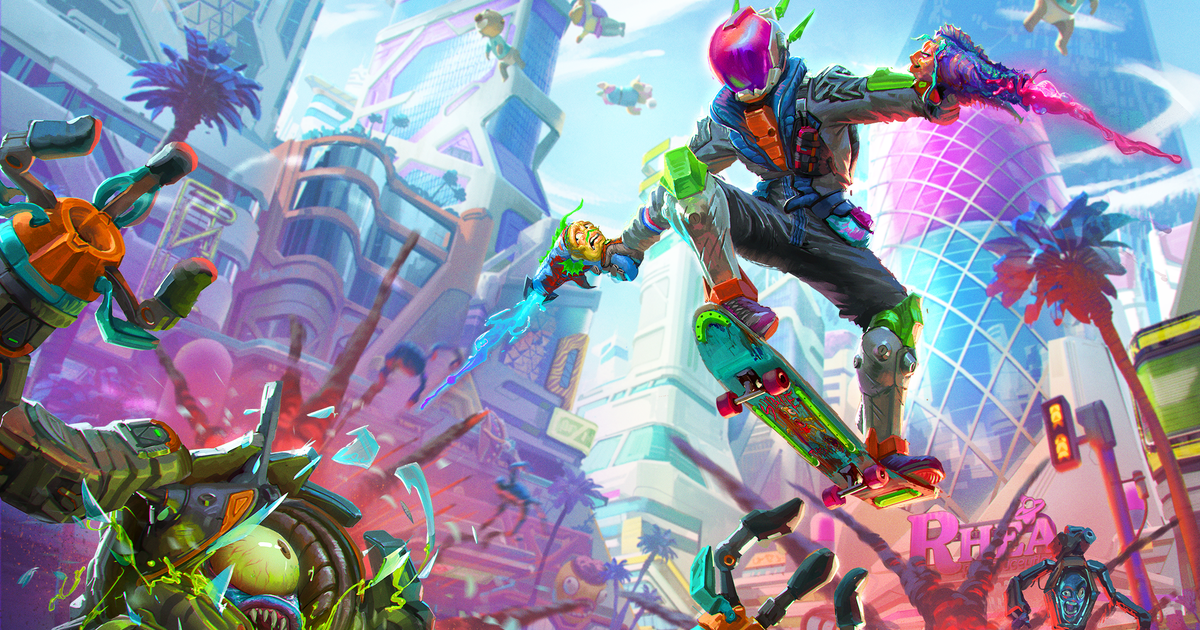
As a follow-up to Squanch Games’ notorious FPS, this sequel clearly moves in the right direction, even if its most noticeable strengths still double as its biggest weaknesses—and the technical troubles are holding back much of the progress it does manage to make.
I can’t stress enough how strongly I disliked High on Life the first time it stumbled out of its mother’s basement in a thick fog of marijuana haze. Squanch Games’ 2022 FPS was a cynical, rambling mess that tried to cover up weak gunplay with wandering, never-ending stoner comedy. Eurogamer’s review rightly called out High on Life for its many problems, and I’ll admit I would’ve been happy never to see one of its smug, grin-filled weapons again.
That said, I do believe in giving things another shot, and High on Life 2 partly earns that faith. I wouldn’t call the first meeting with the game “forgiven,” but Squanch Games has clearly put the last three years into refining what went wrong. This time around, High on Life 2 feels more inviting, more consistently funny, and far more responsive than it was at launch. It has also developed an unexpectedly strong skateboarding streak—odd, but undeniably catchy.
You play as a young intergalactic bounty hunter, and the adventure kicks off with an interactive recap of how you won against the drug-trafficking G3 cartel, which wanted to dominate the market for human narcotics. Pulling humanity out of the alien bong depths has turned you into a celebrity, and High on Life 2’s opening sequence quickly lays out what comes next: talk-show appearances, hover-limo rides, and clashes with alien kaiju.
Of course, the “good life” your character is living has consequences, so it’s a welcome reset when you run into your sister (now running her own resistance cell) and she steers you toward a fresh objective—bringing down the leadership of Rhea Pharmaceutical. The galaxy’s biggest drug manufacturer wants to change the status of humans from illegal substances to medicinal pills; the kind of shift that would be disastrous for the species… once again.
Even if this isn’t a deep critique of Big Pharma, the change still delivers a more entertaining set of goals than the first game. High on Life 2 has you taking out eccentric billionaires, unhinged scientists, corrupt officials, and even real-world finance whizzes—across a run of colorful mission types.
The standout moment is ConCon, where you’re ordered to remove the unfortunately named Muppy Doo—Rhea’s main political partner—on a planet that’s clearly taking inspiration from Coruscant, but for conventions instead. On ConCon, every imaginable activity is paired with its own celebratory event, from political dealings to targeted assassinations. Even getting for the convention parking spots turns into a brutal competition, with drivers from across the galaxy racing for the best spaces in a dangerous mix of musical chairs and vehicular violence.

From that early showdown in a parking lot to its fourth-wall-busting finale, ConCon is where High on Life 2 looks at its best. Not every mission lands equally—there’s a mid-game detour involving infiltration of a cult in Wyoming that’s undermined by fairly dull level design and a drawn-out boss fight—but unlike the original, High on Life 2 doesn’t lose creative steam halfway through. It keeps adding fresh ideas right up until the end.
Even the less compelling areas gain something valuable from the sequel’s most impressive new feature: the skateboard. There’s something almost unbelievable about how naturally Squanch folds skateboarding into both platforming and combat. By combining simplified inputs that spotlight ollies, wall-rides, and grind actions with more familiar action-game moves like double jumps and air-dashes, Squanch builds a movement kit that supports thrilling acrobatics without turning your hands into a tangled mess. Bunny-hopping across lanes of floating traffic in ConCon feels incredible, and so does ramming enemies by launching an ollie straight into them.
The smoothness of skateboarding matches High on Life 2’s broader shift in tone. In plain terms, the writing is much less annoying than it was in the first game. It’s less vulgar, less hostile in spirit, and less tempted to linger on ad-libs that drag on for too long. What replaces it is a more sincere attempt to bring you closer to your chatty weapon lineup. That comes through strongly with Travis, your new pistol. You meet him during a personal crisis after a fallout with his weaponized wife, Jan. Across several missions, their turbulent relationship is explored in a loud but observant way, while Travis’ awkward personality creates the setup for plenty of genuinely funny moments.
Though a considerable
I still feel that High on Life 2’s comedy doesn’t land as hard as it does in games like Psychonauts 2 or Thank Goodness You’re Here. The gap between how packed the dialogue is and how many jokes actually stick with me is simply too wide. It even slips into the annoying habit of letting an NPC physically block you while they keep talking. Still, because the game is less aggressive overall, it’s easier to brush past the moments when the humor misses—and there are…
Scattered through the long script, there are plenty of entertaining bits. I let out a real laugh at a late-game gag about stealth systems, and I also enjoyed a recurring joke tied to how one of your weapons resembles a specific Star Wars character.
The biggest problem with High on Life 2 is that its core activity—shooting—ends up being its least impressive element, even if it’s still a stronger FPS than Squanch’s first attempt. Enemies feel more varied and interesting, the skateboard improves your movement through arenas, and the arsenal has grown to include a few genuinely intriguing guns. One example is a composite bow that can open dimensional rifts for you to fire through, and there’s also an assault rifle with voice work by Ralph Ineson, which is a selling point on its own.
But the combat doesn’t quite feel grounded. It remains a bit too weightless and insubstantial, and it doesn’t deliver the audio and visual punch that great shooters need. When you land melee attacks, it feels closer to swinging Knifey in front of you than landing a proper hit on an opponent. Using the glob shot to deal with enemies is still clunky and doesn’t offer strategic payoff that feels worth the effort, and Assault Ralph’s commanding vocals aren’t matched by the thin, underwhelming sound of his shots.
In the end, when your shotgun doesn’t so much explode as just fade out, the shortcomings show up no matter how carefully its face is animated. Even though I genuinely enjoy seeing the skateboard around, it mostly acts as a distraction from the weaknesses in High on Life 2’s combat instead of fixing them. Sure, launching the board into an opponent’s face is a fun bit of movement, but would I swap that for a shotgun that rattles your soul the moment you pull the trigger? Without any hesitation.
There are other lingering annoyances, too. The music is still awful—more like a sour electronic buzz than something catchy you’d want to hum afterward. The voice work is still a mix of truly excellent performances and oddly flat delivery. The hub area is inexplicably large, yet it offers little reason to explore, and I can’t shake the feeling that those resources might have been put to better use on a couple more high-concept missions.
1: There truly is a Con for everything. 2: Do you enjoy unexpected jumpscares alongside your unsatisfactory restaurant fare? 3: You can’t describe High on Life 2 as ordinary.
Lastly, the version of High on Life 2 I played came with several major glitches. The most serious one stopped me from interacting with key characters outside of cutscenes, which effectively meant skipping all of their dialogue. At first, that didn’t seem too damaging—until I reached a murder investigation during the game’s opening act, where the glitch prevented me from questioning any of the suspects. Thankfully, I was still able to figure out who the culprit was, so you can just call me Lieutenant Sherlock Poirot from here on out.
Even so, I finished High on Life 2 feeling pleasantly surprised. I wasn’t hooked. I wasn’t blown away. But I also don’t regret the time I spent with Justin Roiland across 15 of the most regrettable hours of my life. I won’t guess how Roiland’s departure from Squanch may have influenced the sequel’s development. From where I stand, though, High on Life 2 has grown in mostly the right ways, keeping enough of its strange charm to be genuinely entertaining at the right moments. Is it love? Not quite. But I also can’t bring myself to dismiss it.
A copy of High on Life 2 was supplied for this review by Squanch Games.