Peter Molyneux presents his older, signature ideas, fusing god simulation, business simulation, and third-person adventure into an oddly charming, though slightly awkward, experience.
Godus, if it offered any takeaway at all, was that you should practice caution when Peter Molyneux, his studio 22cans, and early access all collide. That game sat in Steam early access for more than eleven years (during which an equally incomplete spin-off, Godus Wars, emerged) before vanishing suddenly in 2023. Masters of Albion—a kind of Molyneux greatest-hits reel combining god sim, business sim, and action-adventure—launches into early access with plenty that still needs work, including absent features and parts of its world left unavailable. It’s fair to feel wary. Still, with that warning noted, here’s the unexpected turn: Masters of Albion is good. It’s strange, admittedly—powered by an engaging, sometimes jarring mix of systems—but it remains fun, even if it comes with a few caveats.
That said, Masters of Albion doesn’t immediately show off its strongest qualities. Even after a series of updates, its performance can be uneven, and only settles into something close to a shaky 30fps on my well-equipped machine. Its user interface, meanwhile, swings from confusing to unhelpful, including for basic tasks. For instance, leaving the game from the main menu means going to ‘settings’ and then switching to the ‘misc’ tab to find the option you need. And if you want to return to the main menu once you’re in a match, you’ll have to exit to the desktop and start back up. Resolution and refresh rate are tied to your Windows setup and can’t be changed inside the game; DLSS support didn’t seem to function properly on my system, and you’ll be frustrated if you expected multiple save slots. Still…
Masters of Albion isn’t a Fable-like experience. Although it borrows its name from the setting, this is a different ancient Albion facing an approaching calamity; another Albion, shaped by magic and oppression, imagined as a countryside paradise filled with a distinctly British streak of whimsy. It has a cheeky energy (and, surprisingly, a fair amount of profanity). You’ll hear a range of humorous regional accents, and Russell Shaw’s eerie fairytale soundtrack is undeniably pretty—though it also feels, frankly, like something you’d expect from Fable. Even so, there’s enough craftsmanship, originality, and sincerity at work to move past cynicism, resulting in something that feels comfortingly familiar and genuinely delightful at the same time.
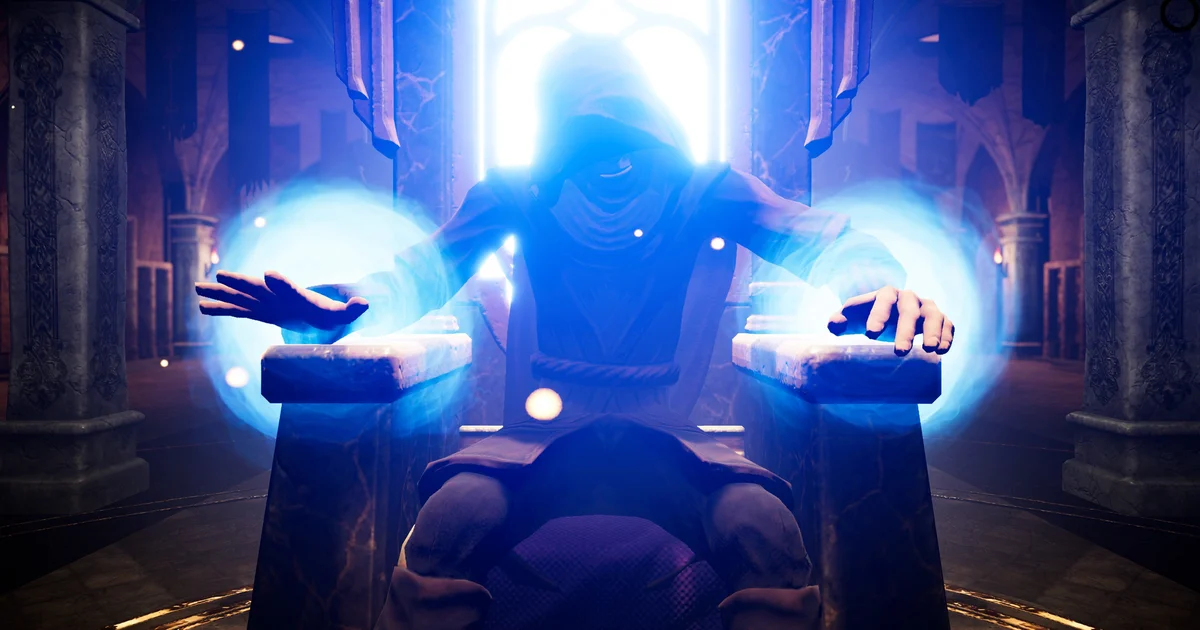
Through it all, you play the Chosen One: a cloaked figure called to the abandoned village of Oakridge by a mysterious voice. Before long, your promised fate settles you onto a throne of unthinkable might—prompting your hand to disconnect, your arm to balloon into absurd proportions, and your godlike awareness to ignite. Let’s take a second to appreciate that oversized disembodied limb, because it’s arguably the real star here. Building on ideas from Molyneux’s 2001 classic Black & White, it’s more than a flashy pointer—it gives a strong sense of weight and presence, making it easier to interact with the world in a more physical, tactile way. In combat you’ll hurl rocks at enemies; in production you’ll assemble pastries on a line; when your workers fall behind, you’ll toss supplies between buildings; you can nudge NPCs around like chess pieces; or you can poke things just to see what happens, knocking objects over along the way.
This ever-present, five-fingered tool forms the backbone of a game built around three separate modes that fit together—helping you transition more smoothly between Masters of Albion’s frenetic real-time battles, its layered business management, and its third-person wandering. That said, there’s a lot to take in, and the clearest way to understand it may be to work from the moment night arrives.

At the end of each day, when night sets in (something you trigger yourself in the launch mode), Albion’s undead forces rise and come for you. They funnel toward one of your settlements from the assigned spawn locations while you do your best to complete both the required and optional objectives before dawn. You’ll use a blend of real-time tactics and planning. In combat, you can guide a small band of heroes across the battlefield to confront the undead crowds; if you don’t intervene, they’ll fight on their own, letting you unleash lightning bolts, throw fireballs, or hurl bits of the environment. Alternatively, you can take direct control and battle from a third-person viewpoint. If you prepared well, turrets placed around the area will mop up extra enemies in a tower-defense style. Success carries you into the next morning, while failure means replaying the same night.
Okay, let’s rewind a bit. Before night falls, you get a whole day to do what you want, but in the end, everything is meant to set you up for the next round of trouble. At any time you can review what’s coming, check who you’re up against, and find where they’ll spawn. That helps give your daytime plans shape as you prepare for what follows—crafting weapons and armor for your heroes, training them to unlock new abilities, programming patrol routes, adjusting turret placement to handle likely bottlenecks, and building boundary walls to strengthen your defenses. The problem is that many of these tasks come with a steep price, so we circle back again.
To keep your finances from collapsing, Masters of Albion asks you to spend a meaningful chunk of time acting as an emerging industrialist—producing goods and managing straightforward production lines. New orders arrive via hot air balloon, and every time you’re expected to create a suitable prototype at your factory to satisfy your client’s specific, often somewhat vague, requests. Maybe they want a simple dish that’s wet, cheap, and green—so you’d drop some rat meat into a bowl of seasoned water and then set a wilted piece of lettuce on top. Order fulfilled.
This framework—along with a market simulation that’s ripe for being gamed to boost profits—feels like it draws from 22cans’ 2023 blockchain business simulator Legacy. Although
I get that building sandwiches one slice at a time might feel a bit off-theme in a title that’s built around a divine power fantasy, yet the tinkerer in me can’t help but enjoy the puzzle-like act of fitting everything together.
It’s oddly gripping. Once your layout has been reviewed to confirm it satisfies the required criteria, you can begin production—this is where your straight, linear production chains take over. For instance, your meals call for flour from your mill, and that mill, in turn, depends on wheat from your farm; every step matters, so there’s not much real strategy in what you make. Instead, you improve performance by placing buildings to cut down the walking distance between important points, and you can push output even faster by bringing in more workers, each of whom also needs their own place to live. In Masters of Albion, money genuinely is everything.
Still, there’s one last point to consider, so let’s back up again. Your oversized hand can’t help in the parts of Albion that are still shrouded in fog, which becomes an issue because you’ll eventually have to expand your production into weapons, armor, and more—each of which demands additional materials and new facilities located farther out. Before you can establish extra settlements, you first need to take control of one of your heroes and scout the region from a third-person view that recalls Fable, heading toward damaged beacons you’ll have to rebuild and activate to clear the fog and seize control. And once you’re down at street level, Masters of Albion looks gorgeous, with rolling hills, thick woods, flower-laden fields, and mysterious stone circles. Crumbling farms sit alongside babbling brooks beneath the weight of towering stone cities; jagged cliffs drop toward drab beaches and bright, shimmering seas broken up by ominous spires. Even so, for all its beauty, the world stays fairly restrained, offering the occasional hidden cave, a few interesting treasure chests, gargoyles that you can smash after they hurl insults, and a couple of whimsically goofy quests to keep you from falling into a rut—like chasing down chickens or taking on wasps.
I know that’s a lot of setup, but Masters of Albion has a great deal going on, and not everything lands as smoothly as it could. The game can be frustratingly unclear about feedback, frequently hiding details you actually need—for instance, why must I open a separate window to see the cost of an ingredient, or why isn’t there an easy way to weigh different weapon strengths against each other? At the same time, the world feels a little too shallow, so third-person wandering ends up feeling more like an amusing novelty, and the single-button hero combat is extremely plain. Nighttime incursions demand enough tactical thinking to be worthwhile, yet the room for error is slim, so the satisfaction you hope for can dissolve into exhausting trial-and-error.
Those production chains, in particular, bring their own brand of difficulty. That’s mostly because a tight economy likely asks you to spend a meaningful slice of your time on production just to earn the cash needed for real progress. I honestly can’t measure how long I’ve sat there tapping a button to nudge my magic finger at a building, trying to speed things up—because even with plenty of workers, production drags along at an almost freezing pace. This isn’t quite the kind of divinity I expected.
That said, I’d be dishonest if I said I wasn’t at least curious about the full experience during the roughly 15 hours I’ve played. Making pies may not feel very godlike, but there’s a satisfying rhythm to assembling the right result from cryptic clues, then watching that finished dish move cleanly along your production line. The nighttime sections can feel unfairly harsh, yet the payoff is often meaningful. Even though exploration doesn’t reveal a ton of sights, it still adds an engaging layer that raises the emotional stakes.
And these different systems connect in compelling ways. The campaign in Masters of Albion can feel like an extended tutorial, but it stays well-paced, smart, and consistently well told—introducing fresh gameplay whenever it senses the risk of monotony. At one point, you even take control of a dog to track a disappearance using its sense of smell, and a later nighttime mission morphs into a frantic escort objective with a trail of worshippers following behind you. Over time, traces of a morality system start to come through, and I haven’t even gotten into the hands-on building tools that let you assemble structures by snapping together various decorative and practical pieces. Masters of Albion is full of these little playful flourishes.
I’ve genuinely been enjoying my time with Masters of Albion so far. It may borrow from several different sources, but the mix somehow works—turning those separate pieces into a fun, engaging whole. I do worry that after around 15 hours in the early access build, signs of tedious repetition may be starting to show, especially as production micro-management starts to swallow everything else, but a few balance tweaks could plausibly fix that.
What I can’t quite determine, though, is how much of the finished game is actually there from the beginning. 22cans says that some parts of Albion won’t be reachable when early access starts, implying that part of its planned 20 to 40 hours of gameplay is still on the way. On top of that, two more modes are planned: Master mode, which limits how much daytime you have to complete tasks, and a permadeath-style Rogue mode. That’s a significant chunk of the experience still resting on a promise—bringing us back to trust, and whether you’re willing to take the chance on a 22cans early access release. Still, this is a promising start, and I’d really like to see Masters of Albion live up to its obvious potential—so let’s revisit it after a year.
A copy of Masters of Albion was supplied for this evaluation by 22cans.