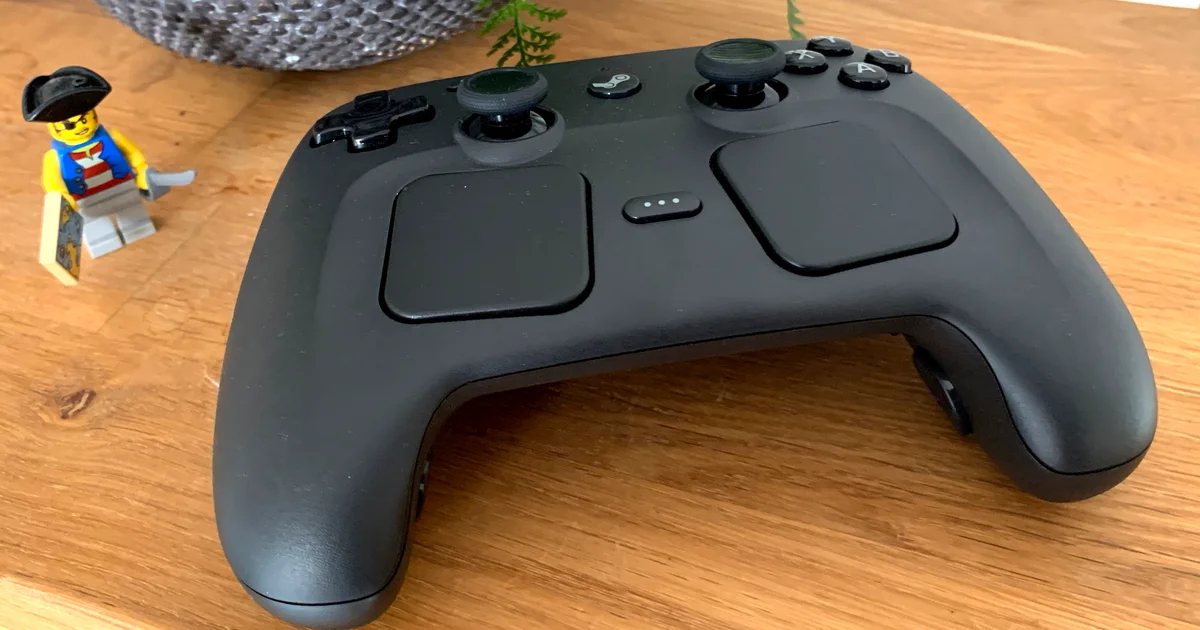
One of the strongest compliments I can give Valve’s latest Steam Controller is that, over the past week or so, I barely even think about it. Thanks to its look that’s heavily inspired by the Steam Deck, it improves on the original Steam Controller in almost every respect — and it’s clearly a better choice for everyday play. Still, the areas where it truly shines are focused enough that, despite those upgrades, it ends up feeling a bit like a niche product.
Much like the first Steam Controller, introduced in 2015 and discontinued four years later, Valve’s newest version is aimed at a very narrow audience. In practice, that audience is basically me: someone who treats their PC like a console, keeps it parked under the TV, and plays games from the comfort of the sofa. The initial Steam Controller was designed to support Valve’s unsuccessful Steam Machine program. In that effort, Valve partnered with third parties to create Steam-based, console-style PCs for living rooms, which required a controller capable of handling the many mouse-driven experiences on Steam at the time, along with games built for traditional controller play.
Naturally, the Steam Machines rollout didn’t last, and the neglected Steam Controller had to stand on its own merits. It’s a real example of Valve’s planning that, even with its single thumbstick falling short for games that genuinely need proper dual-stick control, it has stayed a meaningful part of my home PC routine. I still find it surprising that I can comfortably play titles such as Crusader Kings and Planet Zoo while lounging, without having to reach for a mouse and keyboard. Even with its limitations, I genuinely like it. With production now ended, I’d been bracing for the day it finally died. So last year’s announcement that the Steam Controller was returning was an exciting development.

Then, on 4th May, the Steam Controller finally arrived after six months, and it feels like an odd, almost cyclical chapter of history. Like before, Valve put out this new Steam Controller alongside another attempt to bring Steam Machines to life. This time, though — boosted by the success of the Steam Deck — Valve says it’s being designed and manufactured in-house. Still, once again (this time thanks to an AI-driven SSD and RAM shortage), the new Steam Controller ends up on shelves on its own, cut off from the delayed hardware it was meant to complement.
The most promising thing is that it’s a much stronger everyday controller than the original, fixing nearly every complaint aimed at Valve’s earlier attempt. First, it’s rechargeable and includes a small “puck” that serves as both a wireless receiver (and it also supports Bluetooth and USB) and a charging stand. You plug the USB 3.x end of the included 1.6m cable into your PC, connect the USB-C end to the puck, and you’re ready. The immediate advantage is that the cable can reduce interference linked to your PC case — something I ran into often with the original controller’s dongle. It also means you can top up the controller while you play, either through the USB-C connection or by snapping the magnetic puck onto the controller’s underside. That design choice also helps stop the controller from being knocked out of your hands by stray legs moving through your line of sight. Valve claims a full charge delivers 35 hours of playtime, and although I can’t say I measured it with precision, I haven’t once run the battery down during my week of sessions.
As for the controller’s own build and feel, the first impression is of a device that feels sturdier and heavier in your hands than its earlier, more flimsy predecessor. It may not quite reach the premium sense of a controller like Nintendo’s Switch Pro (which I’ve been appreciating more and more recently), but it doesn’t feel cheap or outmatched either. The new model draws a lot from the Steam Deck, using a similarly tough black plastic shell with extensive texturing that should be grippy enough for most players — even if you’re not the kind of person who ends up with sweaty fingers. Valve has also gone for a slightly blockier profile to fit the controller’s generous set of inputs. Because of the noticeable front face, it comes across a bit larger than the Xbox, PS5, and Switch Pro versions, but the hidden rear grips help keep the ergonomic balance right. They stop your fingers from cramping against the longer shape of the body, so it remains comfortable to hold.
And the set of controls really is substantial. On the upper left, there’s a proper D-pad, paired with the controller’s standard four face buttons on the right. Those buttons have a comparable feel to the Steam Deck — serviceable, but not especially memorable. In the center, a circular Steam button opens up the platform’s various guide features, with dedicated View and Menu buttons off to either side. Right beneath those, you’ll find the twin (nice) thumbsticks. They sit horizontally and are surprisingly close together. Below them are the two trackpads, separated by a Quick Access Menu button in the middle. At the top, there are L/R triggers and bumpers, and on the back, replacing the paddle from the previous Steam Controller, there are four grip buttons — two per side. I’m a big fan of the satisfying, chunky click these deliver. Once you add in the click-enabled thumbsticks and trackpads, it’s clear there are a lot of inputs to experiment with, especially considering Steam’s incredibly deep remapping and customization tools.
There are also other, more technical details that more experienced players have highlighted elsewhere (for example, the twin sticks now use TMR sensors, which is said to improve both accuracy and long-term durability). For me, though, the real test is how it behaves in day-to-day use. In that sense, the new Steam Controller effectively beats the old one across nearly the board. Over the past week, I’ve happily bounced between Masters of Albion and Mouse: P.I. — one a more traditional PC game that leans on mouse and keyboard, the other a quick, retro-style shooter that includes built-in controller support — and I never felt like anything was holding me back.
I tried loading my older custom Steam Controller profiles as a way to take advantage of the new model’s extra buttons for Planet Zoo, which is very much built around mouse-and-keyboard control. While the total button count isn’t dramatically higher, the key change is that the D-pad is now its own dedicated control — rather than being part of the original Steam
The controller’s finicky hybrid touchpad — once sorted out — has opened up a lot of room for experimentation.
To be honest, I’m not especially keen on the newer Steam Deck-style touchpads when I compare them with the previous model. Like on the Steam Deck, they strike me as overly small and oddly square, which means I end up readjusting my finger position far more often than I’d like, even after turning up the sensitivity. Still, I’m confident I can get used to them, particularly since improvements show up elsewhere.
That said, I understand that my expectations are fairly particular. I want a controller that can handle mouse-based games effectively, without needing extra accessories awkwardly balanced on my chest, armrest, or coffee table. If I look at the device more generally as a controller, though, I think it still has some drawbacks. For someone with hands that are probably best described as medium-sized, the main concern is where the thumbsticks sit. They’re placed very close together and sunk deep into a fairly bulky controller, so I have to stretch my thumbs farther than is natural just to reach them—never mind pressing them. On top of that, while I’m moving around in-game, my thumbs can come alarmingly near to bumping into each other. It’s not a major problem, but it’s just awkward enough that I’ve found myself more and more instinctively grabbing the Xbox controller during extended sessions of titles designed for a standard controller.
So, even though I genuinely value the new Steam Controller — and it has clearly replaced its much-loved predecessor on my shelf for mouse-based games — it remains something of a niche product. Chances are it’ll be even more niche in 2026, given how dramatically the number of PC games offering built-in controller support has grown since 2015. Taken together, this all points to the idea that you probably already know whether there’s room for Valve’s latest hardware in your setup, and if there is, it’s a strong upgrade. For everyone else, though, at £85, it’s unlikely to beat out traditional controllers as the best option.
A Steam Controller was supplied for this review by Valve.